
Expert Guidance: Choosing the Best Location for Pallet Rack Installation

Key Considerations for Selecting the Optimal Location for Your Pallet Rack Installation
When it comes to pallet rack installation, positioning your racking system optimally within your warehouse is crucial for maximizing efficiency, productivity, and safety. A well-thought-out layout will not only streamline operations but also ensure that your system operates at its full potential. To help guide your decision, here are the key considerations to keep in mind when selecting the right location for your pallet racks.
A Strategic Approach to Warehouse Layout and Accessibility
Before installing pallet racks, it’s essential to take a holistic approach and examine the overall warehouse layout, considering the size, shape, and height of the space as well as the nature of the goods being stored. The layout should support the most efficient flow of materials and ensure that the racks are easily accessible for both workers and equipment.
Note Any Obstacles
As you plan your layout, it’s important to note any obstacles that could interfere with your pallet rack installation. Obstacles might include structural elements like columns, doors, or mezzanines—anything that requires you to work around it when positioning your racks. These considerations can significantly impact your layout and must be factored into your design.
For a deeper dive into designing your rack system around building columns, read our blog dedicated to this challenge.
Determine Aisle Configuration

Narrow Aisle Selective Rack
The width and length of aisles between your racks play a significant role in the space required to service your rack system. If your desired rack system supports high-density storage, you may want to implement narrow aisles to save significant floor space.
At 8.5 feet to 10.5 feet wide, narrow aisles allow you to pack more products into your facility. However, these aisles require equipment with a tight turn radius to avoid hitting the racking. Three-wheel forklifts are a great option for narrow aisles as they have a tighter turning radius, but other equipment like order pickers and reach trucks are also commonly used in these configurations.
Overall, users of narrow aisle configurations can realize a 10% to 15% gain in storage space over wide aisles, allowing for more efficient use of the warehouse’s floor area.
If you’re looking for even greater storage density, consider very narrow aisles. With aisles ranging from 5 feet to 7 feet wide, this configuration allows you to greatly increase capacity without expanding the footprint of your facility. In fact, very narrow aisles can provide gains of 25% to 35% over wide aisles, maximizing storage space while minimizing the use of additional floor space.
Consider the Flow of Goods
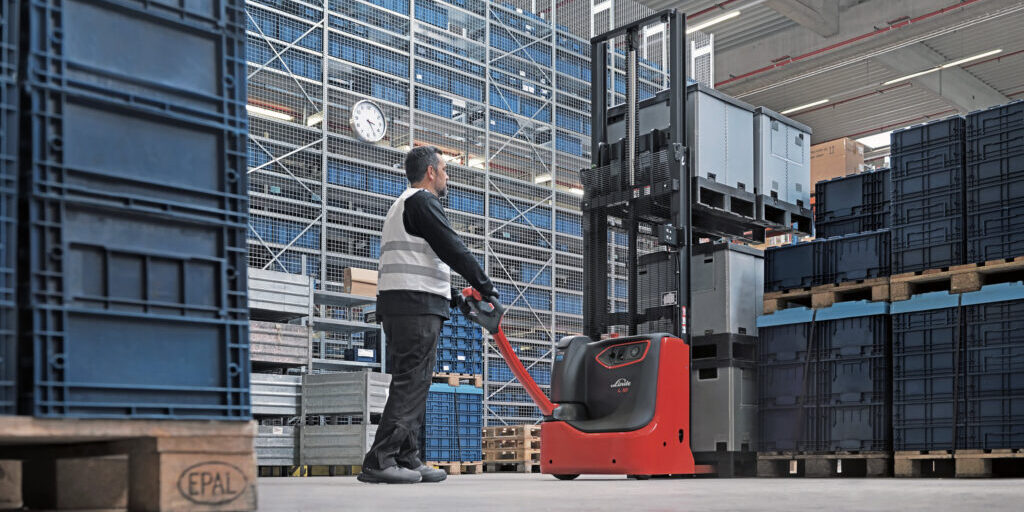
Pallet Stacker
An efficient warehouse layout should support a smooth flow of goods, ensuring that products are easily moved from receiving to storage, then to picking and shipping. The goal is to reduce the time and effort required to move products, minimize bottlenecks, and optimize overall operations. When positioning your pallet racks, it’s important to align the layout with the natural flow of goods to avoid unnecessary movement.
For example, fast-moving products should be placed near shipping lanes to maximize efficiency, allowing for quick retrieval and minimizing delays. Similarly, if you’re storing production materials, positioning them closest to your production line helps reduce pick times and supports a streamlined workflow. By strategically placing fast-moving or high-demand items in prime locations, you can ensure that your warehouse operates at peak efficiency with minimal time spent on picking and shipping.
Additionally, consider where your inventory destined for the pallet racking will be staged. Having staging zones close to your racking system can reduce the time spent moving goods and help your team stay organized, ultimately improving productivity and reducing delays.
Vertical Space Utilization
One of the most underused areas in warehouses is vertical space, which can significantly increase your storage capacity. Standard sizes for pallet racking uprights include 8-feet, 10-feet, 12-feet, 16-feet, and 20-feet. To select the right upright size, you’ll need to consider several factors, including the pallet load height, pallet height, number of pallets stored high, beam height, and beam-load clearance (at least 3 inches is recommended). All measurements should be in inches to ensure precise calculations.
Additionally, it’s important to leave 18 to 24 inches of space between the top of your highest pallet and the ceiling to comply with fire codes. This clearance ensures that your warehouse meets safety requirements while maximizing storage.
Once you’ve determined the height, be sure to account for your forklift’s maximum lift height. This ensures you can safely reach and retrieve items stored at higher levels.
Combining all this information lets you determine the pallet rack dimensions necessary to accommodate your products, materials, and lift equipment, optimizing your vertical space while maintaining safety and accessibility.
Safe and Compliant Pallet Rack Installation
Safety is always a top priority in any warehouse environment, and it’s no different when positioning your pallet racks. Ensuring your warehouse layout and racking system comply with the necessary safety standards and regulations—such as OSHA for pallet rack safety—is crucial. This includes making sure that racks are properly anchored, aisles remain clear of obstructions, and that fire exits, sprinklers, and other emergency systems are not blocked by the racking. Here’s how to maintain compliance and safety in your racking system.
Anchors and Column Guards
Anchoring your rack system is the most consequential element of your installation. Properly anchored racks ensure stability and safety, preventing tipping or shifting that could lead to accidents. However, it’s essential to regularly check the anchors to ensure they remain secure and undamaged. Over time, the vibration from vehicles moving around the system can cause anchors to loosen, which is why anchor inspection is an integral part of a regular Apex rack inspection. Additionally, consider adding column guards and end-row guards to your racking system. These protective barriers can significantly reduce the risk of costly downtime and repair costs in case of accidental strikes from warehouse equipment.
Load Capacity and Weight Distribution
Every racking system should have load plaques visible on each unit. These plaques indicate the racks’ weight capacity and are essential for maintaining safety and compliance. It’s also important that pallet loads are evenly distributed across the pallet. Ensuring that each load is uniformly loaded helps with safe pallet placement and extraction. Uniform load weights also reduce excess and dangerous stress on the rack system.
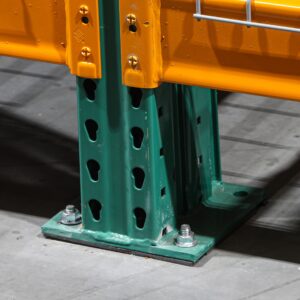 Anchored Rack Column |
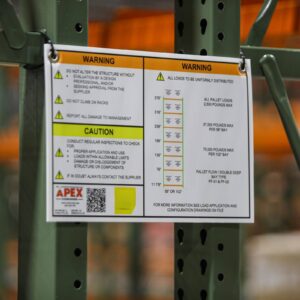 Load Capacity Plaque |
Routine Maintenance and Inspections
 To keep your racking system in optimal condition, routine maintenance and inspections are recommended. The Apex PROs can regularly inspect your racking and perform any necessary repairs. They also maintain detailed watch lists for areas that may need attention, allowing them to stay ahead of potential issues or recurring damage.
For even more convenience, warehouse management can utilize the Apex Rack Repair App. This app allows users to quickly respond to rack strikes or areas of concern by documenting damage, capturing detailed specs, and uploading findings for prompt evaluation. By leveraging the app and the expertise of Apex PROs, you can keep your racking system in operation with minimal disruption.
Professional Installation by the Apex Team
The foundation of a safe and effective pallet rack system starts with professional installation. Proper installation of storage racking and material handling systems can significantly impact your warehouse’s safety and productivity. A well-executed installation also ensures you stay within budget and adhere to your timeline.
Benefits of Apex Installation Services:
- Expertly trained rack installation professionals
- Fully licensed and insured
- Commitment to adhering to OSHA safety standards
- Experienced with top-tier rack manufacturer specifications
- Skilled and certified equipment operators
- Ongoing cleanliness and organization during installation
- Clear accountability with customer sign-off upon completion
The Apex team can provide expert guidance throughout this process, developing a comprehensive layout plan that optimizes your warehouse’s space, accessibility, and safety. Whether you’re in the initial planning stages or looking to make adjustments to an existing space, having a solid layout strategy for your pallet rack installation is key to maximizing your warehouse’s operational efficiency.
Contact the Apex team for full-service, expert support — We Got This!
