Pallet Rack and Storage Systems

Match Your Inventory to the Right Storage System
Choosing the right storage system isn’t about maximizing density or achieving the lowest cost per position. It’s about matching your inventory profile to systems that earn their space through reliable access, throughput, and operational fit.
This page covers the storage families that handle the majority of warehouse and distribution center requirements: pallet rack systems, safety accessories, industrial shelving, and high-density bin storage. Each system makes trade-offs between density, selectivity, and cost. Understanding those trade-offs before you commit prevents costly mistakes later.
Apex brings 20+ years of warehouse storage expertise to every project, with national installation teams covering design, permitting, and system commissioning from start to finish. Whether you’re outfitting a new facility or upgrading an existing operation, we’ll help you determine what fits your inventory and your operation.
Pallet Rack Systems
Most warehouse operations use a mix of pallet rack systems, not a single configuration wall-to-wall. The right system depends on SKU variety, pallet volume per SKU, and how inventory needs to rotate.
Each rack system section below follows the same structure: best fit, system overview, core capabilities, and a “learn more” link to a deeper system page.
Selective Pallet Racking
Best for: High SKU variety with direct access to every pallet position.
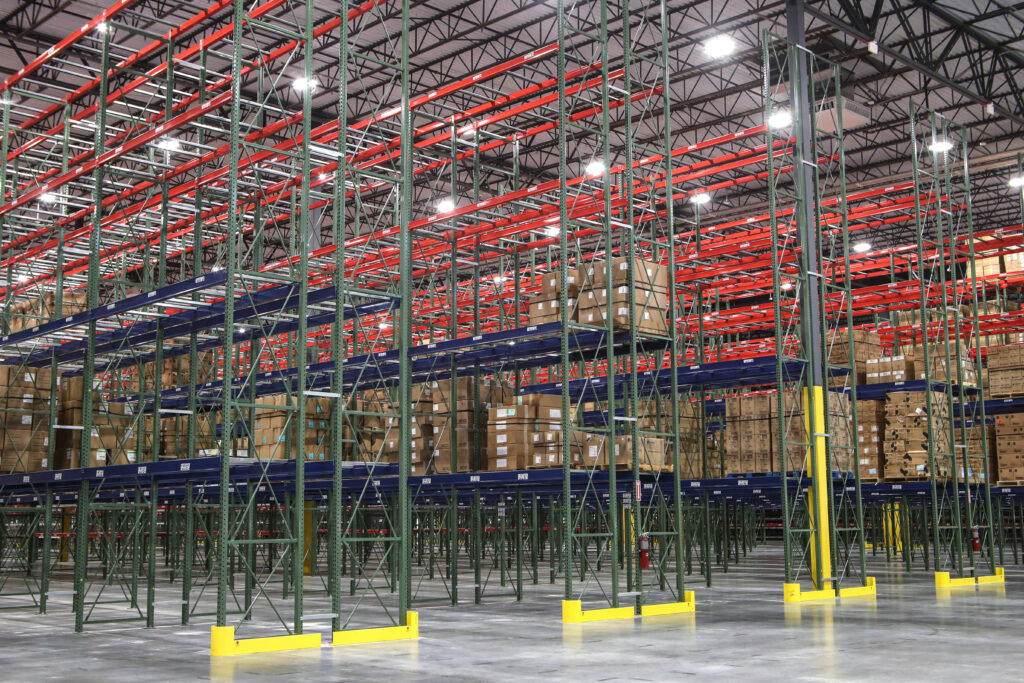
Selective pallet racking stores one pallet deep per aisle face, giving forklifts immediate access to every position in the system. It's the most common pallet rack configuration in North America and the baseline for operations that need 100% selectivity.
Core Capabilities
- Standard and reach truck compatible with no specialty equipment required
- Adjustable beam heights support mixed inventory sizes within the same system
- Back-to-back configurations reduce aisle count and increase pallet positions per square foot
- Best fit for distribution centers, 3PLs, and any operation managing diverse SKU mixes
- Trade-off: lower storage density compared to deep-lane or dynamic systems
Learn more: Selective Pallet Racking
Double-Deep Pallet Racking
Best for: Operations with multiple pallets per SKU willing to trade some selectivity for higher density.
Double-deep pallet racking stores two pallets back-to-back per lane, accessed from a single aisle using a reach truck with deep-reach forks. It doubles pallet positions in the same footprint compared to selective rack.
Core Capabilities
- Requires reach truck with deep-reach forks for rear pallet access
- Best fit for medium-volume SKUs where LIFO per bay is acceptable
- Approximately 100% more pallet positions than selective rack in the same floor space
- Reduces selectivity from 100% to roughly 50% since rear pallets require front pallet removal first
- Trade-off: equipment investment and reduced individual pallet access
Learn more: Double-Deep Pallet Racking
Drive-In Pallet Racking
Best for: High-volume, low-SKU operations where LIFO rotation is acceptable.
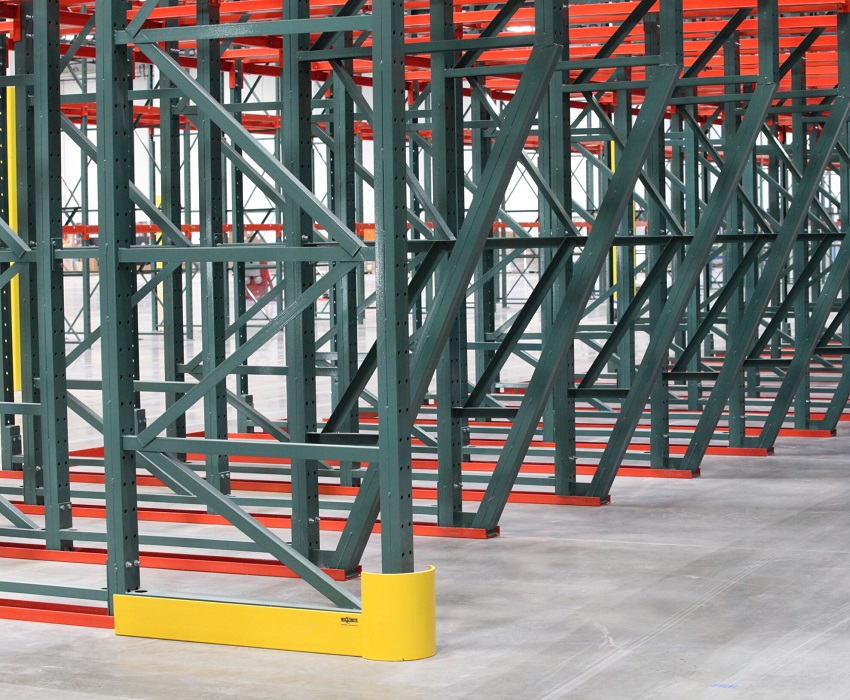
Drive-in pallet racking eliminates cross-aisles by allowing forklifts to drive directly into the rack structure. Each lane stores a single SKU on a last-in, first-out basis, delivering some of the highest pallet density available in static storage.
Core Capabilities
- Approximately 75% reduction in aisle space compared to selective rack
- Best fit for cold storage, seasonal staging, and manufacturing buffer storage
- Requires counterbalance forklift and disciplined operator training
- Column protection becomes essential due to forklift traffic inside the rack structure
- Trade-off: LIFO flow only, slow throughput, and higher risk of rack damage
Learn more: Drive-In Pallet Racking
Push-Back Racking
Best for: Density across multiple SKUs with LIFO flow and faster cycle times than drive-in.
Push-back racking uses inclined rails or nested carts where loading a pallet pushes previous pallets deeper into the lane. Each lane operates independently on a LIFO basis, typically storing 3 to 6 pallets deep from a single aisle.
Core Capabilities
- One SKU per lane with full lane-level selectivity across the system
- Operates from a single aisle with no forklift entry into the rack structure
- Best fit for medium-volume SKUs where LIFO is acceptable and density matters
- Standard counterbalance or reach truck compatible
- Trade-off: pallet condition affects flow reliability, and cost per position is higher than selective or drive-in
Learn more: Push-Back Racking
Pallet Flow Rack
Best for: High-throughput FIFO operations with date-sensitive or fast-moving inventory.
Pallet flow rack uses gravity-fed rails pitched from a loading aisle to a separate picking aisle. Pallets load at one end and flow forward automatically, presenting the oldest inventory first in a continuous FIFO rotation.
Core Capabilities
- Separate load and pick aisles support parallel put-away and retrieval operations
- Best fit for food and beverage distribution, cold storage, and high-velocity SKUs requiring strict rotation
- Hardware includes speed controllers, entry guides, and ramp stops to manage flow and prevent hang-ups
- Requires GMA-standard pallets and consistent load weights for reliable lane performance
- Trade-off: highest cost per position among conventional pallet rack systems
Learn more: Pallet Flow Rack
Carton Flow Rack
Best for: High-volume case and piece picking where reducing travel time per pick drives efficiency.
Carton flow rack operates at case and piece scale, not pallet scale. Gravity-fed lanes keep pick faces replenished as cartons are removed, making it a building block of pick modules and order fulfillment zones.
Core Capabilities
- Designed for manual picking at the carton and piece level
- Best fit for e-commerce fulfillment, order picking operations, and high-velocity case picks
- Integrates with industrial shelving and pallet rack in multi-zone layouts
- Refill cycles need planning since lanes hold limited depth compared to pallet systems
- Trade-off: not suitable for full-pallet storage or forklift-level material handling
Learn more: Carton Flow Rack
Cantilever Racking
Best for: Long, bulky, and irregular materials that don’t fit standard pallet rack.
Cantilever racking uses horizontal arms extending from vertical columns with no front upright, allowing open-front access for materials that overhang or vary in length. Lumber, pipe, steel bar stock, sheet goods, and furniture are common applications.
Core Capabilities
- Arms adjust vertically to match inventory height and can be configured as straight, inclined, or axel-style
- Best fit for building materials, steel distribution, furniture warehousing, and manufacturing staging
- Single-sided and double-sided configurations available depending on aisle access
- Load ratings must match actual inventory weight and arm length
- Trade-off: lower pallet density per square foot compared to standard rack systems
Learn more: Cantilever Racking
Pallet Rack Safety Accessories
Rack damage prevention determines how long your system performs safely and how much it costs to maintain. Safety accessories protect structural integrity and reduce the risk of rack failure.
Column protectors absorb forklift impacts before they reach uprights. End-of-row guards shield exposed rack ends in high-traffic zones. Row spacers tie back-to-back rack rows together for stability. Per Apex installation standards, row spacers are required for back-to-back systems with a height-to-depth ratio of 6:1 or greater, placed no more than 8 to 10 feet apart.
Pallet supports provide underside support for misaligned or damaged pallets during loading. Wire decking spans between beams to prevent cartons and pallets from falling through, while also improving fire suppression performance by allowing sprinkler water to penetrate rack levels. Rack netting secures to the structure to prevent loose items from falling into aisles or work areas.
Every component in this category reduces downtime, protects people, and extends the service life of your racking investment.
Learn more: Pallet Rack Safety Accessories
Industrial Shelving
Best for: Non-palletized inventory requiring hand-picked access at the piece and carton level.
Industrial shelving handles inventory below pallet scale: small parts, tools, supplies, kits, and hand-picked goods. It’s the right storage solution for parts rooms, maintenance areas, forward-pick zones, and anywhere pallets don’t make operational sense.
Core Capabilities
- Aisle widths sized for foot traffic, not forklifts, which increases pick density per square foot
- Slotting by pick velocity improves throughput and reduces travel time
- Integrates with mezzanines, pick modules, and pallet rack in multi-zone warehouse layouts
- Best fit for piece picking, MRO storage, and any operation where manual handling is the norm
- Trade-off: not suitable for full-pallet loads or forklift access
Learn more: Industrial Shelving
High-Density Bin Storage Systems
Best for: Small parts, components, and low-volume high-variety inventory requiring compact organization.
High-density bin storage uses compact bin grids and drawer systems to organize small-SKU inventories more efficiently than open shelving. Common applications include MRO and parts departments, manufacturing kitting, electronics distribution, and medical inventory.
Core Capabilities
- Reduces floor space per SKU compared to traditional shelving
- Best fit for operations with high SKU counts and low pallet volumes per item
- Pick rate and WMS or barcode integration determine system configuration
- Maximizes vertical space in areas where floor space is the limiting factor
- Trade-off: not suited for bulk storage or high-volume picking at the pallet level
Learn more: High-Density Bin Storage
How to Choose the Right System
Every pallet rack and storage system makes trade-offs between density, selectivity, and throughput. Higher density reduces aisle count and increases pallet positions per square foot, but it also limits individual pallet access. Systems with full selectivity provide immediate access to every position but use more floor space. High-throughput systems like pallet flow maximize picking speed and rotation compliance but come with a higher cost per position.
The comparison table below shows how each system balances these factors. Use it as a starting point, not a final answer. Your actual fit depends on SKU profile, pallet volume, rotation requirements, and forklift fleet.
| System | Density | Selectivity | Throughput | Cost per Position* | Forklift Type |
|---|---|---|---|---|---|
| Selective Pallet Racking | Low | Very High | Moderate | $ | Standard or reach truck |
| Double-Deep Pallet Racking | Moderate | High | Moderate | $$ | Reach truck with deep-reach forks |
| Drive-In Pallet Racking | Very High | Low | Low | $$ | Counterbalance forklift |
| Push-Back Racking | High | Moderate | Moderate | $$$ | Standard or reach truck |
| Pallet Flow Rack | High | Moderate | High | $$$$ | Standard or reach truck |
| Carton Flow Rack | Moderate | High | High | $$$ | Manual (no forklift) |
| Cantilever Racking | Low | Very High | Moderate | $$ | Standard or reach truck |
| Industrial Shelving | Moderate | Very High | Moderate | $ | Manual (no forklift) |
*Relative cost per pallet position; exact figures available on request.
Before You Select a System: Six Decision Inputs
Pallet specs: Dimensions, load weight, and pallet condition all affect which systems will perform reliably. Non-standard pallets or inconsistent load heights limit your options.
SKU profile: Total SKU count and pallet volume per SKU determine whether you need full selectivity or can accept lane-based storage.
Ceiling and column placement: Clear height sets your maximum storage levels. Building columns affect row length, aisle layout, and total pallet positions.
Forklift fleet: Your current equipment determines aisle widths, lift heights, and which rack systems are practical without additional investment.
Slab condition: Floor thickness, rated PSI, and anchor capacity affect structural specifications and permitting requirements.
Operating environment: Temperature extremes, seismic zones, and moisture exposure all factor into material selection and system design.
Apex engineers use this data to design layouts in 3D AutoCAD before any system is ordered. We model pallet positions, aisle widths, column clearances, and traffic flow to confirm the system meets your operational requirements before installation begins.
Ready for a layout review and 3D facility walk-through? Call (630) 957-4020 to schedule an assessment.
Frequently Asked Questions
What types of pallet rack and storage systems does Apex provide?
Apex provides selective pallet racking, double-deep, drive-in, push-back, pallet flow, carton flow, and cantilever racking, along with pallet rack safety accessories, industrial shelving, and high-density bin storage systems. We design, engineer, and install complete storage solutions tailored to your inventory profile and facility constraints. Every project includes layout modeling, permitting coordination, and professional installation by Apex teams.
How do I choose the right pallet rack system for my warehouse?
Start with your SKU count and pallet volume per SKU. Operations with high SKU variety and low pallet counts per item typically need selective racking for full access. High-volume, low-SKU operations benefit from drive-in or push-back for density. FIFO rotation requirements point to pallet flow. Your forklift fleet, ceiling height, and floor space also factor into the decision. Apex engineers review your inventory data and facility layout to recommend the right system before you commit.
Can I mix multiple rack types in the same facility?
Yes. Most distribution centers and warehouses use multiple rack systems across different zones to match storage method to inventory behavior. Fast-moving SKUs may go into pallet flow for FIFO rotation, while slower-moving items go into selective rack for full access. Seasonal or bulk inventory may use drive-in for density. Apex designs multi-system layouts that integrate different rack types within the same facility for maximum operational efficiency.
Does Apex handle the full project — design through installation?
Yes. Apex manages the full project from initial facility assessment through final installation. Our team provides 3D AutoCAD layout and design, load calculations, PE-certified engineering when required, permitting coordination, and professional installation. You work with one company throughout the project, and our national installation teams complete hundreds of racking projects annually across all system types and facility sizes.
Can Apex evaluate and improve my existing pallet rack systems?
Yes. Apex PROs are trained through a SEIZMIC Engineering-certified program to conduct OSHA-compliant rack inspections covering structural integrity, load compliance, damage assessment, and safety accessories. Each inspection produces a detailed report with severity ratings and independent repair recommendations. We also assess whether your current system matches your inventory profile and recommend reconfigurations or expansions when operational needs have changed since the original installation.
Does Apex offer used pallet rack inventory?
Yes. Apex carries used pallet rack components including uprights, beams, wire decking, and complete systems. Used rack is inspected before sale and can be refurbished and paint-matched to integrate with your existing system. Availability depends on current inventory, so contact our team early in your planning process to confirm what’s in stock and whether it matches your specifications and load requirements.
We Got This!
Warehouse storage decisions are about fit, not features. The right pallet rack and storage system earns its space by supporting how your operation actually moves product — not by checking boxes in a spec sheet.
Apex brings 20+ years of storage expertise to every project. Our team walks your facility, models your layout in 3D, and designs systems that match your inventory profile, your equipment, and your operational flow. From initial consultation through installation and long-term service, we handle the full scope so you get a system that performs from day one.