
Warehouse Fans: How to Target Hot Spots and Improve Airflow

Address Warehouse Hot Spots with the Right Fan for Every Zone
Heat can build quickly in a warehouse, especially in high-bay areas, enclosed work zones, and spaces where air circulation is limited. For employees working long shifts at pick stations, packing areas, loading docks, and other active zones, moving air where it’s needed can help create more comfortable working conditions.
Warehouse fans can improve airflow across a facility, but choosing the right fan starts with understanding where—and why—airflow problems are developing.
A warehouse rarely experiences the same conditions from one end of the building to the other. A high-bay storage area may experience temperature stratification while employees working beneath a mezzanine or at packing stations may struggle with limited air movement.
That’s why addressing warehouse hot spots isn’t necessarily about adding more fans. It’s about matching the airflow solution to the conditions within each zone.
Key Takeaway: The right warehouse fan solution starts with the hot spot, not the fan. Identify whether the area needs broad circulation or targeted air movement, then match the equipment, placement, and controls to the conditions in that specific warehouse zone.
What Causes Hot Spots in a Warehouse?
Hot spots can develop anywhere air circulation is limited, heat accumulates, or building and operating conditions create uneven temperatures.
Common trouble spots include:
- High-bay storage areas, where warm air can rise and collect near the ceiling, creating temperature differences between the upper and occupied levels of the facility.
- Long rack aisles, where rows of storage systems and inventory can interrupt airflow and contribute to areas with limited circulation.
- Pick modules and pick tunnels, where multi-level structures, rack, and other equipment can restrict airflow from reaching employees working within the system.
- Areas beneath mezzanines, where the overhead structure can separate the work area from broader air circulation in the building.
- Packing stations and other employee work areas, where people may remain in one location for extended periods and need airflow directed into the occupied zone.
- Loading docks and staging areas, where open dock doors, changing outdoor conditions, trailer activity, and the configuration of the space can create uneven conditions throughout the day.
- Enclosed or partially enclosed spaces, where walls, partitions, equipment, or other barriers can limit natural air movement and allow heat to accumulate.
- Areas with concentrated worker activity, where a larger number of employees may be working within a relatively small zone that doesn’t receive adequate air movement.
- Zones with heat-generating equipment or processes, where the heat source can create localized conditions that require more than general building-wide circulation.
Before selecting an airflow solution, identify what is happening in the problem area. That determines what kind of change is actually needed.
Start With the Hot Spot, Not the Fan

One of the most important distinctions in warehouse airflow planning is understanding whether a hot spot requires broader air circulation or targeted airflow into a specific area. Identifying the difference—and the conditions surrounding the problem area—helps determine the right approach.
Consider:
- Air movement: Does the area need broader circulation or targeted airflow into a specific dead zone?
- Location: Is the hot spot on an open warehouse floor, in a high-bay storage area, beneath a mezzanine, inside a pick tunnel, or in an enclosed work zone?
- Facility conditions: How will ceiling height, rack, structure, lighting, ducts, sprinklers, conveyors, MHE, traffic patterns, and other obstructions affect airflow and fan placement?
Coverage guidelines can help with preliminary planning, but the final solution should be selected and positioned based on actual facility conditions.
Use HVLS Warehouse Fans for Broad Air Circulation

Large, open warehouse areas often require broad air movement rather than airflow directed toward a single workstation or aisle.
High-volume, low-speed (HVLS) warehouse fans use large-diameter blades operating at relatively low speeds to move large volumes of air across wide areas. In high-clear facilities, that circulation also helps mix air that has stratified by temperature.
The Vindus HVLS line available through Apex includes fan diameters from 8 to 24 feet, allowing the system to be sized for different warehouse footprints and clear heights.
The P680 Series, with diameters from 8 to 14 feet, fits tighter warehouse and distribution center zones where larger fan diameters may not be practical. P730, P780, and X800 models extend the range for open warehouse floors, high-bay storage aisles, and large pick areas.
The goal isn’t simply to install the largest fan that fits. Diameter, quantity, spacing, mounting location, clearances, obstructions, and the areas that actually need airflow all influence system design.

Target Pick Modules, Mezzanines, and Work Areas with Directional Fans
Pick tunnels, workstations, packing areas, spaces beneath mezzanines, and other obstructed areas can require more focused airflow. Directional industrial fans deliver air directly into these zones without increasing airflow throughout the entire building.
The Vindus C100 provides compact directional airflow for tighter warehouse areas and can be deployed as a mobile or wall-mounted fan. Its long-throw airflow can reach approximately 100 feet, making it useful for dead zones, pick tunnels, high-activity workstations, and other locations where targeted air movement is needed.
For larger enclosed areas and hot zones, the mobile C150 provides higher-capacity directional airflow with a long throw of approximately 60 feet. Variable-speed operation and lockable swivel casters allow the fan to be repositioned as workflows or operating needs change.
That flexibility can be particularly useful in facilities where staging areas, temporary work zones, or seasonal operations don’t remain in one fixed location.
One Warehouse May Need More Than One Airflow Solution
A large distribution center may have several airflow challenges happening at the same time.
The open storage floor may benefit from HVLS fans, which provide broad circulation and help reduce temperature stratification. A pick tunnel beneath a mezzanine may require targeted directional airflow, while a changing staging area could benefit from a mobile fan.
These solutions don’t have to operate independently.
Thinking about warehouse airflow by zone makes it possible to address the conditions in each area rather than asking one type of fan to do every job. It can also help avoid overbuilding a solution in areas where a more targeted approach would be appropriate.
This is where controls become an important part of the airflow strategy.
Coordinate Warehouse Fans with Smart Controls
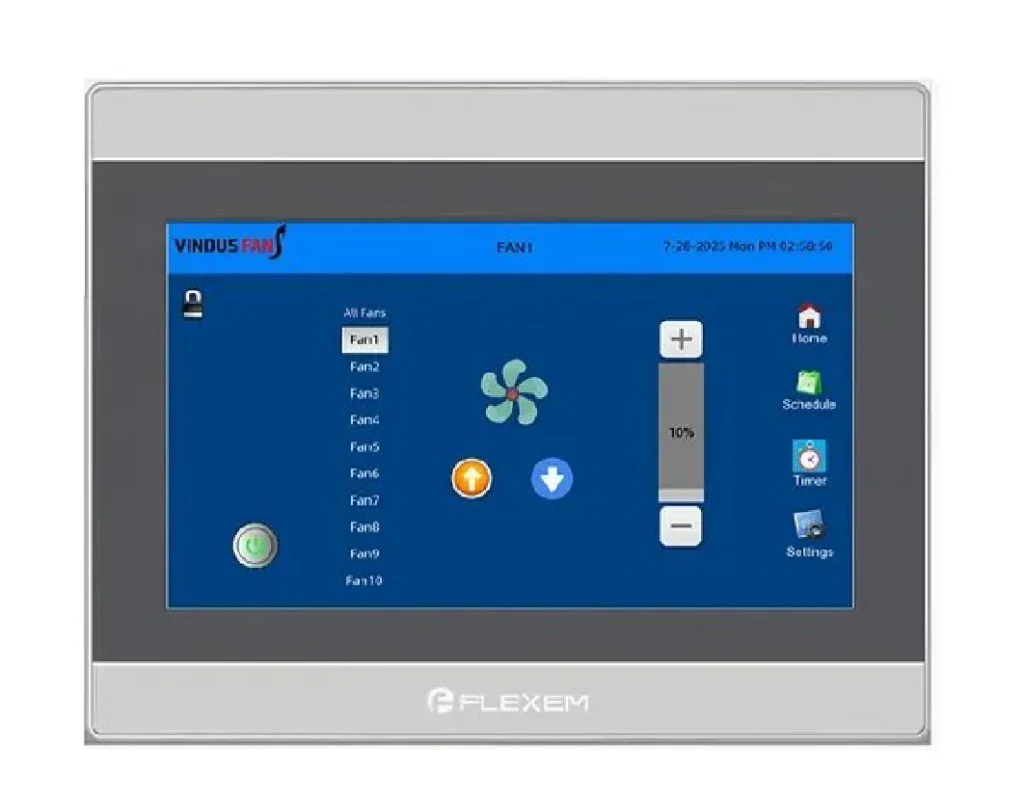
Airflow requirements can change throughout the day and throughout the year. Work shifts change, dock activity increases and decreases, temperatures fluctuate, and some warehouse zones may be occupied more frequently than others.
Centralized controls allow multiple warehouse fans and airflow zones to operate as a coordinated system.
Vindus HMI 1–10 controls provide centralized touchscreen control for up to 10 fans, including on/off operation, variable speed, zone grouping, scheduling, and timer functions. Fans can be grouped around areas such as pick zones, storage aisles, or docks rather than controlled individually.
For facilities requiring greater automation and integration, FanBrain™ adds temperature-responsive operation, programmable scheduling, zoning, Modbus-RTU communication, and building management system integration capabilities.
The advantage is control based on how the facility actually operates. Instead of every fan running the same way throughout the day, airflow can be managed by zone, schedule, activity level, and changing thermal conditions.
Want a closer look at the available fan options? Download the Industrial Airflow Systems brochure for product specifications and application information.
Design Warehouse Airflow Around the Facility
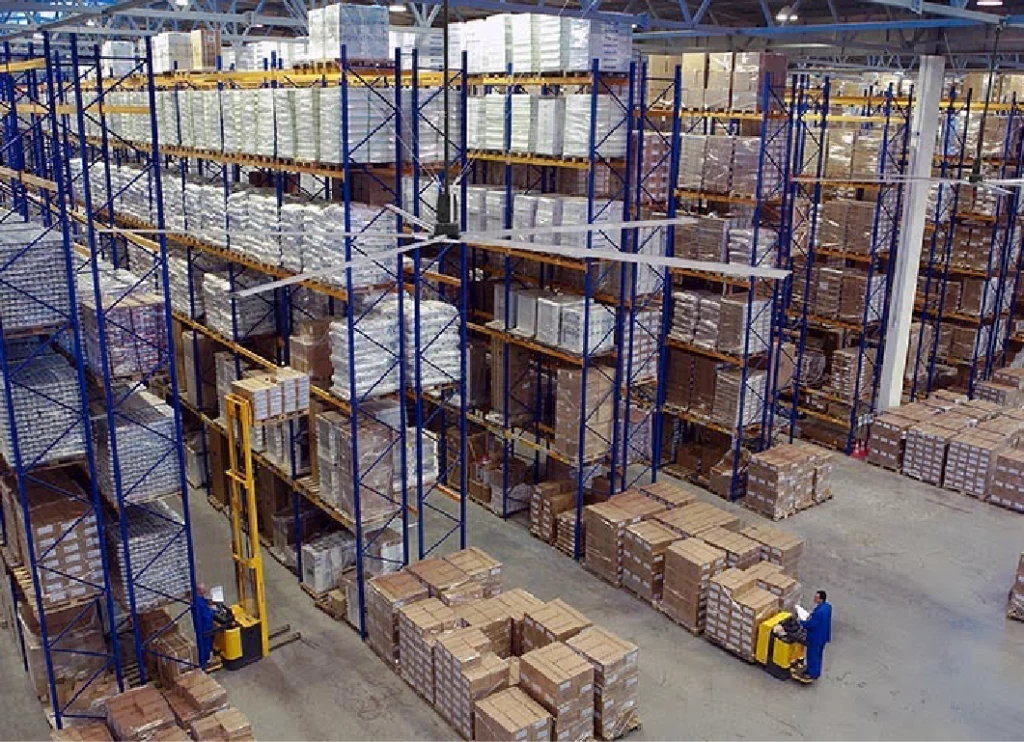
Selecting warehouse fans is only one part of developing an effective airflow system. Fan size, quantity, placement, controls, installation, and commissioning all influence how the finished system performs.
Apex offers a comprehensive line of industrial warehouse fans, along with experienced professionals who can help select the appropriate fans, determine placement, and coordinate installation around facility conditions.
The process can include a site walk and operational needs review, fan selection and placement by zone, controls strategy, layout coordination, pre-installation verification, installation, startup, commissioning, and ongoing system support.
Whether the challenge is broad air circulation across a high-bay warehouse, a stubborn hot spot beneath a mezzanine, or targeted airflow at a workstation, the objective is the same: put the right airflow solution where it can do the right job.
Talk with Apex about your warehouse hot spots and get help selecting and installing the right fans for your facility.
