
Vertical Lift Modules For Food And Beverage Warehousing: Where Small-Pick Automation Fits

Where VLMs Fit In Food And Beverage
Small-pick fulfillment in food and beverage has quietly become one of the harder warehouse problems to solve. SKU counts are growing, order profiles are shifting toward eaches and split cases, and inventory requirements — lot control, expiration dates, temperature sensitivity, customer-specific handling — are adding complexity that static shelving wasn’t designed to handle.
The labor cost shows up in travel time, search time, and picking errors. In food and beverage, those errors carry real consequences: order quality, traceability, compliance, and customer relationships are all on the line.
Vertical lift modules won’t solve every storage challenge, but for the right workflows, they offer a practical path to faster picking, better inventory control, and smarter use of conditioned and general warehouse space. This guide covers where VLMs fit in food and beverage operations, how to evaluate whether they’re the right fit for yours, and what to look for before committing to a system.
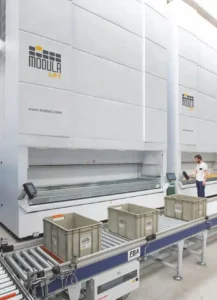
Vertical Lift Modules Goods-to-Person Order Picking
What Is A Vertical Lift Module?
A vertical lift module is a goods-to-person automated storage and retrieval system that stores products on trays inside an enclosed vertical unit. Instead of requiring an operator to walk to shelving or rack locations, the system locates the selected tray and delivers it to an accessible pick window.
One of the key advantages of a VLM is its efficient use of internal space. The system automatically measures the height of the items on each tray, then stores the tray in the most efficient position inside the unit. By reducing unused space between trays, VLMs can increase storage density and make better use of the full vertical cube inside the machine.
For food and beverage operations, those features can support high-SKU storage, fast goods-to-person access, ergonomic picking, tighter inventory control, and automatic inventory updates when integrated with the host or WMS systems.
Food And Beverage Challenges VLMs Can Help Solve
For food and beverage teams, the strongest VLM applications are usually small-pick, high-SKU, controlled, or temperature-sensitive workflows where space, labor, and accuracy are already creating pressure.
Here are the use cases where vertical lift modules tend to make the most sense.
1. Managing High-SKU Small-Pick Inventory
When SKU counts grow, and order profiles shift toward eaches, split cases, and specialty items, static shelving stops working efficiently. Operators spend more time searching, walking, and verifying than actually picking. A VLM consolidates that inventory into an organized, goods-to-person system — so the right item is delivered to the operator quickly, with less handling and fewer opportunities for error.
2. Improving Space Utilization In Controlled Environments
Temperature-controlled and conditioned spaces are expensive areas to build, operate, and maintain. When small-pick inventory is stored in those areas, a VLM can help consolidate SKUs into a smaller footprint by using available vertical cube more efficiently. That can reduce static shelving needs and cut down on the walking and searching required to complete the pick.
Before specifying a VLM for a controlled environment, teams should review the facility conditions, product sensitivity, access frequency, condensation risk, maintenance access, and whether the selected unit and configuration are appropriate for the application.
3. Supporting Lot, Batch, And Expiration-Controlled Inventory
Food and beverage inventory is often managed by lot, batch, expiration date, customer requirements, traceability needs, or special handling requirements. A VLM does not replace food safety procedures or inventory software, but it can support more controlled picking when paired with barcode scanning, host/WMS integration, or defined FIFO/FEFO workflows.
4. Reducing Travel In Segmented Storage Areas
In facilities with segmented or controlled storage areas, travel time compounds quickly. A VLM placed at the boundary of those zones can consolidate access points and reduce the back-and-forth that slows small-pick workflows without adding value.
5. Controlling Access To Sensitive Or High-Value Items
Some food and beverage inventory needs more control than open shelving provides. High-value products, customer-specific inventory, samples, limited-run items, returned goods awaiting disposition, or SKUs with special handling requirements can be stored in an enclosed system that improves accountability and limits unnecessary access.
6. Handling Seasonal Or Promotional SKU Complexity
Seasonal items, promotional products, limited-time offers, and customer-specific SKUs can create temporary storage challenges. A VLM can help organize these items when they are small enough for tray storage and the pick/replenishment profile supports automation.
 What To Evaluate Before Adding VLMs To A Food And Beverage Distribution Operation
Once the right use cases are identified, the next step is determining whether a VLM fits the actual distribution workflow. The best applications are based on product data, order activity, facility constraints, and how the system will connect to existing processes.
Start With The SKU Profile
A VLM should be evaluated around the items it will actually store. That includes SKU dimensions, weights, packaging types, storage requirements, and whether products can be safely and efficiently stored on trays.
This is especially important when the inventory includes mixed pack sizes, samples, seasonal items, specialty packaged goods, labels, or temperature-sensitive products. The more accurately the SKU profile is defined, the easier it is to determine tray configuration, storage capacity, access points, and replenishment needs.
Review The Order Mix And Pick Activity
VLMs are often a strong fit for each-pick, split-case, open-case, sample, promotional, and smaller packaged items that need organized access without taking up prime floor space.
Pick velocity also matters. A VLM can support fast, efficient picking when the system is matched to the order profile, but higher-volume workflows need to be reviewed carefully. The number of units, access points, operators, tray presentation speed, replenishment strategy, and host/WMS integration all affect whether the system improves throughput or creates a bottleneck.
Confirm Environment And Handling Requirements
Confirm the temperature range, humidity conditions, access frequency, product sensitivity, and moisture exposure for the intended installation area. For controlled or conditioned environments, the evaluation should also include equipment placement, condensation risk, maintenance access, and whether the selected VLM configuration is appropriate for the facility’s operating conditions.
Define Inventory Control Needs
Lot, batch, expiration date, FIFO/FEFO logic, traceability needs, and customer-specific handling requirements should be reviewed before system design. A VLM can support more controlled picking, but the result depends on the quality of the inventory data and how the system is integrated.
Barcode scanning, inventory software, and host/WMS integration can help support item confirmation, inventory visibility, and a more consistent picking process. The technology should match the level of control the operation actually needs.
Look At The Facility And Labor Model
Available ceiling height, floor space, access points, replenishment paths, and operator workflow all affect whether a VLM is a good fit. The system should be placed where it reduces travel and supports the next step in the process, whether that is packing, consolidation, staging, shipping, or replenishment.
Labor planning is part of the same conversation. A VLM can reduce walking, searching, and unnecessary handling, but the operator workflow still needs to be designed around how orders move through the building.
Compare The VLM To Other Storage And Automation Options
A VLM may be the right answer for small-pick, controlled, seasonal, e-grocery, or temperature-sensitive inventory, but it is not the only option. Some workflows may be better served by pallet rack, carton flow, shelving, conveyor, AMRs, pallet shuttle, mini-load ASRS, or a hybrid system.
The evaluation should focus on fit, not just the equipment. For food and beverage operations, the right solution is the one that improves accuracy, space utilization, labor efficiency, and inventory control without forcing products into a process that does not match how they move.
Why The Right Automation Partner Matters
A successful VLM project depends on more than the equipment. It requires the right inventory analysis, workflow design, climate planning, software integration, and implementation support.
For food and beverage operations, that means aligning the system with how products actually move through the facility. A Modula VLM may be a strong fit for small-pick, split-case, controlled, e-grocery, seasonal, or temperature-sensitive inventory, but it should be evaluated alongside the full storage and fulfillment process.
Apex helps teams determine where VLMs make sense, where another solution may be a better fit, and how automation can support labor efficiency, inventory control, space utilization, and picking accuracy.
Ready To Evaluate VLMs For Your F&B Operation?
Evaluating automation for a food and beverage operation means accounting for SKU complexity, climate requirements, order profiles, and how the system connects to your existing processes. Apex works through that evaluation with you — helping identify where a VLM fits, where another solution may serve you better, and how to build a storage strategy that holds up as your operation grows.
If you’re ready to take a closer look, we’re ready to help you structure it. Talk with an Apex automation expert.
