
Pick-to-Light Order Picking Systems: The Future of Fast, Accurate Fulfillment

Pick-To-Light Can Streamline Your Order Fulfilment Process–Here’s How:
Order picking is one of the most critical and labor-intensive processes in modern warehouses and fulfillment centers. As consumer expectations for faster delivery times continue to rise, businesses are increasingly looking for innovative ways to improve efficiency and accuracy. Traditional order-picking methods often rely on lengthy manual processes, which can be prone to errors, time delays, and inefficiencies, especially in high-volume environments. With a semi-automated pick-to-light system, manual errors are significantly reduced.
Pick-to-light systems empower operators to handle high volumes of orders with confidence and precision. From improving speed and accuracy to minimizing training time and worker fatigue, pick-to-light technology delivers tangible benefits for businesses striving to meet the demands of modern logistics. Let’s explore how pick-to-light systems work, their key advantages, and the next-gen trends shaping their future.
What Are Pick-To-Light Systems?

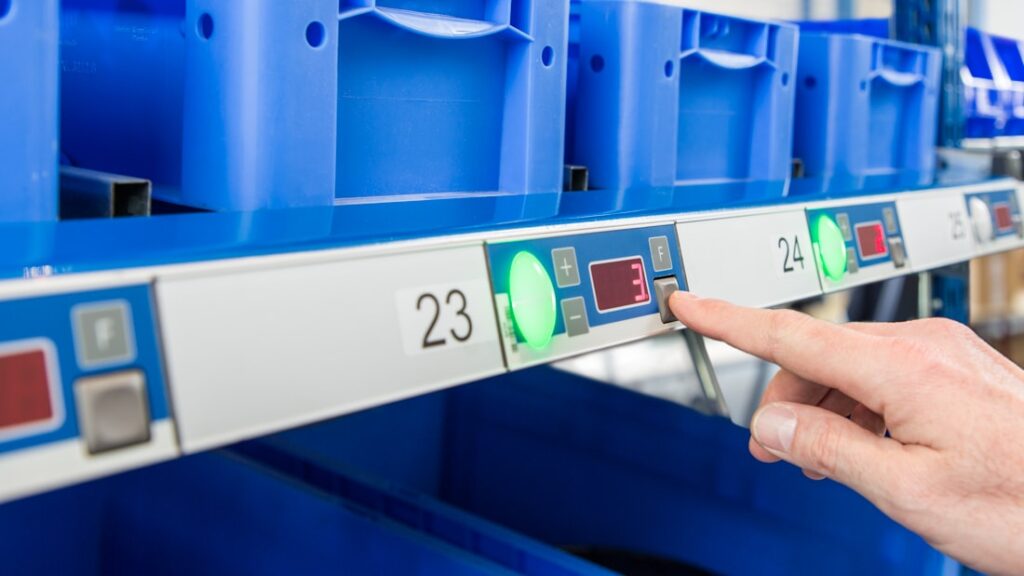
Pick-to-light technology is an operator-friendly system that uses light displays to direct warehouse staff to specific picking locations. These systems eliminate guesswork and reduce reliance on paper-based instructions or handheld devices. Here’s how it works:
- The order is received, and the operator scans the barcode on the carton/tote assigned to a specific order to kickstart the process.
- LED lights illuminate the item’s location, accompanied by a display showing the number of items to pick.
- The operator confirms they’ve picked the correct number of items by pressing a button that turns off the light.
- The process repeats until all items are picked, and the order moves to the next zone or packing area.
Operators don’t need to memorize complex instructions or constantly check screens—they can focus entirely on the task at hand. These systems integrate in real time with warehouse management software (WMS) to ensure that picking tasks align with inventory data, improving overall operational efficiency.
Pick-to-light systems are versatile and commonly used for batch picking, where multiple orders are picked simultaneously, enhancing speed and accuracy. They also support zone picking, wave picking, and kitting by guiding workers to precise locations, reducing errors, and streamlining workflows across various order fulfillment processes.
The Benefits of Pick-to-Light Technology
The advantages of pick-to-light systems go beyond efficiency, impacting nearly every aspect of warehouse operations. Here are a few benefits to implementing a pick-to-light system:
The benefits of pick-to-light technology are multifaceted:
- Significantly reduces picking errors
- Accelerates picking speed
- Improved customer service
- Reduces training time
- Minimizes worker strain & injuries
- Scalable for inventory changes
1. Enhanced Picking Accuracy
Accuracy is critical in order fulfillment, as errors can lead to customer dissatisfaction and costly returns. Pick-to-light systems provide visual indicators that ensure operators pick the correct items and quantities.
2. Increased Speed and Productivity
Time is money in warehousing, and every second saved in the picking process boosts overall efficiency. Pick-to-light replaces the cumbersome, paper-based methods of the past with intuitive technology that enables faster, more accurate picks at a higher volume. All this increased speed and productivity also translates to dollars in your pocket in labor savings.
3. Improved Customer Service
Faster and more accurate order fulfillment translates directly to better customer service. Quick and error-free deliveries are the standard in today’s competitive market, and pick-to-light technology helps businesses meet these expectations while maintaining high standards.
4. Reduced Training Time
One of the most significant challenges in warehouse management is training new employees, especially during peak seasons. The intuitive design of pick-to-light systems ensures that operators can quickly learn and execute tasks—often in a single 45-minute training session—which reduces downtime and boosts productivity from day one. Plus, many pick-to-light systems offer immediate feedback on worker performance so workers can track their productivity over time.
5. Minimizes Worker Strain & Injuries
Traditional order picking requires extensive walking and cumbersome scanners, leading to fatigue and repetitive motion injuries. Consolidated pick zones equipped with pick-to-light systems streamline workflows, reduce walking, and eliminate the need for bulky devices, easing physical strain.
6. Scalable for Inventory Changes
Pick-to-light solutions are designed with modular components that simplify customization and adaptation as needed. Whether scaling up for peak seasons or introducing new product lines, these systems can provide the flexibility to keep operations running smoothly without significant downtime or cost.
By addressing these key operational challenges, pick-to-light technology positions warehouses for success in an increasingly demanding industry.
Emerging Innovations in Order-Picking Technology

As warehouses embrace automation, pick-to-light systems are evolving with next-gen solutions to meet the demands of the future. One such advancement is the integration of Autonomous Mobile Robots (AMRs). These robots can be deployed to make the picks or support the batch-picking process by ferrying totes from the pick zone to a conveyor system or directly to the packing stations. These collaborative applications can deliver significant labor savings and increased productivity.
Additionally, AI has the potential to enhance the functionality of pick-to-light systems by further improving inventory accuracy and workflow efficiency. Equipped with AI sensors, pick-to-light systems could monitor stock levels at each station and autonomously initiate replenishment when inventory runs low. For example, when a pick-to-light system identifies a need for replenishment, it could deploy an Automated Guided Vehicle (AGV) to retrieve and deliver the required items from storage, ensuring uninterrupted operations during high-demand periods.
AI could further enhance pick-to-light efficiency by analyzing real-time system data, such as pick frequencies and item demand. Regular data analysis is essential for maintaining optimal slotting through periodic reslotting. Low-volume SKUs should be replaced with high-volume SKUs to improve efficiency. Key data-driven triggers for slotting adjustments include declines in pick accuracy, increased congestion, and longer travel times—indicating the need for immediate re-evaluation. Additionally, seasonal shifts and major operational changes should prompt a thorough SKU slotting analysis.
Emerging trends include multi-modal systems combining pick-to-light technology with voice-directed picking and wearable vision devices. These systems could provide operators with multiple layers of guidance, making the picking process even more intuitive and efficient. For example, an operator could use voice commands to confirm picks while receiving visual cues from pick-to-light indicators or wearable vision devices.
These are but a few examples of innovative technology emerging to improve warehouse efficiency—and it all starts with a reliable pick-to-light system.
How to “Pick” the Right System for Your Business
Choosing the right pick-to-light system involves assessing key factors such as warehouse size, order volume, system scalability, and compatibility with existing infrastructure. Pick-to-light systems can become the cornerstone of your order-processing operations by simplifying order-picking processes and reducing errors.
Not sure what system is right for you? Apex takes a personalized approach to every project, leveraging detailed data analysis to design pick-to-light solutions that align with your business’s specific needs. Call today to learn how Apex can help you optimize your order-picking process with a tailored pick-to-light solution!
