
Pallet Stops Are a Go When It Comes to Warehouse Safety

Why are Load Stops an Important Piece of Pallet Rack System Design?
Pallet rack systems provide efficient, space-saving industrial storage. The safety features built into the rack design ensure its strength and stability under enormous load capacities and against external factors such as equipment strikes and even seismic activity. Although we often consider rack protection for aisle-facing components where forklift damage is more prevalent, we can’t neglect the back of the rack, where it’s equally critical to prevent misaligned pallets, falling inventory, and overcrowded flue spaces.
The flue space is the vertical space behind a single row or between back-to-back rows of pallet rack. To comply with National Fire Protection Association (NFPA) regulations, there must be at least 6” of open area, or flue space, behind these systems to allow for heat and smoke to flow up and delay fire from spreading in the event of an emergency.

Single-Sided Offset Flue Protector
Several rack load stop options are available to prevent pallets from intruding into the flue area and to help keep the pallets and inventory secure. Selection depends on the rack type and configuration.
Load Stop Protection for Standard Pallet Rack Systems
- Backstop beams
- Flue space protectors
- Wire backstops
- Rack straps
- Netting
- Steel panels
 Backstop beams – bolted between the uprights between 6-12” above the shelf beam, backstop beams prevent the pallet loads from pushing too far into the flue space. Rack designed for pallets sitting flush with the rear of the rack bay use a flush backstop beam, and systems designed for a slight pallet overhang (approx. 3”) use the offset backstop beam.
Flue space protectors, or flue guards – steel pallet stops, approximately 6” wide, mounted to the rear beam. The type of flue space protector depends on the pallet rack configuration. Select a single-sided flue protector for single rack rows and a double-sided flue protector for back-to-back rows. Dimensions and offset size will vary by manufacturer.
To learn more about transverse vs. longitudinal flue spaces, check out our blog for a deep dive.
Wire backstops – vertical wire dividers mounted in the rear of the pallet rack back help protect hand-stacked inventory from falling off the back of the rack shelf. Wire backstops can be hung from the bay above and then secured below to form a very secure stop. Alternatively, partial dividers clip-on at the base. The best choice will depend on inventory specs and stacking heights within the bay. See our blog for more on products to streamline hand stack operations.
Rack straps – durable straps made from polyester and elastic webbing mount quickly and easily to rack uprights using metal connectors at the ends. Mount as many as needed per bay and quickly move them as inventory specs change. Straps allow for a 6” overhang of the pallet.
Safety netting – attaches to the pallet rack system uprights and beams on the front, rear of the system, or underneath rack bays to protect against falling items. Safety netting is made from polypropylene or nylon and fitted to your specific pallet rack system specs.
Wire mesh containment panels – modular-sized panels are usually available in single or double-wide widths. They are made of steel-welded wire mesh and mounted to the rear of the rack system using either a flush or offset positioning.

Pallet Load Stops for High-Density Rack Systems
High-density pallet racking systems have unique pallet stop features often designed into individual lane configurations.
Push-back rack systems are pallet storage racks that rely on enveloping carts set on inclined rails. The pallets are placed on the carts at the load aisle and then pushed back as forklift operators add new pallets to the lane. There are two ways to address push-back load stops.
- The rails can be manufactured with steel stops welded at the rear (see the picture below) which prevents the top cart from exceeding the lane length.
- The top cart can be built with a raised rear backstop to ensure the pallet cannot shift too far back and off the cart.
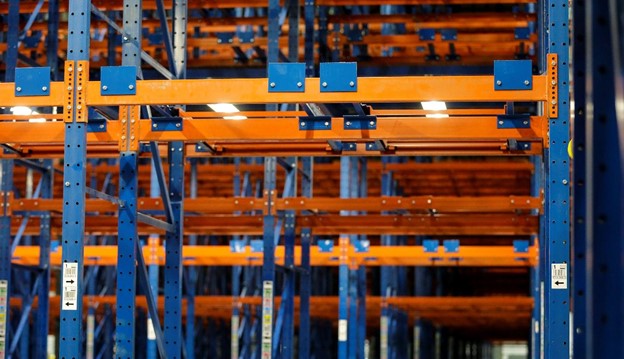
Drive-in rack is a high-density pallet storage system where pallets are loaded in deep lanes on rails mounted on either side of the lane. Rail stops welded at the end of the rails, particularly in higher levels, prevent pallets from falling off the end of the rail.
Pallet flow rack is a gravity flow storage system designed with rails or rollers set at a pitch from a load aisle down to a discharge aisle on an opposite aisle. Ramp stops at the discharge side of the lane are designed to stop the pallet safely and hold it in the lane until extracted. Steel ramp stops are durable to withstand the brunt of heavy pallets.
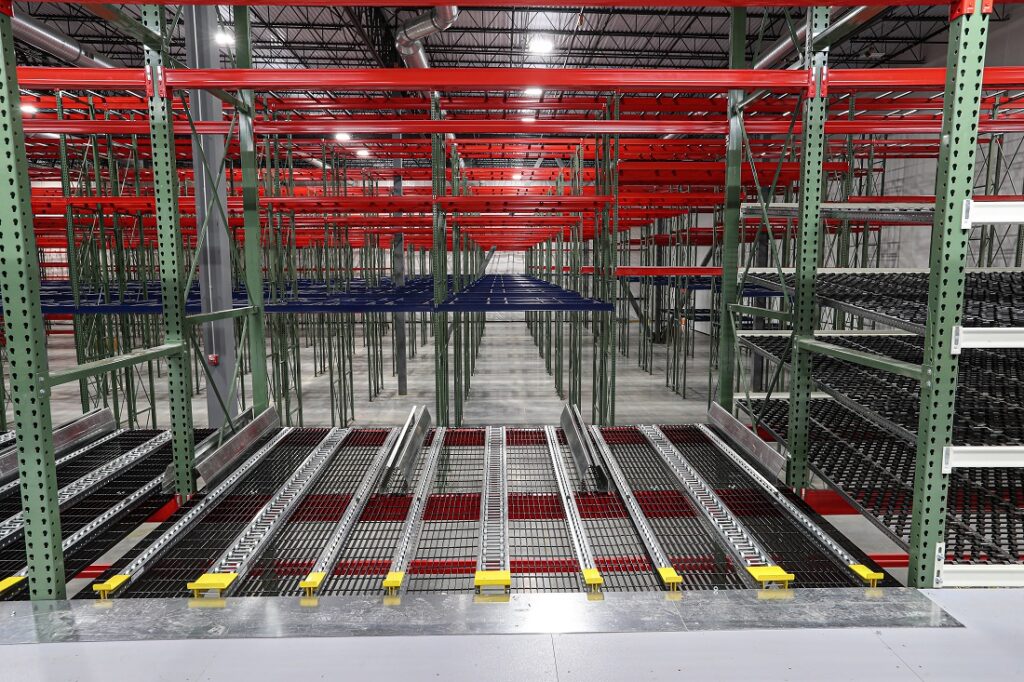
Pallet Stops (yellow) at the Discharge Aisle
Apex’s Commitment to Safety
Apex Companies is committed to warehouse safety. Our pallet racking systems are carefully designed and professionally installed to ensure that your team is safe and that your racking systems will produce for your operation for the long haul. We also offer expert pallet rack audit and warehouse safety inspection services through our Apex PROs. Contact our team for prompt service and creative solutions for your warehousing, distribution, order fulfillment challenges.
