
Warehouse Fans FAQ: Choosing the Right Airflow Solution

What Does Better Airflow Look Like in Your Warehouse?
When parts of a warehouse feel hot, stagnant, or noticeably different from one work zone to another, adding a fan may seem like the obvious solution. But before you buy, reframe the question: What is the air doing—or failing to do—in your facility?
That matters because the goal isn’t simply to put more fans in a hot building. It’s to understand how air needs to move through the space to improve conditions where people are working.
A fan doesn’t create cold air. It controls how air moves through the space.
And how that air moves depends on the facility itself. Ceiling height, rack layout, work areas, equipment, mezzanines, dock doors, obstructions, and existing ventilation can all influence airflow.
Key Takeaway: Effective warehouse airflow starts with understanding how air needs to move through each area of the facility, then selecting and coordinating the right solutions to improve comfort, productivity, and operational efficiency.
Can Warehouse Airflow Require More Than One Solution?
Warehouse airflow doesn’t always have a one-fan answer. A large open storage area may benefit from broad air movement, while a packing station, mezzanine, or dock may need more targeted airflow. Ventilation and controls can add another layer depending on how the facility operates.
That’s why it can be more useful to think in terms of an integrated airflow solution. The objective is to understand how air needs to move through different parts of the facility, then select and coordinate the equipment that supports those needs.
Integrated doesn’t necessarily mean more equipment. It means using the right equipment where it can do the most useful work.
That may mean:
- HVLS fans for broad coverage
- Directional fans for targeted areas
- Ventilation equipment
- Coordinated controls
- A combination approach
Zoning and controls can coordinate airflow around how different areas operate, including schedules and changing conditions. Matching the solution to each zone can help avoid over-equipping some areas while leaving problems unresolved in others.
That more strategic approach can also support the economics of the operation. Equipment can be selected and controlled around actual airflow needs, while better conditions in occupied work areas support the people and processes that keep the warehouse productive.
What Types of Warehouse Fans Are Available?
Warehouse airflow systems can use several types of equipment, depending on the facility and the problem being addressed.
High-volume, low-speed (HVLS) fans move large volumes of air at relatively low speeds. Their large diameter makes them well-suited for broad coverage in warehouses, distribution centers, manufacturing areas, and other large spaces with sufficient overhead clearance.
Directional industrial fans provide more concentrated airflow. Available in mounted or mobile configurations, they can target specific work areas or provide airflow where the building layout makes a large ceiling fan impractical. Examples can include pick areas, workstations, areas beneath mezzanines, and other constrained or isolated spaces.
Exhaust and ventilation equipment serves another purpose: exchanging or exhausting air rather than simply circulating the air already inside the building. Exhaust fans move indoor air out of the facility, allowing replacement air to enter through designated openings or other sources of makeup air.
Do Warehouse Fans Actually Cool the Air?
Fans and mechanical air conditioning do different jobs.
A fan moves air rather than lowering its temperature. Moving air helps perspiration evaporate from the skin, creating a cooling effect that can improve comfort even though the actual air temperature hasn’t changed.
That distinction is especially important when evaluating a warm warehouse. If the underlying problem is trapped warm air, poor circulation, or an area where employees aren’t receiving sufficient air movement, that’s where a properly designed airflow system adds value by moving and distributing air where it’s needed. If the process requires the air itself to be maintained at a specific temperature, fans alone aren’t a substitute for cooling or HVAC equipment.
The first step is defining what needs to change.
How Do HVLS Fans Help With Warehouse Airflow?
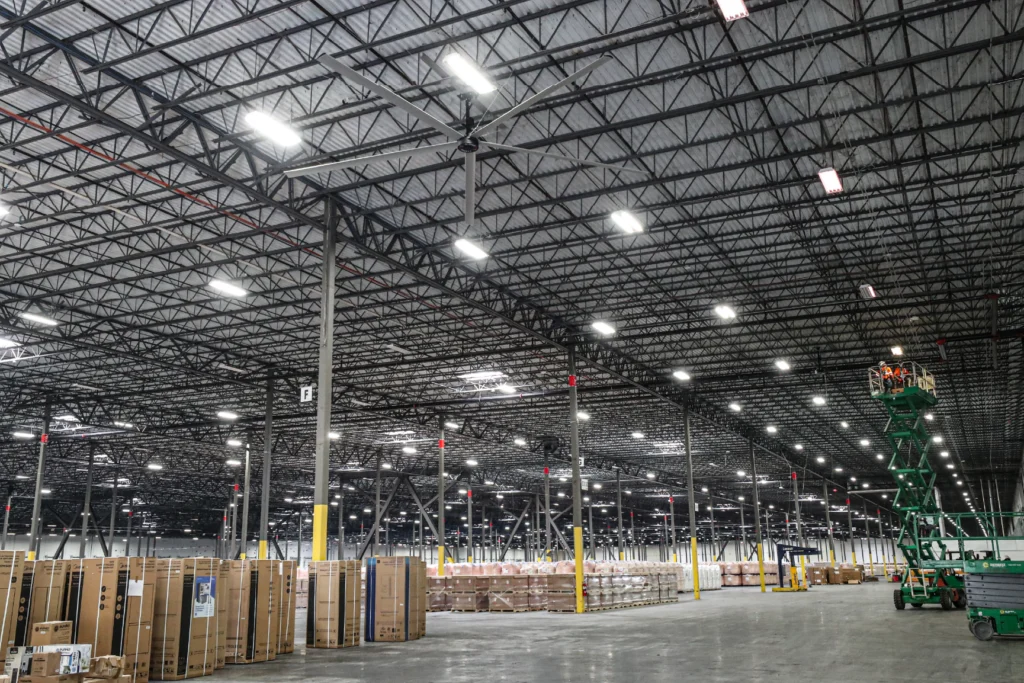
Warm air naturally tends to accumulate higher in a building while cooler air remains lower, creating temperature layers known as stratification.
HVLS fans can move large volumes of air through tall, open spaces and help mix these layers, a process commonly called destratification. They can also create broad air movement through occupied areas.
That doesn’t make an HVLS fan the automatic answer for every large warehouse.
Rack configurations, ceiling obstructions, sprinkler systems, lighting, building structure, work zones, and other equipment all affect placement and performance. A facility with tall rack, multiple mezzanines, or highly compartmentalized work areas may require a different approach—or a combination of broad and targeted airflow.
When Are Directional Fans a Better Fit?
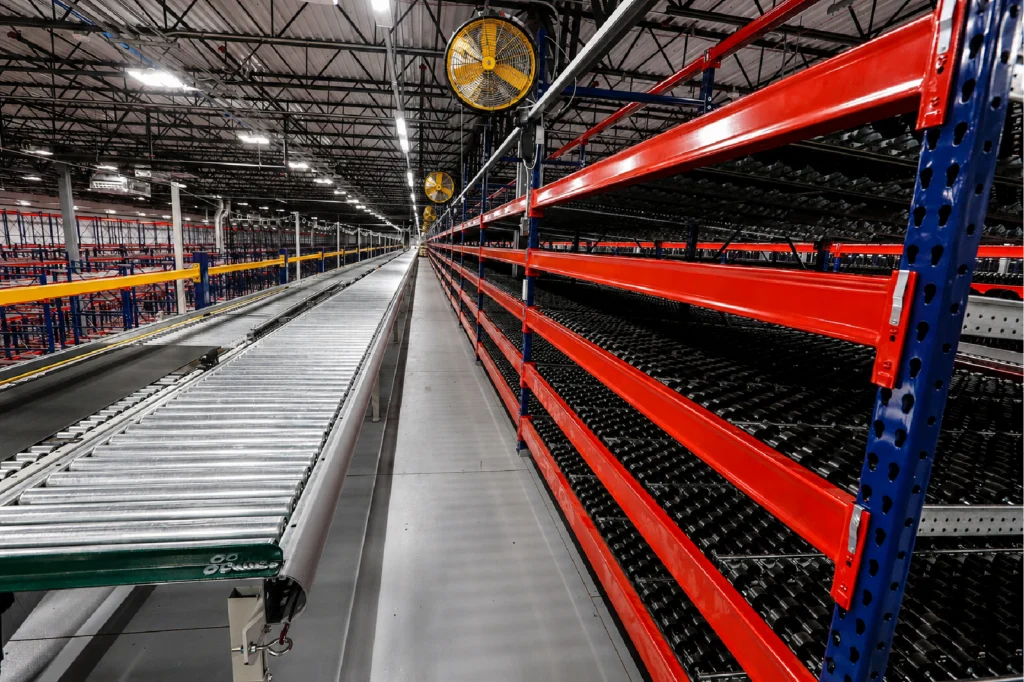
Sometimes the airflow problem is local rather than facility-wide.
A packing station may feel stagnant. Employees may work beneath a mezzanine where broad overhead airflow doesn’t effectively reach them. A pick tunnel, dock area, or other constrained zone may need air directed specifically toward the occupied space.
Directional (wall-mounted or mobile) fans can target those areas more precisely.
This is why comparing HVLS and directional fans strictly by airflow capacity misses an important part of the decision. They create different airflow patterns and can solve different problems. In some warehouses, they work together as parts of the same airflow strategy.
How Do Warehouse Layout and Open Doors Affect Airflow?
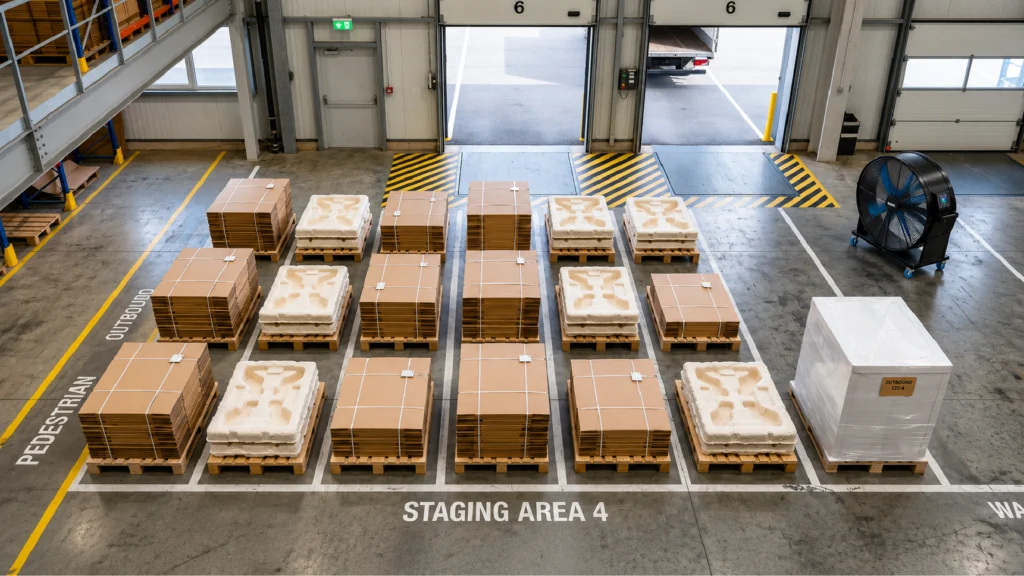
Warehouse air doesn’t move through an empty box. Pallet rack, stored product, mezzanines, machinery, walls, and other structures can interrupt or redirect airflow. As a result, two work areas in the same building can experience very different conditions.
Exterior openings add another variable. When dock and entry doors open, wind, indoor/outdoor temperature differences, and building pressure can affect how air enters and moves through nearby areas. Depending on conditions, that can mean introducing warm, cold, or humid outdoor air into the facility.
Fans don’t eliminate the heat or humidity coming through an open door, but they can influence how air moves through the occupied space.
That’s why airflow planning considers the facility as it actually operates—including clear height, rack and equipment layout, work zones, obstructions, ventilation, and active docks. Together, those conditions help determine where broad circulation makes sense and where more targeted airflow may be needed.
What Should You Consider Before Choosing Warehouse Fans?
You don’t need to perform a detailed airflow analysis yourself before talking with a warehouse airflow specialist. But you should be prepared to describe the problem.
Start with a few practical questions:
- Where are employees uncomfortable or reporting stagnant conditions?
- Is the issue widespread or limited to particular zones?
- Does it change throughout the day or season?
- How high are the ceilings?
- What structures or equipment could interfere with airflow?
- Which exterior doors remain open or cycle frequently?
- Are there heat-generating processes or equipment nearby?
- What HVAC, exhaust, or ventilation systems are already operating?
- Could the layout or use of the space change in the future?
- Are there areas where airflow needs to be limited or carefully controlled?
Those answers provide much more useful information than square footage alone.
Solve the Airflow Problem Before Selecting the Equipment
Choosing warehouse fans isn’t simply a matter of finding the biggest fan that fits the building. Effective airflow planning starts by understanding the facility: its layout, work zones, obstructions, operating conditions, and the people working within it.
One area may benefit from the broad air movement of an HVLS fan. Another may need targeted directional airflow. A dock or process area may introduce ventilation considerations. And some facilities may benefit from several approaches working together.
Apex evaluates clear height, rack layout, thermal zones, obstructions, work areas, docks, and other facility conditions before specifying equipment. From there, the airflow plan can incorporate the appropriate mix of warehouse fan options.
The objective isn’t more fans. It’s better facility performance.
Schedule a Warehouse Walk-Through / Request a Facility Assessment
