
Warehouse Automation Tech: RFID vs. Barcode for Smarter Inventory Control

Warehouse Automation Pros & Cons of RFID & Barcode Inventory Management
Selecting the right inventory tracking technology is key to supporting efficient operations and ensuring your facility runs smoothly. RFID and barcode systems are two of the most commonly used tracking solutions, but do you know which warehouse automation tool is best fit for your unique operation?
The Apex team is here to help with a side-by-side comparison of RFID and barcode technologies. We’ll explain how each works—whether through hand-held or fixed-position scanning—their benefits and drawbacks, and how they’re applied in modern inventory tracking. We’ll also walk through key decision-making factors such as system costs, scalability, infrastructure requirements, and how each option aligns with your automation goals.
By the end of this article, you’ll have a clear understanding of the strengths and limitations of both technologies—and the insights you need to select the solution that best supports your warehouse automation strategy.
Now, let’s get started!
What is RFID and How Is It Implemented
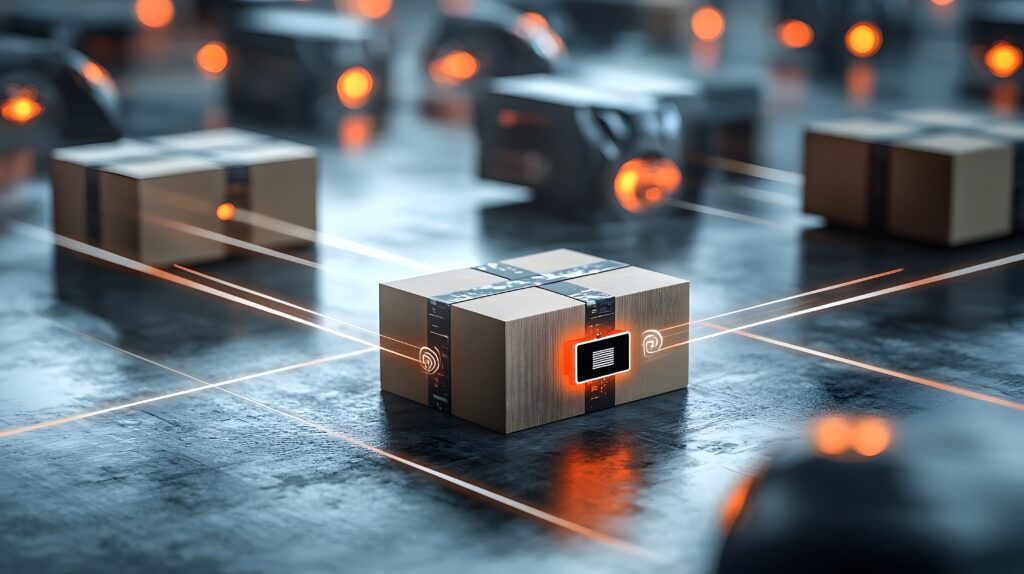
Radio Frequency Identification (RFID) is a wireless technology that uses electromagnetic fields to automatically identify and track tags attached to objects. In warehouse environments, RFID plays a pivotal role in automating inventory control by reducing the need for manual scanning and increasing the speed and accuracy of data collection.
How RFID Works
RFID systems consist of three main components:
1. Tags (or transponders): Often resembling adhesive labels or durable stickers, these are embedded with a microchip and antenna that store item-specific data. Tags are affixed to products, pallets, or containers and come in a variety of materials and formats depending on the warehouse environment.
RFID tag options:
a. Passive: Powered by the energy from the reader’s signal. These are more cost-effective and commonly used in large-scale inventory systems.
b. Active: Battery-powered and capable of transmitting signals over greater distances—ideal for tracking high-value or mobile assets.
2. Readers (interrogators): Devices that emit radio waves to detect and communicate with the RFID tags.
3. Antennae: Facilitate communication between the tag and the reader.
Fixed vs. Hand-Held RFID Scanners
RFID supports both hand-held and fixed-position scanning, allowing you to tailor your solution to your warehouse operations.
- Hand-held RFID readers are portable devices used for on-the-spot inventory checks, ideal for cycle counts, audits, and mobile asset tracking.
- Fixed-position RFID readers are integrated into conveyor lines, dock doors, or racking systems to continuously capture tag data without manual intervention… key for automated workflows.
Benefits of RFID for Warehouse Operations
- Speed: Ability to scan more than a hundred tags at a time, leading to accelerated inventory processing.
- No Line-of-Sight Required: Scans items without direct visibility—ideal for boxed or palletized goods.
- Accuracy: Integrates with WMS (warehouse management system) to reduce errors and improve inventory precision.
- Enhanced Security: Encrypted and uniquely coded tags reduce the risk of duplication.
Challenges of RFID Implementation
- Higher Upfront Costs: Equipment and tags are more expensive than barcoding systems.
- Environmental Sensitivity: Metal and liquids may interfere with signal performance.
- Infrastructure Complexity: Requires more advanced integration and system configuration.
- Tag Read Range Limitations (for Passive Tags): Not ideal for long-distance tracking without enhancements.
In short, RFID enables a high level of warehouse automation by providing fast, accurate, and secure inventory tracking through smart label technology. These durable, data-encoded tags reduce manual intervention, improve throughput, and enhance real-time inventory visibility. For operations prioritizing scalability, labor efficiency, and long-term system integration, RFID offers a forward-thinking solution that aligns seamlessly with advanced automation goals.
Barcodes and Their Role in Warehouse Operations

Barcodes are one of the most established and accessible technologies for inventory tracking in warehouse environments. These optical, machine-readable codes use patterns of bars or squares to identify and track inventory throughout warehouse operations.
Barcodes affixed to cartons, pallets, individual items, etc., get scanned to transmit key information to the WMS, triggering tasks like inventory updates, location tracking, or order processing. Their low cost, ease of use, and integration with automation tools make them a practical choice for many operations.
If your operation receives goods already labeled with manufacturer-applied barcodes, leveraging those existing labels can eliminate redundant tracking steps and reduce labor costs. Even when custom labeling is required, creating and printing barcode labels is quick, inexpensive, and flexible to include additional item details as needed.
How Barcodes Work
The black lines and white spaces or QR code patterns are read by:
- Hand-held barcode scanners: Portable devices used by warehouse staff to scan item or pallet labels during picking, packing, and cycle counts.
- Fixed-position barcode scanners: Mounted on conveyors or workstations, these scanners automatically capture data as items pass through a scan zone.
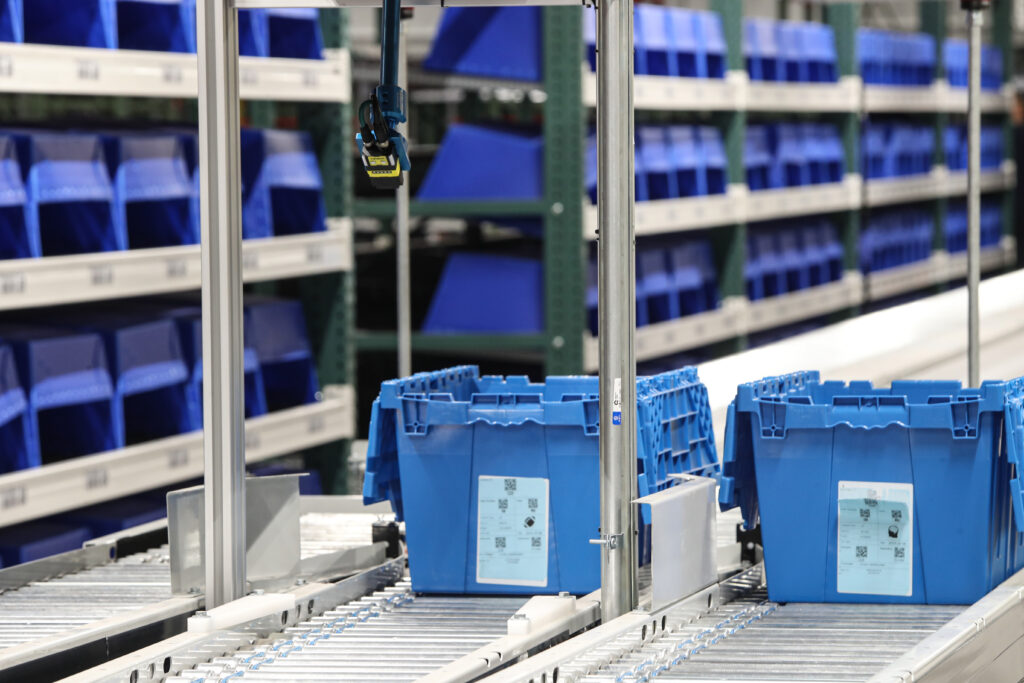
Fixed-Position Scanner Reading QR-Coded Totes
Barcodes fall into two standard formats:
- 1D (Linear) Barcodes: These are the traditional horizontal barcodes commonly found on retail and shipping products. They use a series of bars and spaces to represent binary data (0s and 1s), encoding numeric or alphanumeric information. 1D barcodes are ideal for basic inventory identification tasks, such as tracking SKUs or part numbers.
- 2D Barcodes – QR Codes: Shaped like squares and capable of holding significantly more data than 1D formats, QR codes are increasingly popular in modern warehouses. They can store detailed information such as item descriptions, batch numbers, or expiration dates—all in a compact format. Just like linear barcodes, they are easy to print and scan, but offer enhanced flexibility for operations looking to include more data on each label.
Benefits of Barcodes for Warehouse Automation
- Cost-Effective: Low-cost labels and scanners are easy to implement.
- Simplicity: Minimal training required; quick to adopt.
- Compatibility: Integrates with most WMS and can be paired with semi-automated workflows.
- Precision: Consistent accuracy when systems are maintained.
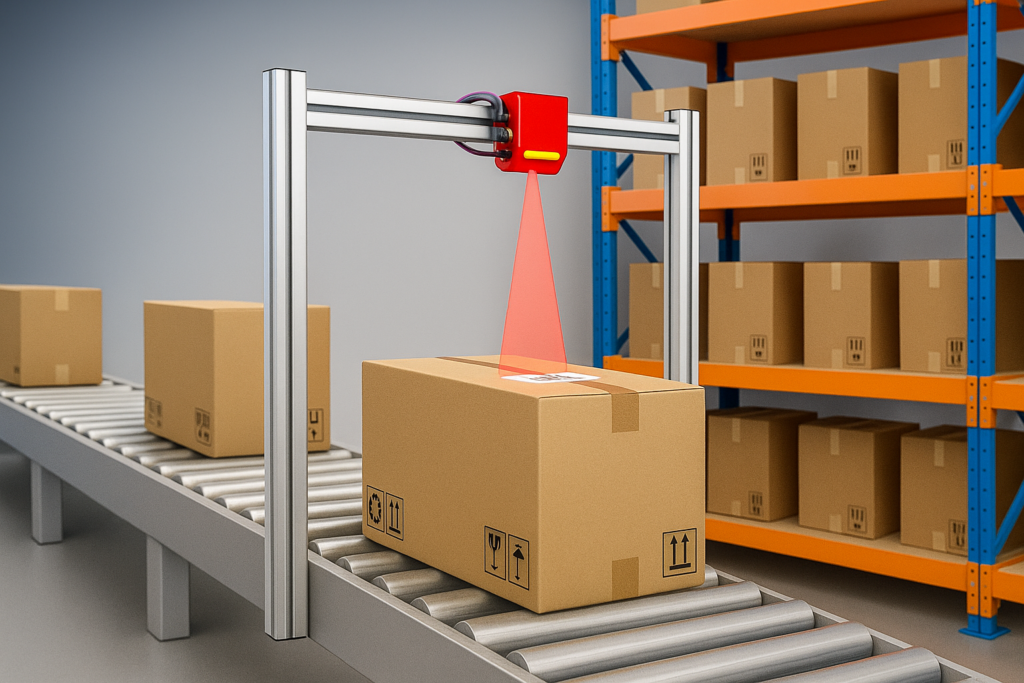
Bar Code Reader
Challenges of Barcode Technology
- Line-of-Sight Requirement: Codes must be visible and properly aligned to scan –this can slow down high-speed workflows.
- Single-Item Scanning: Labels must be scanned individually.
- Label Durability: Labels can wear, fade, or smudge over time, especially in harsh warehouse conditions, requiring reprinting and relabeling.
- Limited Capacity of 1D barcodes: Contain only basic item data, potentially requiring a secondary system to manage complete item info.
Barcodes remain a trusted solution for inventory management across a wide range of facilities, particularly those with lower throughput, smaller teams, or hybrid warehouse automation models. While they may not match RFID in speed or automation potential, they offer proven reliability and affordability.
RFID vs. Barcode: Matching Technology to Your Warehousing Goals
Choosing between RFID and barcode systems isn’t just about features—it’s about alignment with how your facility operates, the environment you’re working in, and what kind of return you expect from your investment. Here’s how to evaluate each option through three key lenses:
Comparing RFID & Barcode Options
| Feature | RFID | Barcode |
| Initial Cost | Higher | Lower |
| Scanning Efficiency | Multi-Item | Single-Item |
| Scanning Speed | Fast | Slower |
| Infrastructure Needs | Advanced | Basic |
| Automation Compatibility | High | Medium |
| Line of Sight Required | No | Yes |
Operational Scale & Throughput Requirements
- RFID is ideal for high-volume operations where speed and automation are critical. It supports rapid, hands-free scanning of multiple items simultaneously, making it well-suited for facilities with fast-moving inventory, multi-shift operations, or heavy conveyor automation.
- Barcodes, while slower, are effective for low- to mid-volume facilities or operations with defined manual processes. If your warehouse doesn’t demand lightning-fast throughput, barcodes may offer all the functionality you need at a fraction of the cost.
Environmental Considerations
- RFID signals can be disrupted by metal, liquids, or cold storage conditions, which may require additional shielding or system adjustments.
- Barcodes are not affected by physical interference, but require clear visibility and intact labels. In dusty, high-moisture, or abrasive settings, barcode labels may degrade, requiring more frequent reprinting or protective label solutions.
Cost vs. Performance for Your Automation Roadmap
- RFID typically requires a higher upfront investment for readers, tags, and system integration, but it delivers long-term gains in efficiency, accuracy, and labor reduction. It’s best suited for organizations looking to scale and automate over time.
- Barcodes are more budget-friendly and easier to implement in stages. For teams building a hybrid automation model or piloting new workflows, barcodes offer a cost-effective entry point with flexibility to upgrade later.
What is Hybrid Automation?
In this context, hybrid automation refers to warehouse applications that blend manual processes with automated tools, such as hand-held scanners alongside automated conveyors, or RFID portals at loading docks paired with manual inventory audits. Even powered conveyors feeding manual packing stations qualify as hybrid setups. These systems combine automation and human activity to create flexible, scalable solutions—often ideal for operations in transition or those balancing cost and complexity.
Integrating RFID or Barcode with Warehouse Automation
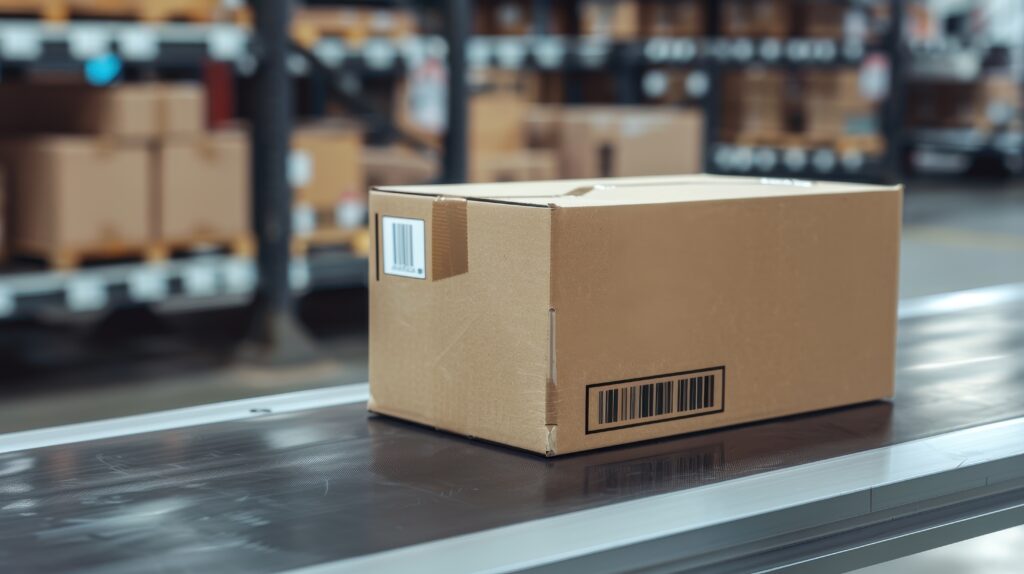
Regardless of your chosen technology, your RFID and/or barcode system will be vital in automating your inventory management. Their value isn’t simply limited to scanning capabilities but also to their seamless connection with your broader warehouse automation infrastructure and software systems.
How They Fit into Automated Inventory Systems
- RFID: Because RFID readers can capture multiple tags at once—often without needing direct visibility—they are especially effective in high-throughput, automated workflows. RFID is frequently integrated at dock doors, on conveyors, or within robotic systems to enable continuous, hands-free inventory tracking as items move through the facility.
- Barcodes: Barcodes remain highly adaptable within automation frameworks. Fixed-position barcode scanners are commonly installed along conveyors or packing lines to validate orders, confirm routing, or update WMS data at defined scan points. Barcodes also pair well with semi-automated stations, where human workers interact with systems that prompt scans for validation or task completion.
WMS Compatibility
Both technologies are compatible with modern warehouse management systems (WMS). Barcode and RFID scanners relay data in real time to your WMS, updating inventory counts, flagging discrepancies, and triggering next steps like restocking or shipping. The choice comes down to the level of automation your WMS needs to support:
- RFID typically requires more integration and configuration upfront, but enables more advanced automation.
- Barcodes offer plug-and-play simplicity and broad compatibility with most commercial WMS platforms.
Real-Time Data Capture & Analytics
Real-time data is a cornerstone of warehouse automation… and both technologies enable it to different degrees:
- RFID captures data passively and continuously, delivering high-frequency inventory updates with minimal human interaction. This improves visibility, reduces decision-making lag, and supports predictive analytics.
- Barcodes, while more manual, still provide accurate real-time data when scanned consistently. With disciplined processes, barcode systems can feed the same analytics tools to track throughput, stock levels, and employee performance.
How Apex Automation Can Help
Whether you choose RFID, barcoding, or a hybrid solution, Apex Automation delivers the insight, hands-on expertise, and technical resources to transform your inventory management strategy. Our team partners with you to evaluate current workflows, identify operational gaps, and define clear ROI goals. From label design and equipment sourcing to full-scale system integration, we guide you every step of the way.
With Apex, you’re not just adopting a new technology—you’re building a smarter, more scalable warehouse automation ecosystem.
