
How to Obtain Pallet Racking Load Ratings | Apex Safety Spotlight

Pallet Racking Load Capacity –The Process, The Players, & The PROs
The Apex PROs are certified pallet racking inspectors and repair technicians. When your racking has an unfortunate interaction with a forklift, or when it’s time to perform routine maintenance, they’re the ones to call. One question that the team is frequently asked is, “Can you provide load ratings?” The short answer is, “Yes, We Got This!” That said, it may require a few steps, but we can absolutely get it done.
While it would certainly be easier to plug a few numbers into a formula and arrive at an answer, pallet rack manufacturing has a tremendous amount of variance that requires context when establishing a load rating.
Let’s take a look at the process and players involved in obtaining pallet racking load ratings.
What Are Pallet Rack Load Ratings?
Pallet rack load ratings specify the maximum weight a rack can safely support. Critical for
warehouse safety, these ratings consider factors like material strength of uprights and beams, design features, and system height. Understanding and adhering to load ratings ensures proper storage, preventing accidents, and maintaining the structural integrity of the pallet racking. Load plaques detailing the critical system data must be prominently displayed on the pallet racking.
UDL – Load ratings are typically determined on uniformly distributed loads (UDL). UDLs ensure even weight distribution across the pallet.
Point Load – Conversely, point loads concentrate weight at specific spots and potentially exceed the designed capacity. This can lead to localized stress, deformation, or even structural failure, compromising the overall integrity of the rack. Regularly exceeding load limits may result in costly damage, affecting safety and operational efficiency.
How Can Apex Help?
The Apex PROs can pull the following information while onsite:
- System type – design, depth & pallet movement
- Manufacturer
- System dimensions, component specs, and location for seismic considerations
- Elevations
The system type is significant because weight distribution differs from system to system. Consider, for example- a deep-lane, high-density system (e.g., double-deep or drive-in) vs. a single pallet selective rack.
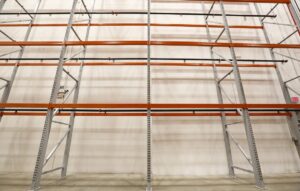 Single Pallet Selective |
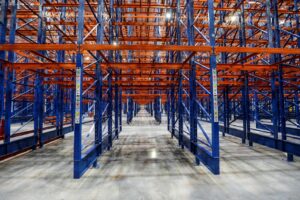 Double Deep Rack |
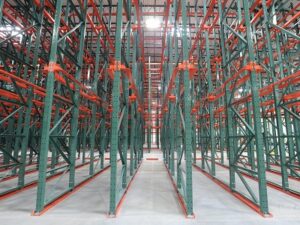 Drive-In Rack |
Static and dynamic systems also affect capacity load ratings differently because of the pallet movement. Push-back and pallet flow systems must be identified as dynamic to calculate load capacity accurately.
 Deep Lane Pallet Flow Rack |
 3 Deep Push Back Rack |
Manufacturers provide designed weight limits for individual rack components (beams & uprights) based on the steel used and manufacturing process. Beam capacity is determined based on a pair of beams.
Design details dictate the dimensions of the uprights, beams, and footplates, among other details. Seismic zoning is also a critical factor in pallet racking load capacity.
The elevation of a pallet rack system is crucial in determining load capacity because it affects the structural stability and weight distribution. Different elevations alter how forces are distributed across the rack, impacting its ability to bear loads safely.
Pre-2021 Pallet Racking & Updated ANSI Load Calculations
The updated American National Standard for storage rack, ANSI MH16-1-2021, released by the Rack Manufacturers Institute (RMI), introduces fresh criteria for determining load capacity in pallet rack applications. In contrast to the 2012 edition, which solely relied on column unbraced length for capacity calculations, the 2021 revision incorporates various supplementary factors influencing rack structure stiffness into its capacity calculation guidance.
The revised standards will likely derate certain pallet racking systems designed before the updates took effect. Apex can use historical calculations or drawings from the original equipment manufacturer (OEM) to provide updated capacity signage based on the archived records.
Next Steps –Load Plaques
After gathering all the critical details, the next step is to provide the information to a 3rd party licensed PE to run the calculations and provide stamped drawings. With that information, customized load plaques can be ordered and placed on the racking to satisfy compliance requirements.
Pricing will vary depending on the system(s) type and elevation configurations. The Apex PROs will be happy to provide an estimate for services prior to commencing load rating analysis.
Let us take care of your pallet racking safety concerns. From complete inspections, repairs, and capacity ratings…We Got This! We make it easy to be compliant, protect your team, and optimize productivity. Call today to schedule an on-site pallet racking inspection.
DIY Rack Inspections with the Apex Rack Repair App

For routine rack inspections and quick DIY damage assessments, download the Free Apex Rack Repair App. Our rack inspection team uses the same device to capture critical component data to assess safety risks. The app offers a user-friendly interface for identifying, documenting, and managing rack damage. Your findings are uploaded to our PROs to classify damage risk and provide an independent repair solution if needed.
In addition to the app, check out our inspection training videos that provide an overview of different racking system designs and components, plus general warehouse safety guidelines and damage prevention.
|
Download the Apex Rack Repair App Today FREE on the App Store.
|
