
Ensuring Warehouse Safety: A Guide to Inspecting Pallet Rack for Deflection Dangers

How to Inspect Pallet Rack for Deflection Risk to Stay Safe in Your Carolina Warehouse
Ensuring the safety and efficiency of your pallet rack system is crucial for warehouse operations in North and South Carolina’s industrial sector. Your pallet racks are designed to handle specific load capacities, with each component working in tandem to ensure safe inventory storage. Regular inspections are vital to detect potential issues, including subtle but hazardous deflections in uprights, beams, and struts.
Deflection, which refers to the bending or displacement of structural components like uprights, beams, and struts under load, requires careful monitoring. A certain amount of deflection is permissible, but distinguishing between safe and unsafe levels is critical. Following is a step-by-step guide to assessing deflection in uprights, beams, and struts based on RMI guidelines. Download our checklist for a more comprehensive guideline to a pallet rack inspection.
Upright Deflection Detection
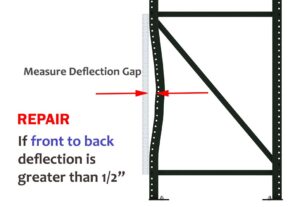
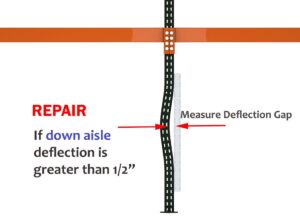
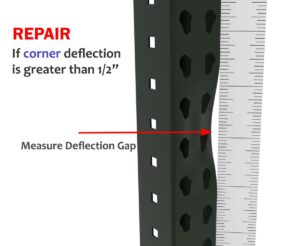
When assessing damage to uprights, inspect them thoroughly from front to back, along the aisles, and at the column corners. Look for any bending or deflection in the columns exceeding ½ inch at its widest point. Uprights showing deflection should be repaired –unload the area until a suitable repair kit is applied. Note any gaps between seismic backers and columns as signs of damage.
Corner Deflection Detection

Strut Inspection
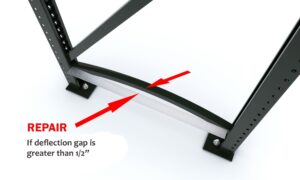
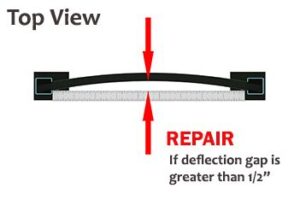
Inspect struts for bowing beyond ½ inch, often observed in the lower sections of uprights, to maintain structural stability.
Examining Beams for Deflection
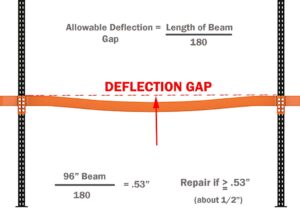
Pallet rack beams should ideally remain flat horizontally; any bending indicates a need for assessment and action. To determine beam deflection, divide the beam length (measured from inside the columns) by 180. For instance, a 96-inch beam divided by 180 equals approximately 0.53 inches or about ½ inch. If the deflection exceeds or equals ½ inch, the beam is considered overloaded and poses a hazard.
Load Plaques & Pallet Rack Safety

The importance of load plaques in maintaining safe pallet rack capacities cannot be overstated. These plaques, unique to each system, detail maximum permissible unit loads and uniformly distributed loads per level, ensuring compliance with safety standards and preventing overloading-induced deflection. Load plaques must be affixed at the end of each aisle for every system. Strict adherence to these load capacities plays a crucial role in minimizing deflection.
The load plaque provides detailed information such as:
- Maximum permissible unit load (combined weight of product and container/pallet) and/or maximum uniformly distributed load (UDL) per level.
- Average unit load (calculated as the highest anticipated total weight of products on all beam levels in any row, divided by the number of beam levels), where applicable.
- Maximum total load per bay.
- Storage levels capable of supporting stacked unit loads.
Don’t Let Beam Deflection Be a Heavy Burden
The Apex team understands the value of regular pallet rack inspections on the safety of your team and operations. To help facilitate easy, accurate inspections, download the Apex Rack Repair App. We created this Free app to guide users through comprehensive rack inspections, utilizing point-and-click features and 3D graphics for accurate assessment.
If you’d rather have a professional inspect your rack systems… contact our Apex PROs! The Apex PROs are trained, certified pallet rack and safety experts who come to you and assess your storage racking for any damage or risks.
By prioritizing pallet rack safety, your Carolina business will enhance warehouse safety, comply with industry recommendations, and optimize operational efficiency.
