
Need More Capacity? Push-Back on the Idea of Expansion

Push-Back Pallet Rack: Add Capacity Without Expanding Your Warehouse
When pallet positions are running out, but there is no practical floor space left to expand, the right storage system can help recover capacity from underused warehouse cube. Push-back pallet rack is a high-density pallet storage solution that can help increase pallet storage capacity within a consolidated footprint. For operations with moderate- to high-volume SKUs and Last-In, First-Out (LIFO) inventory flow, push-back racking can increase storage density within the existing footprint and help delay or avoid warehouse expansion.
Key Takeaways
- Push-back pallet rack stores pallets 2 to 7 deep in single-SKU lanes loaded from one aisle, adding storage density without expanding the building.
- It can increase pallet storage capacity by roughly 20% to 40% versus standard selective racking by cutting the number of aisles needed.
- Pitched rails and nested carts let rear pallets flow forward to the aisle automatically, supporting Last-In, First-Out (LIFO) rotation.
- Best fit: moderate- to high-volume SKUs with consistent pallets and LIFO flow that need density over 100% pallet access (often cheaper than expansion).
Can Push-Back Pallet Rack Add Capacity Without Expanding?
Yes. Push-back pallet rack can add capacity by turning underused floor space and aisle space into deeper, higher-density pallet storage. Instead of storing one pallet deep in each rack position, push-back systems are designed as individual SKU lanes that commonly store pallets 2 to 7 deep. Each lane is loaded and unloaded from the aisle face, so forklifts do not need to enter the rack structure.
That helps consolidate storage, reduce travel, and make better use of the existing footprint before considering warehouse expansion.
High-Density Pallet Racking Advantages of Push-Back Rack
Push-back rack is designed to combine dense pallet storage with easier access than a drive-in rack and better SKU organization than bulk floor storage.
Key advantages include:
- High-density pallet racking in a consolidated footprint
- More pallet positions without expanding the building
- Organized SKU lanes
- Deep lane design, typically 2 to 7 pallets deep
- Dynamic cart-and-rail design that lets pallets flow automatically to the aisle
- Single-aisle access for loading and unloading
- Reduced forklift travel compared to spread-out storage layouts
How Does Push Back Racking Increase Pallet Storage Capacity?
What makes the push-back rack distinct is that it relies on pitched rails fitted with nested wheeled carts. The rails installed in each lane angle down from the rear of the system to the aisle, where the wheeled carts await loading.
The forklift loads the first pallet onto the top cart. To load the next pallet, the forklift operator pushes back the first pallet to reveal the cart underneath for the second pallet. The process continues until the lane is full.
To extract pallets, the forklift removes the front pallet, and the rear pallets automatically flow forward to resupply the pick aisle. The driver controls the speed of the rear pallets by backing out slowly from the lane. With just one aisle for load and extract activity, you save valuable warehouse space and support LIFO inventory rotation.
When Push-Back Rack Beats Adding Warehouse Space
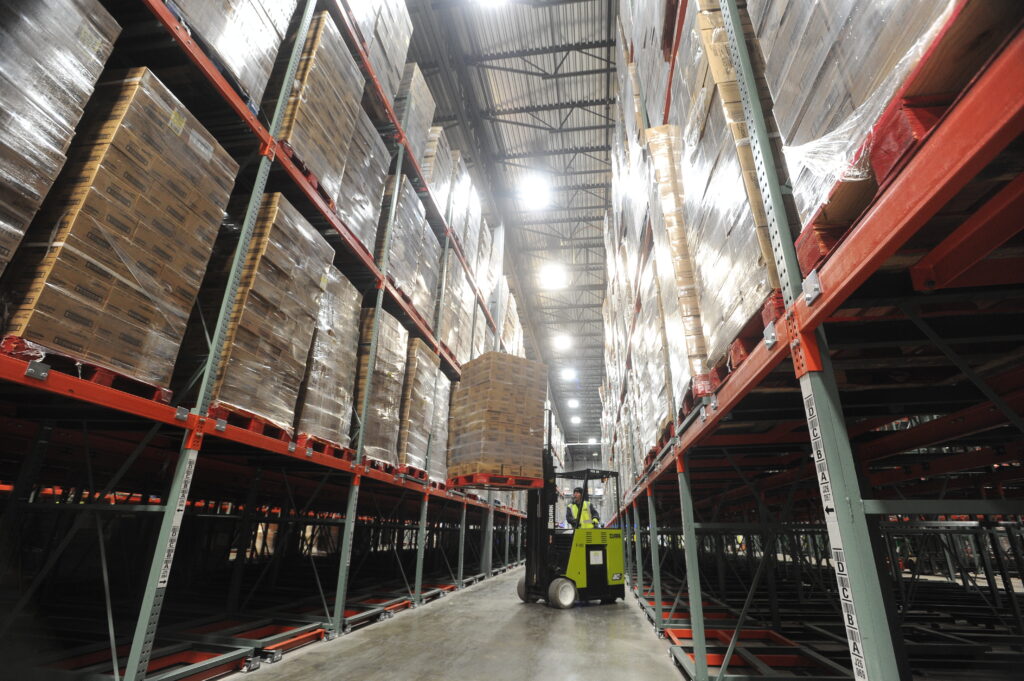
Push-Back Pallet Rack
Before you price out a building expansion, offsite storage, or a move to a larger facility, it is worth asking whether your current warehouse layout is carrying its weight.
Push-back rack is especially worth considering when:
- You have moderate volume for a low number of SKUs
- LIFO rotation works for your inventory
- You need storage density more than 100% individual pallet access
- Your pallets are consistent in size and weight
- Pallets are in good condition and can support the load without sagging
- Your current layout relies heavily on selective rack and wide aisles
- You have available building depth or height that is not being fully used
When those conditions line up, reconfiguring storage can be faster, less disruptive, and more cost-effective than adding square footage.
Push-Back Pallet Rack & Forklift Operator Training
As you may have noticed from the video above, careful forklift operation is key to push-back rack safety and productivity.
We recommend that your warehouse team be fully trained in proper loading and unloading, including how to control pallet movement and respond to push-back rack hang-ups. To make training easier, the Apex team created brief training resources for operators:
Push-back pallet rack is relatively easy to maintain, but it does need regular review, just like any racking product. The carts must remain free from debris such as shrink wrap, splintered pallet wood, and loose boards. Quick, consistent checks of palletized materials are one of the best ways to avoid hang-ups.
We also recommend using quality GMA-style pallets for smoother cart travel.
Push-Back Rack Capacity Planning FAQ
How many pallet positions can the push-back rack add?
In many applications, push-back rack can increase pallet storage capacity by 20% to 40% compared to a standard selective system by reducing the number of aisles required and storing pallets 2-7 deep within each lane.
The actual increase depends largely on lane depth, rack layout, available building height, and the SKU volume profile. Operations with moderate- to high-volume SKU counts often see stronger storage gains because deeper lanes can be used more efficiently without creating unnecessary honeycombing.
What drives the cost of push-back racking?
The cost of push-back racking is influenced by both the storage system and the facility itself. Key factors include the number of pallet positions, lane depth, pallet dimensions and load weights, rack height, and the overall storage layout. Engineering requirements, seismic considerations, permitting, installation conditions, and retrofit versus new-construction applications can also impact project cost.
When is a push-back rack better than warehouse storage expansion?
Push-back rack is often worth evaluating before expanding a warehouse when pallet positions are becoming limited, but the facility still has usable cube. For operations with moderate- to high-volume SKUs and inventory that can accommodate LIFO rotation, increasing storage density within the existing building may be more cost-effective and less disruptive than construction, relocation, or offsite storage.
Ready to Add Pallet Positions?
Apex Companies has designed and installed more push-back rack systems than we can count… well, maybe we can count them, but it would take a long time, and we would rather work on your project.
Give us a call, and let’s see if push-back pallet rack is the right way to increase capacity before you expand.
