
Accelerate Success: Tips to Tackle Distribution Center Challenges with Automated Conveyors

EASE DISTRIBUTION WOES WITH AUTOMATED CONVEYORS
In fast-paced distribution centers, efficient inventory movement is crucial amidst challenges like mispicks, inventory tracking issues, and bottlenecks. Automated conveyors address these challenges with advanced technologies such as automated sorting, loading/unloading, and WMS integration. These systems streamline sorting, picking, and inventory management, reducing errors and enhancing safety. Explore how these automated solutions can transform your distribution center operations.
Common Distribution Center Challenges:
- Worker ergonomics and physical strain
- Inventory mishandling and damage
- Mispicks and order fulfillment errors
- Inventory tracking
- Bottlenecks and cumbersome flow of goods
The goal of automation is to reduce manual intervention. Automated conveyors are explicitly geared towards moving products, ensuring that these logistical problems remain in the past.
Reduce Physical Strain & Improve Worker Ergonomics

In-Rack Conveyor System
Conveyors can effectively address the challenge of worker ergonomics and physical strain in distribution centers through several key mechanisms:
- Reduced Manual Handling: Automated conveyors minimize the need for manual lifting, carrying, and repetitive movements that can lead to ergonomic strain. By handling the movement of goods, automated conveyors alleviate physical stress on workers, reducing the risk of musculoskeletal injuries.
- Ergonomic Design Features: Modern conveyor systems are designed with ergonomic considerations in mind. These features ensure that tasks are performed in a more natural and less physically taxing manner:
- Adjustable heights
- Easy access points for maintenance
- Ergonomic loading/unloading stations
- Improved Workflow: Conveyors streamline workflow by automatically moving items along designated paths. This eliminates the need for workers to traverse long distances or carry heavy loads manually, thereby minimizing fatigue and physical strain over extended shifts.
- Enhanced Safety Protocols: Automated conveyors are equipped with safety sensors and controls to prevent accidents and injuries. By maintaining consistent movement and clear pathways for goods, conveyors create a safer working environment where workers can focus on monitoring operations rather than performing strenuous physical tasks.
- Productivity Gains: By reducing physical strain and improving ergonomics, conveyors contribute to higher productivity levels among workers. Employees can maintain efficiency throughout their shifts without the cumulative fatigue that often accompanies manual labor, leading to improved overall performance in distribution center operations.
Mitigating Mishandling and Damage
Inventory mishandling and damage are significant concerns in distribution centers, often resulting from human error during manual handling processes. Automated conveyors mitigate these risks by providing consistent and controlled movement of inventory items throughout the facility. Here’s how:
- Gentle Handling: Automated conveyors use smooth, controlled movements that minimize jostling and impacts on inventory items. This gentle handling reduces the risk of damage to fragile or sensitive goods, such as electronics or perishable items.
- Precision Loading and Unloading: Automated loading and unloading processes ensure that products are handled precisely according to their requirements. This reduces the likelihood of items being dropped, mishandled, or improperly stacked during manual operations.
- Integration with Robotics: Many automated conveyor systems integrate seamlessly with robotic arms or pick-and-place technologies. This integration allows for precise and careful handling of items, further minimizing the risk of mishandling or damage.
- Real-time Monitoring and Alerts: Advanced automation systems often include real-time monitoring capabilities. Sensors and cameras along the conveyor lines can detect anomalies such as jams, misalignments, or potential impacts. Alerts can then prompt immediate corrective actions, preventing inventory damage before it occurs.
- Quality Control Checks: Automated systems can incorporate quality control checks during the handling process. Options may include barcode scanning, weight verification, or visual inspections to ensure that products meet quality standards before moving to the next stage of distribution.
Precision Picking – Minimizing Mispicks in Order Fulfillment
Mispicks and order fulfillment errors can lead to customer dissatisfaction, increased operational costs, and delays in delivery. Automated conveyors play a crucial role in minimizing these issues through several key mechanisms:
- Automated Sorting: Automated conveyors use advanced sorting technologies such as barcode scanning, RFID (Radio Frequency Identification) systems, or vision systems to identify and sort items accurately. Sorting technology reduces the likelihood of picking errors by ensuring that each item routes correctly to its designated location.
- Pick-to-Light Systems: Integrated pick-to-light systems on conveyors provide visual cues to warehouse operators, guiding them to the exact location of items needed for order fulfillment. This technology minimizes picking errors by improving accuracy and efficiency during the picking process.
- Error Detection and Correction: Automated systems can detect potential errors in real time, such as picking the wrong item or incorrect quantities. Alerts can immediately notify operators or trigger corrective actions, such as diverting items for re-checking or adjusting inventory counts in the WMS.
- Batch Picking and Consolidation: Automated conveyor systems can support batch-picking strategies, allowing multiple orders to be picked simultaneously and consolidated later in the workflow. This approach significantly reduces the steps workers take and minimizes walking distance, enhancing overall efficiency.
- Integration with WMS: Seamless integration with Warehouse Management Systems (WMS) ensures accurate order processing from start to finish. WMS integration provides real-time inventory visibility, order status updates, and optimized picking routes, further reducing the likelihood of order fulfillment errors.
Enhancing Tracking Capabilities with Automated Conveyors
Automated conveyors contribute significantly to enhancing inventory tracking in distribution centers through various capabilities:
- Real-Time Data Capture: Automated conveyors often integrate with barcode scanning, RFID, or other automated identification technologies. These systems capture real-time data as items move along the conveyor, providing accurate information about inventory location and status.
- Inventory Visibility: By continuously updating inventory data in the Warehouse Management System (WMS) or Enterprise Resource Planning (ERP) system, automated conveyors ensure real-time visibility of stock levels. This visibility helps warehouse managers make informed decisions about replenishment, order fulfillment priorities, and inventory accuracy.
- Traceability and Serialization: Automated systems can track individual items or batches through unique identifiers like serial numbers or RFID tags. This traceability ensures that each item’s movement through the supply chain is documented, facilitating easier recalls, quality control, and compliance with regulatory requirements.
- Efficient Replenishment: Automated conveyors streamline the replenishment process by automatically routing products to designated storage locations or picking areas based on inventory levels. This reduces manual handling errors and ensures that stock levels are maintained optimally.
Streamlining the Flow of Goods with Automated Conveyors
In distribution centers (DCs), bottlenecks and inefficient flow of goods can lead to delays, decreased productivity, and increased operational costs. Automated conveyors offer several solutions to address these challenges:
- Continuous Flow Management: Automated conveyors can maintain a steady flow of goods throughout the distribution process. By optimizing speed and routing, they prevent congestion at critical points such as loading docks, picking stations, and shipping areas.
- Dynamic Routing and Flexibility: Modern automated conveyor systems can use advanced routing capabilities. They can dynamically adjust paths and divert goods based on real-time conditions and priorities. This flexibility helps in bypassing congested areas or temporarily storing items until downstream processes are ready, thus minimizing bottlenecks.
- Reduced Handling Time: Automated conveyors streamline material handling tasks by automating the movement of goods between different stages of the distribution process. By reducing the time spent on manual handling, loading/unloading, and repositioning of goods, you can optimize overall throughput and reduce bottlenecks caused by human limitations.
- Integration with Sortation Systems: Automated sortation systems integrated with conveyors further enhance efficiency by sorting items based on predefined criteria (such as destination, SKU, or order priority). With this system, goods are routed to the correct locations or packing stations without manual intervention, reducing sorting errors and improving flow continuity.
How Do They Do It?
Different powered conveyors can be integrated with automation to handle a range of distribution center tasks – from basic transport across long distances to complex integration with automated storage and retrieval systems (ASRS). These solutions create an autonomous inventory-in/inventory-out process.
Here is a breakdown of several common conveyor types:
Accumulation Conveyors
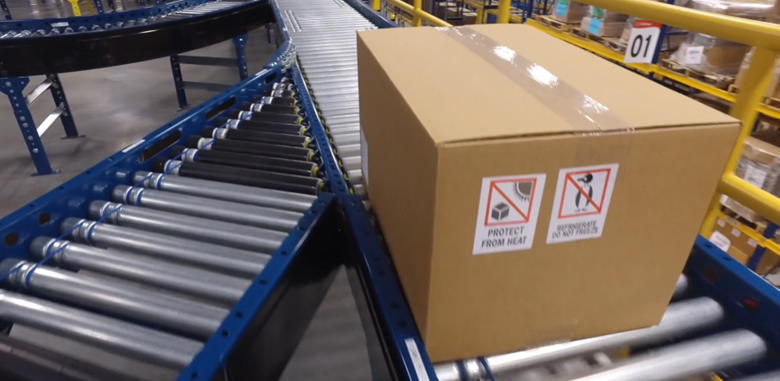
Accumulation conveyors integrate with automation to optimize material handling. They use sensors and PLCs for automated control, coordinating with sortation systems to route items based on real-time needs. By managing product flow, your conveyor helps reduce bottlenecks and adapts to varying throughput demands. Integrated with WMS or ERP systems, they provide real-time data for enhanced operational visibility and decision-making, making them crucial for modern distribution centers.
Transportation Conveyors
Transportation conveyors, when paired with automation, optimize material movement in distribution centers. They integrate sensors and PLCs (programmable logic controllers) for automated control, facilitating seamless transport of items across various points. These conveyors work in tandem with sorting and loading/unloading systems to streamline operations, adapt to changing demands, and minimize manual handling. Integrated with WMS or ERP systems, they provide real-time data insights for efficient inventory management and operational agility, essential for enhancing productivity and reducing logistics costs in modern warehouse environments.
 |
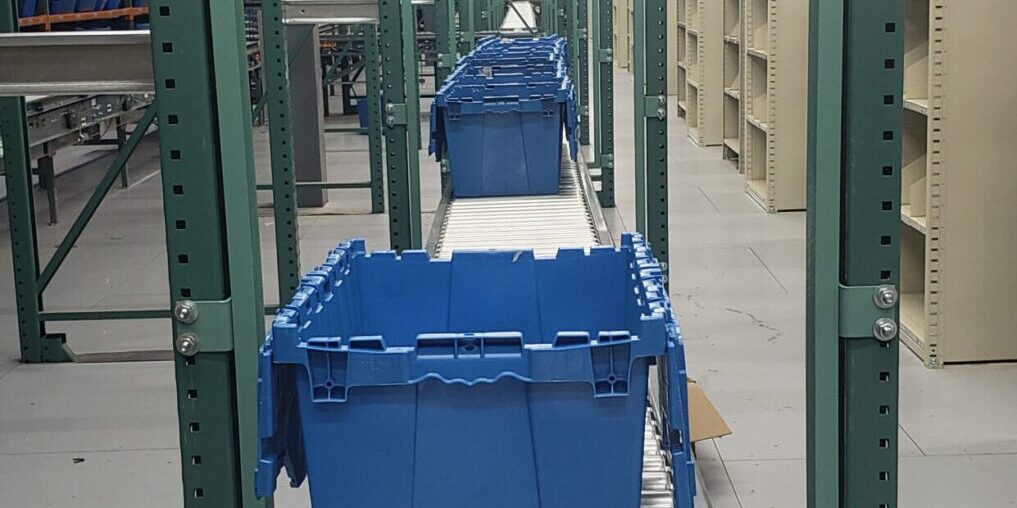 |
| Accumulation Conveyor | Transportation Conveyor |
Sortation Conveyors
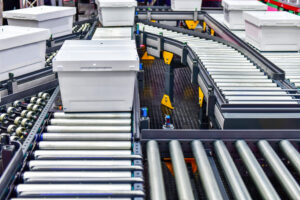
Automated sortation systems use various technologies such as barcode scanners, RFID readers, diverters, and computerized controls to sort items based on predefined criteria accurately. These conveyors are capable of handling high-speed sorting tasks across a wide range of products, making them essential in modern distribution and fulfillment centers.
Automated sortation conveyors enhance efficiency by reducing manual handling, minimizing errors, and optimizing the flow of goods through the facility. They are often integrated with warehouse management systems (WMS) or other automation platforms to maximize operational throughput and accuracy.
These conveyor examples illustrate a diverse selection of configurations available to you. Our Apex automation experts rely on comprehensive data analysis to define the most effective solutions tailored to your specific distribution challenges. With their help, your distribution center will be ideally equipped to overcome obstacles and enhance efficiency. Let us assist you in optimizing your operations by matching your storage and distribution needs with the perfect conveyor solution.
