
Strengthen Your Pallet Rack from the Ground Up: Four Essential Steps

Pallet Rack Baseplate Safety Made Simple with the Apex Rack Repair App
Think about what happens when you stub your toe or twist an ankle—you instinctively limp or shift your weight, temporarily losing balance. Your pallet rack faces a similar challenge when its “feet” endure repeated impacts. Ignoring these base-level issues can lead to much larger problems than just a minor inconvenience.
Adding safety accessories to your pallet rack can reduce the risk of damage, but your system may still experience impacts from forklifts or other warehouse equipment. Over time, components like anchor bolts can also loosen due to floor vibrations. Conducting regular inspections of your racking system is the most effective way to prevent costly repairs, minimize downtime, and avoid workplace injuries. The best place to begin? Start with the most vulnerable part of your rack system: the baseplate.
4 Steps to Baseplate Safety
- Anchoring Guidelines: Make sure each baseplate is secured with at least one anchor bolt. Many baseplates include additional holes that, while often unused, provide flexibility for re-anchoring if the plate becomes damaged, bent, or impacted by rebar during installation.
- Shimming Columns: To keep your rack system level, insert shim plates under the baseplate as needed. The shims must match the baseplate size, and you should adhere to RMI guidelines for proper stacking. Shims help maintain stability and evenly distribute weight, compensating for flooring slopes in both cross-aisle and down-aisle directions.
RMI Guidelines for Safe Shim Stacking:
- Shim packs smaller than twice the anchor diameter do not need to be “locked” with welding or a second anchor.
- For shim packs measuring between 2 and less than 6 times the anchor diameter, the shims must be “locked” together, either by welding or by adding a second anchor.
- Shim packs exceeding 6 times the anchor diameter are prohibited.
- Baseplate Damage: Inspect for signs of damage, such as bent “ears,” tears, or twists exceeding ½ inch. Make sure to examine both the front and rear baseplates for any issues.
- Anchor Damage: Carefully check for missing, loose, or sheared anchors on both the front and rear baseplates. Properly securing these anchors is essential for maintaining rack stability.
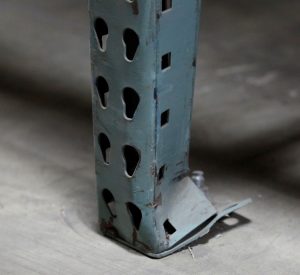 Baseplate Damage |
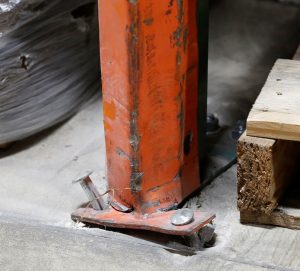 Column Guard Damage |
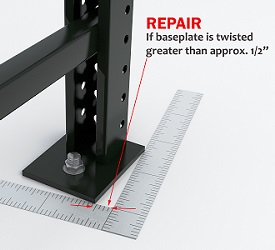 Baseplate Measurement |
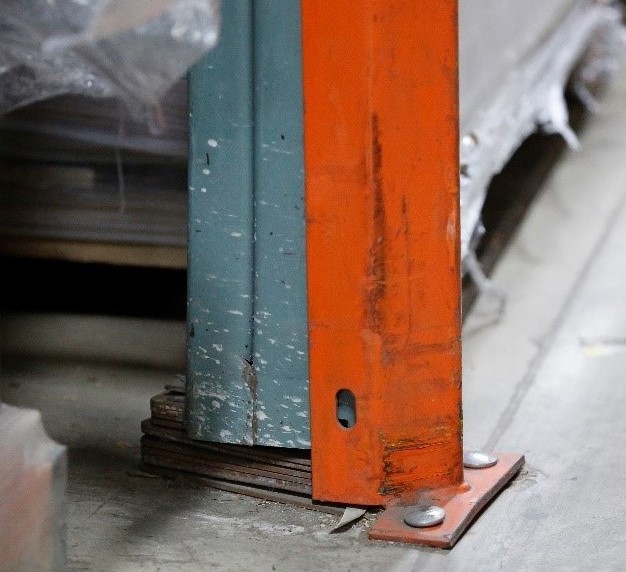 Stacked Shims |

Pallet Rack Inspections from the Apex PROs – Rack Repair Made Simple
At Apex, warehouse safety is our top priority. That’s why we offer a dedicated program for rack inspection, repair, and safety. With Rack Repair & Safety Program, you have two convenient options: use the Rack Repair App for a DIY inspection or rely on the expertise of our certified Apex PROs.
The Rack Repair App guides you through a thorough inspection process, allowing you to document structural or safety concerns with detailed notes and images. Once complete, simply upload your findings to our PROs for evaluation and next steps.
Prefer to leave it to the experts? The Apex PROs can conduct on-site inspections using the app to ensure nothing is overlooked. Whether you choose the DIY option or professional assistance, you’ll receive a comprehensive report with unbiased repair recommendations.
A strong, secure rack is essential for maintaining warehouse efficiency. Download the Apex Rack Repair App today or contact us to learn more about how we can help!
