
How Do Push Forces Affect Push-Back Rack Loading & Unloading?

What You Should Know About Push Forces & Push-Back Rack Safety
A push-back rack is a dynamic, high-density storage system that uses nested wheeled carts and slightly inclined rails to store multiple pallets deep in individual storage lanes. During loading, a forklift pushes the pallets already in the lane backward and upward along the rails. During unloading, gravity advances the remaining pallets toward the aisle.
The required push force depends primarily on pallet weight, the number of stored pallets being moved, rail slope, and system design. Debris, damage, or misalignment can create additional resistance, making a lane harder to load. Understanding these factors helps warehouse operators select suitable equipment and operate the system safely.
Key Takeaway
Push force generally increases as the forklift moves more loaded pallets deeper into a push-back lane. Heavier pallet loads and more occupied positions require greater force during loading, while gravity advances the remaining pallets during unloading.
How Push-Back Rack Loading and Unloading Work
Push-back rack uses individual SKU lanes with wheeled carts nested at the aisle face on inclined rails. Systems are commonly designed for two to six pallets deep, although deeper configurations are available for some applications. Each lane typically operates on a last-in, first-out (LIFO) basis.
|
|
Loading a Push-Back LaneThe operator places the first pallet on the cart positioned at the aisle face. To load the next pallet, the forklift pushes the stored pallet and cart farther into the lane, exposing the next cart. As additional pallets are loaded, the forklift moves more stored pallet weight, increasing the required push force. |
Unloading a Push-Back LaneDuring unloading, the forklift removes the front pallet and slowly backs away from the rack. Gravity then advances the remaining pallets toward the aisle along the inclined rails. The forklift operator controls their movement by backing away from the rack gradually. |
|
For detailed operating guidance, see Apex’s push-back pallet rack forklift training.
What Is Push-Back Rack Push Force?

Push force is the amount of horizontal force a forklift must apply to move the pallets and nested carts deeper into a push-back rack lane during loading. The required push force varies with pallet weight, lane depth, rail slope, and the condition of the carts and rails.
During unloading, the system relies on gravity to advance the remaining pallets; the forklift operator controls their speed by slowing and backing away from the rack.
The required force depends on several factors:
- The weight of each pallet
- The number of pallets already in the lane
- The slope of the rails
- The rolling resistance of the carts and wheels
- The condition and alignment of the system
Push-force percentages and calculation methods vary by rack manufacturer and system design. The correct force is calculated using the specifications for the installed push-back system rather than a universal percentage.
How Push-Back Lane Depth Changes Push Force
Push-back lane depth directly affects push force because each additional occupied position adds another loaded pallet that the forklift must move farther into the lane. As the lane fills, the combined weight being moved increases even when every pallet has the same load weight.
Push-Force Example

Push-back rack rail slope varies by manufacturer and system design. Common designs may use slopes such as 1/4 inch, 5/16 inch, or 1/2 inch per foot.
For example, the accompanying chart uses a 5/16-inch-per-foot slope and estimates the push force at approximately 4% of the combined pallet weight being moved. Under those assumptions, loading a two-deep lane with 2,000-pound pallets creates an estimated push force of approximately 85 pounds.
The estimated push force for 2,000-pound pallets increases to:
- 85 pounds in a two-deep lane
- 169 pounds in a three-deep lane
- 254 pounds in a four-deep lane
- 339 pounds in a five-deep lane
- 423 pounds in a six-deep lane
These values are examples, not universal design criteria. Actual push force depends on the manufacturer’s rail slope, cart and wheel design, pallet weight, lane depth, component condition, and other system-specific factors.
Confirm the anticipated push force with the rack manufacturer or system designer and verify that the lift equipment is suitable for the application.
How Many Pallets Deep Can a Push-Back Rack Lane Be?
Push-back systems are most often configured three or four pallets deep, but deeper lanes—up to seven pallets—can be engineered for applications with sufficient pallet volume per SKU.
The appropriate lane depth depends on:
- The number of SKUs and pallets stored per SKU
- Pallet weight
- Available warehouse space
- Forklift capabilities
- Inventory flow requirements
What Should Operators Confirm Before Loading?
Before loading a push-back rack lane, operators should confirm the following:
- Pallet weight: Each pallet must fit within the rack’s rated load capacity. The combined weight of the stored pallets being moved must also be included in the system-specific push-force calculation.
- Forklift capability: The forklift must safely support the pallet load and provide the required push force, especially in deeper or heavier lanes.
- Pallet condition: Compromised pallets with broken or sagging boards, protruding nails, loose wrap, or unstable loads should not be placed in the system.
- Pallet alignment: Enter the lane squarely and keep pallets centered to prevent binding or uneven movement.
- Cart, wheel, and rail condition: Check for debris, damage, or misalignment that could increase resistance.
- Inspection needs: Recurring resistance, uneven movement, or visible damage may require a professional pallet rack inspection.
Frequently Asked Questions About Push-Back Rack Push Force
Does push-back lane depth affect push force?
Yes. A deeper push-back lane requires the forklift to move more loaded pallets at the same time, increasing the total push force. Pallet weight, rail slope, and cart resistance also affect the final force requirement.
What determines the push-back rack push force?
Push-back rack push force is determined primarily by the combined weight of the pallets being moved, the rail incline, and the rolling resistance of the carts and wheels. The calculation should be based on the specifications of the installed system.
How many pallets deep can a push-back rack store?
Push-back racks are most often configured three or four pallets deep, although systems are available from two to seven pallets deep, depending on the application.
Is a push force required during unloading?
The forklift does not normally push the stored pallets during unloading. Gravity moves the remaining pallets toward the aisle while the forklift operator slowly backs away and controls their forward movement.
Why is a push-back lane difficult to load?
A lane may be difficult to load because of excessive pallet weight, greater lane depth, damaged wheels, debris, misalignment, or an unsuitable pallet. Operators should stop and inspect the lane rather than applying additional force without identifying the cause.
Can any forklift load a push-back rack?
A forklift must have sufficient load capacity, stability, and pushing capability for the specific pallet weight and lane depth. The forklift and rack suppliers should verify suitability before the system is placed into operation.
Confirm Push Force Before Operating the System
A push-back rack can provide efficient, high-density pallet storage, but the system must be designed around the actual loads and handling equipment used in the facility.
As pallet weight and lane depth increase, the forklift must overcome a greater push force during loading. Confirming these forces during system design—and keeping carts, wheels, rails, and pallets in good condition—supports smoother and safer operation.
Apex can help you design a push-back racking solution that fits your products, equipment, and operation.
Forklift Operator Training for Push-Back Rack & More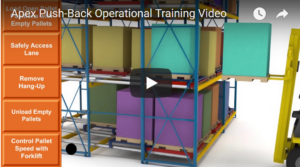
Ensure your forklift operators are equipped with more than safe equipment… train them to understand your unique pallet rack storage systems. Apex Resources includes system-specific videos for push-back, pallet flow, and drive-in systems.
You can also call Apex for on-site group training and OSHA-compliant certification for your team. When it comes to full-service warehouse services, you only need to make one call –We Got This!
