
A Close Look at Narrow Aisle Warehouse Design

A Deep-Dive on VNA, Narrow Aisle & Double-Deep Warehouse Design
What difference can a couple of feet make? Well, a lot when it comes to warehouse space configuration. Narrow aisle and very narrow aisle configurations are separated by just a few feet, but the gap between them in terms of application, cost, and efficiency can be rather wide. Take a look as we break down the pluses and considerations of these warehouse design options to help you make the right choice for your operation.
Evaluating the Pluses & Minuses
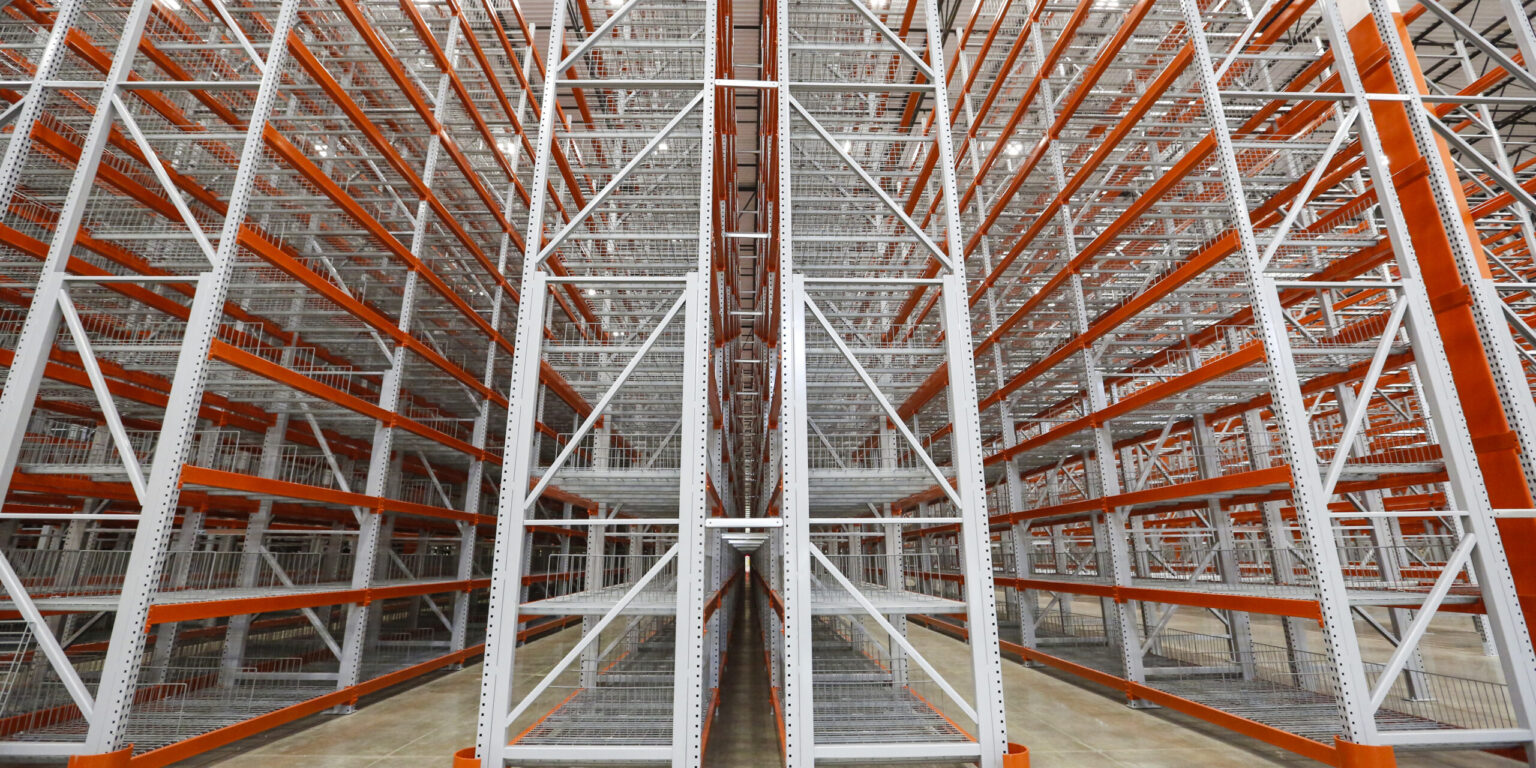
The benefits of narrow aisle and VNA storage systems look like a slam-dunk to gain/regain valuable warehouse space and increase your storage capacity…
Narrow Aisle vs. Standard Width
- Free up 20-25% space with narrow and 40-50% with VNA vs. wide
- Increase storage capacity, and reduce reliance on off-site/external storage
- Increase pick rates
- Maximize productivity & throughput
- Decrease cost per square foot
Seeing these benefits may have you thinking, “Let’s slide those racks closer and get more space!” But narrow aisle design isn’t economical for every application. There are significant cost considerations to examine before you jump ahead.
For our comparison, we will assume the same pallet racking application for all three systems; in this case, the rack provides 100% SKU selectivity and first-in/first-out (FIFO) or first-in/last-out (FILO) inventory rotation.
| Design Parameters | Capacity | Comparison |
| Wide aisles > 10 | Baseline | Standard equipment |
| Narrow aisles = 9’ | +20-25% | Standard equipment, gain free space, may require safety features |
| VNA < 9’ | +40-50% | Specialized + standard equipment, even more free space, may slow processing |
Narrow Aisle / VNA Applications Overview
Standard aisles are most efficient where you need room for multiple workers and or forklifts to access inventory. However, if you need to free up space, a narrow aisle warehouse design is likely less expensive than moving or acquiring additional space.
A narrow aisle design allows you to increase capacity without sacrificing warehouse space… and the rack is accessed by standard forklift equipment. One note, however, is that you may have to add safety equipment such as gates, guards, or rails to ensure pedestrian safety within the work area.
The more confined, very narrow aisle (VNA) systems are accessed exclusively by specialty lift equipment working off a guidance system. These vehicles move swiftly up and down the aisle and allow for case pick access to very tall racking levels. However, the VNA lift trucks remain in the aisle, requiring additional forklifts or pallet movers to stage and transport picked pallets to shipping. An additional design consideration is the required staging area at the end of the aisle.
Both narrow aisle and VNA designs are well suited for high SKU, slow-moving inventory, and high-volume case or goods picking from pallets. The narrow and VNA aisle design maximizes picking efficiency; however, you must assess the cost/benefit of adding specialized equipment, safety features, and an extra processing step or two to your evaluation.

Order Picker
Industries that Commonly Benefit from Narrow Aisle & VNA Warehouse Design
- Pharmaceutical
- Home appliances
- Auto parts
- Manufacturing
- Food Distribution
Lift Equipment Requirements for Narrow Aisle & VNA Design

Man-Up Turret Truck
Narrow Aisle – accessed via standard forklifts and narrow aisle reach trucks, depending on the aisle width.
VNA – requires specialized lift equipment. Options include man-up turret trucks (short racking <22’), man-down turret trucks (up to 40’ tall), and guided high-level order pickers.
VNA trucks operate in a straight or diagonal line via a rail or wire guidance system, which maneuvers the vehicle in and out of the aisle, thus eliminating the risk of forklift rack strikes. However, the VNA turret trucks are marginally slower. Some benefits over standard lift vehicles include extended lift heights, picking at all levels, and lifting to the pick level during travel which can speed up activity.
VNA Truck Considerations
- A guidance system is required for VNA vehicles; however, the guidance reduces rack damage caused by standard lift trucks
- VNA trucks can cost nearly double that of standard reach trucks
- VNA design is not scalable – only one truck operates per aisle
- Aisle accessibility is limited to one VNA at a time
- VNA trucks are limited to use within the guidance system
- VNA operators require additional Safety Training and Certification
- VNA vehicles can require additional maintenance vs. standard forklifts
While narrow aisle and VNA configurations have many pluses, it’s important to evaluate the cost/benefit vs. your current and expected inventory needs.
Alternative Designs – Consider Double-Deep or 2-Deep Push-Back

2-Deep Push Back
Alternatives to a narrow aisle configuration that still deliver twice the pallet density in half the space are double-deep and 2-deep push-back rack. However, before you make the switch to a deep-reach rack solution, consider whether your SKU volume supports two pallets deep per lane vs. 100% SKU selectability of a single-deep row.
Considerations for a double-deep system include:
- A deep-reach forklift capable of loading or extracting two pallets deep
- Ample space below the first beam level for the forklift outriggers to slide under when addressing the rack system
- Wide (2-pallet deep) turn radius — a slope-leg front column or I-beam configuration are good options for minimizing forklift strikes while keeping the aisle width as narrow as reasonably possible.
Push-back rack systems are another option. The rack bay is equipped with steel rails and enveloping wheeled carts. The carts sit at the bay opening until a pallet is placed on the top one –it is pushed back to load the second pallet on the cart underneath, and the final pallet sits directly on the rails. A two-deep system would have one cart per lane.
When extracting the pallets, the rear pallet flows forward automatically, filling the pick aisle.
It’s certainly good to have options, but your rack system decision should ultimately be predicated on your inventory and operational requirements. Let us help you find the best solution.

Maximize Your Space with Expert Warehouse Design
You pay for every square foot of your facility; there’s no reason to underutilize your space. Our warehouse design experts can help configure your facility to meet your needs and your budget. Whether it’s consolidated pallet racking in narrow aisles, high-density storage, or mezzanine levels optimized for storage, picking, and more –we have the team to work with you each step of the way.
Call the Apex team for full-service support from concept to installation and beyond.
Apex full-service support:
- Warehouse Design & Engineering
- Automation Solutions
- Project Management/Permitting & Installation
- Rack Inspections & Repair
- Material Handling Equipment
- Forklift Operator Training & Certification
- Forklift Service & Fleet Maintenance
- Equipment Financing, Leasing & Rentals
…with Apex, One Call Does It All.
Related Materials:
Pallet Rack Comparison Matrix – compare storage systems re. density, selectivity, cost, etc.
Pallet Rack Aisle Width – Is It Working For or Against You?
10 Tips to Maximize Your Small Warehouse
