
Fire Detection Tips for Improving Cold Storage Warehouse Safety | Apex Safety Spotlight


Fire Detection Challenges Unique in Cold Storage
Fire & Ice may be opposites, but they’re not exactly independent of one another in a cold storage facility. Despite the frigid temperatures, these facilities are still vulnerable to the threat of fire, and as we all know, seconds count when the danger is smoke and flames. Keeping your team safe will depend on focused attention to the risks and effective mitigation tactics.
Cold Storage Fire Safety Challenges
- Equipment Reliability
- Condensation
- False alarms – confidence in the system
- Combustible materials
- Insulated walls and ceilings – retain heat from the fire
- Safe worker egress
Assessing the Potential Fire Risk
Despite the cold and frozen condition of the inventory, there is still an abundance of combustible materials that pose a risk. Think of wood pallets, cardboard boxes and cartons, wax and grease impregnated papers — the presence of these elements requires an attentive approach to fire safety, yet a different one than you employ in ambient environments. Here’s why it’s an important distinction.
While much effort focuses on minimizing condensation in cold storage, it is still a consideration. Condensation can degrade elements of your fire detection system, leading to false alarms or slow reaction time. False alarms are dangerous when they become so frequent that workers lose confidence in the effectiveness of the system and slow walk their way out of the building. In addition, tall ceilings and strong airflow units can compound the fire detection equipment’s slow reaction times, creating an unsafe situation on the ground. Thankfully there are smart, strategic steps you can take to safeguard your facility from fire damage.
5 Tips to Keep Your Team Safe & Provide Dependable Fire Detection
Note that it’s not only important to choose the right equipment and train your team to be prepared; the National Fire Protection Association (NFPA) requires regular testing of fire detection and mitigation devices. Be sure to strictly follow all local and state fire and safety regulations. In addition, keep these helpful tips in mind.
- Fire Detection Equipment – Ensure that your fire detection equipment is safe for frigid temperatures. Consider a system that draws air samples from piping along walls in addition to ceilings to quickly identify smoke before it makes its way up to extreme heights. Also, see if using a light source for flare detection makes sense to take a multi-sensory approach to early detection. As a cautionary note, be mindful of spot units on pallet racking that are vulnerable to forklift damage.
- Fire Suppression – Install and maintain fire suppression classified for cold temperatures. Ensure that sprinklers are protected from ice plugs forming. Keep extinguishers charged and in easy-to-access locations throughout the facility. Teach personnel how to operate the suppression devices.
- Planned Exit Strategy – Exit routes must always be maintained and open. Each worker should understand the most efficient exit route and have access to alternative ways wherever possible.
- Emergency Lighting – A multi-prong approach is highly effective in producing safe egress for your team in an emergency. Exit signs, access routes, and discharge areas require illumination, and so using different types of overhead, floor, and wall lighting — with a battery backup– is the best way to provide safe passage for your team in an emergency. Note, emergency lighting must shine 90 minutes after a power loss.
- Regular Employee Training – Whether you do groups on a rotating basis or full staff drills, fire safety must be intentional. Much like forklift operating training, dock safety, and equipment handling safety, etc., fire safety is a regular part of your healthy cold storage operations.
Could you use help ensuring the safety of your team? The Apex PROs are here to help.
 Warehouse Safety & The Cost of Doing Business
Bottom line, operating a bustling warehouse, distribution center, or manufacturing facility is fraught with the potential for damage and injury daily; luckily, most facilities go months or even years without a significant loss. That may be a little bit of luck, but it’s more often preparedness, dedication, and the right tools.
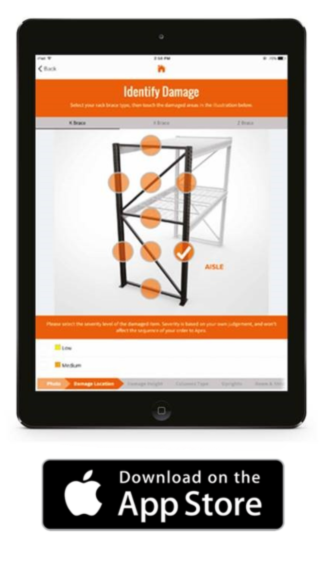
The Apex Rack Repair App is a free tool that can increase your odds of safe operations. Use the Rack Repair App to conduct a pallet rack audit and inspection of damaged pallet racking. This is what we call the Do It Yourself approach. Quickly capture detailed rack specs to enable the Apex PROs to evaluate the damage and provide a custom repair solution, if necessary. It’s the best way to reduce system downtime and resume safe activity.
If you prefer, call the Apex PROs, and our certified rack inspectors will come to you and conduct a thorough pallet rack audit and safety inspection.
Whether you do the inspection yourself or you call the PROs, you will receive an independent custom repair solution for any damage significant enough to require repair. Your repair will be the most cost-effective, long-lasting solution recommended for your rack damage.
It’s your choice; the Apex team is here to support you in whatever way you decide to go. Call us for full-service support for all your warehouse needs.
Download the Apex Rack Repair Mobile App – Available on the App Store.
