
Working Building Columns into Your Pallet Rack Design

Colorado Customers – Maximize Storage Around Support Columns with Our Pallet Rack Design Tips
Coloradans, you’re used to wide-open spaces, but as we know, even wide-open spaces have their challenges. When designing pallet racking systems for large floor plans, it may initially feel like you’re painting on a blank canvas; however, these open areas have structural impediments that can get in the way –if you let them. Warehouse support columns are structurally imperative yet require a creative approach to maximize your storage capacity. Years of pallet rack design have led to a few reliable solutions for seamlessly incorporating warehouse columns within rack structures to minimize the loss of storage space.
In a perfect world, it’s best to work with your customer to design the support columns around the rack layout. We consider 58’ the optimal distance between columns to easily incorporate them inside the flue space for several popular rack system configurations.
- VNA selective
- Narrow aisle selective
- Narrow aisle double-deep
- Narrow aisle push-back
Most often, however, the columns are set in place, and your job is to work with what you’ve got. Take a look at these tips to help get the most from your warehouse space while maintaining safe movement for your team and equipment.
Challenges of Working Around Building Columns
- Columns cannot impede vehicle or pedestrian flow within aisles
- Incorporating columns within pallet rack may reduce storage capacity
- Ensure columns do not interfere with racking system integrity
Seismic Considerations: RMI specifies separating rack bays and building columns by a distance equivalent to 5% of the rack height in the longitudinal (down-aisle) and 2% of the rack height in the cross-aisle. This can have a significant impact on the layout. For example, a 360” tall frame at 2% creates a 7.2” separation on both sides. Providing space between the rack and building column allows independent movement in the event of an earthquake and prevents a collision.
Pallet Rack Design & Hide the Column Tips

Back-to-Back Rack with Row Spacers
Selective Pallet Rack
A system design that is ideal for smoothly incorporating building columns is a back-to-back configuration. Using selective rack for back-to-back eliminates one aisle for every two rows, thereby creating additional storage capacity. Single-deep or deep-reach pallet storage systems are good choices for this design. Columns can be positioned behind the two rack rows in what is called the flue space. The flue space is a fire safety requirement and must remain free from obstruction i.e. pallets, inventory, and any other combustible material; however, it is an excellent area to place the building columns.
A design note for back-to-back systems is to remember to stabilize the rack systems using row spacers –typically installed every 10’ of frame height.
Optimal column spacing for back-to-back selective pallet rack is determined as follows:
(Rack Depth * 2) + Flue Aisle + Aisle Width / No. of Rack Sections Between Columns
Note that aisle width will depend on the forklift turn radius and interface with the rack system and is therefore not a constant from facility to facility.
|
|
Drive-In Pallet RackDrive-in pallet rack is a high-density system that uses a single aisle for forklift access. It is a last-in/first-out (LIFO) storage option that requires the operator to drive into the rack to put and pick the pallets. For these systems, it is best to place the columns between the lanes of rack storage keeping them out of the way of the forklifts. Uprights can butt up to both sides of the columns (typically 10” x 10” or 12” x 12”) reducing the storage loss to approximately 10” or 12” every 40’ to 50’ of system depth. The potential loss equates to roughly one drive-in lane for every 3 columns when using standard GMA-style (40” x 48” pallets. Again, row spacers are necessary for system stability, but this time they get positioned where the columns are between the bays. |
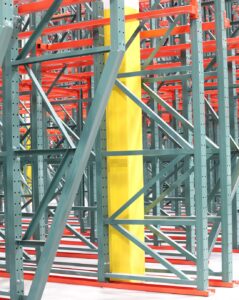
Push-Back Rack
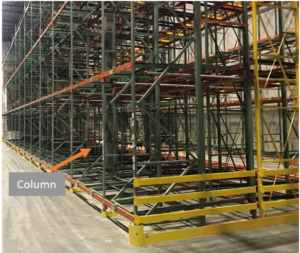
Another high-density, LIFO system is push-back pallet rack. Push-back gets its name from the pallet loading process. The system is several pallets deep and pallets are loaded onto enveloping carts that sit at the aisle face. The first pallet is loaded onto the top, then subsequent pallets are loaded by pushing back the pallet at the aisle to expose a cart beneath. As pallets are extracted, the rear pallets flow forward on a slightly inclined rail that secures the carts.
Ideally, place the column in the rear of the bay to allow you some use of the forward pallet positions. For example, a 4-deep lane might turn into a 3-deep with a column in the rear vs. losing the whole lane with the column in the front.
The photo to the right illustrates a retrofit push-back installation within an existing building. In this case, the most efficient use of the space resulted in the columns at the 2nd pallet position.
Gravity Flow Rack

Gravity flow racking is a dynamic, dense storage solution for pallets or cartons/totes. The design uses separate aisles for loading and unloading inventory which keeps aisle congestion down and allows both activities to happen simultaneously.
Pallet flow rack systems can average from 2-10 pallets deep, which requires customizing your design to each unique system to incorporate support columns. As you can see in the above photo, the “column bay” on all levels is lost, but the overall capacity loss is minimized with careful pallet rack design. Installing bar grating around the column minimizes gaps and prevents inventory from falling through.
Carton flow storage is a popular choice for high-volume case picking. Carton flow design is closely based on the size and shape of the cases or totes. You can design your system using the specs to minimize lost capacity and work around the columns.
Call Apex Colorado for Expert Pallet Rack Design & Installation
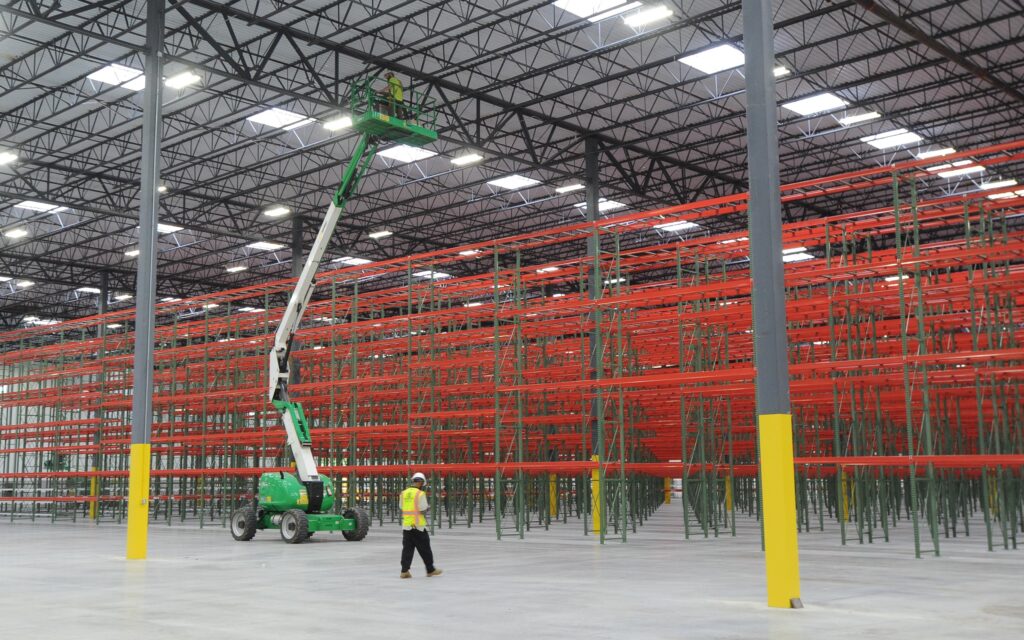
Expert pallet rack design takes a strategic look at your space, inventory, turn rates, and processing to develop the most economical way to optimize all the parts into one productive solution. The Apex team has tried and true methods to help configure your pallet rack to ensure you achieve your operational, safety, and ROI goals. Give your local Apex team a call to schedule a call, and let’s discuss your next project.
