
Fire Safety – What You Need to Know About Transverse and Longitudinal Pallet Rack Flue Space

Transverse and Longitudinal Pallet Rack Flue Space Fire Safety
If this were a scrabble game, we’d be in it to win it with Transverse and Longitudinal. Those are some good score-getters; however, pallet rack safety isn’t a game, and fire safety is no joke. So let’s review what the National Fire Protection Association (NFPA) says about the significance of pallet rack flue spaces to ensure we comply, whether designing a new system or working with one in operation.

 Let’s start at the beginning with a few definitions.
- Back-to-back pallet rack is created by placing two rack systems… you guessed it, back-to-back. The systems are secured together with ties called row spacers.
- Row spacers attach to each rack system to ensure that the rack rows stay straight and that an open area called a flue space is maintained between them. They also help add stability to the rack structures.
- Flue space constitutes OPEN space that allows heat to vent up and activate ceiling sprinklers (and in-rack) to prevent fire spread.
-
- Transverse Flue Space: Orientating yourself towards the racking face is the space between the products parallel to the direction of loading. NFPA requires 6” of transverse flue space.
- Longitudinal Flue Space: Orientating yourself to the end of the row of racking. This is the space between each row of back-to-back systems going perpendicular to the direction of loading. The NFPA requires a 6” minimum of longitudinal flue space.
Transverse Flue Space – Getting to the Center of Pallet Rack Design
Commonly, storage system designers will use even spacing between inventory and the upright frames of the rack. For example, using a 92” beam with two standard 40” wide loads would leave 4 inches of transverse flue spacing between the pallets and on either side of the rack frame. While that sounds logical on the surface, it does not comply with NFPA regulations.
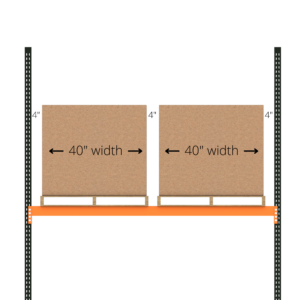 Does not comply with NFPA regulations. |
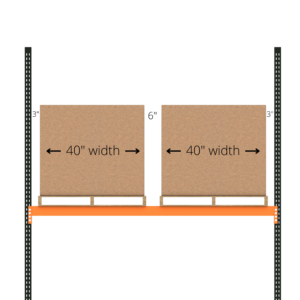 Does comply with NFPA regulations. |
The NFPA requires 6” of transverse flue space between loads for proper venting. Therefore, using our same example with 6” between the loads with 3” on either side in a 92” wide beam configuration.
It is important to note; however, that most storage bay openings are 96” and as such, would have 6” in the center and 5” on either side of each load.
Prevent Items from Invading the Flue Space with These Rack Accessories
 |
Keep Clear stickers are acceptable in some municipalities vs. requiring flue space protectors. | |
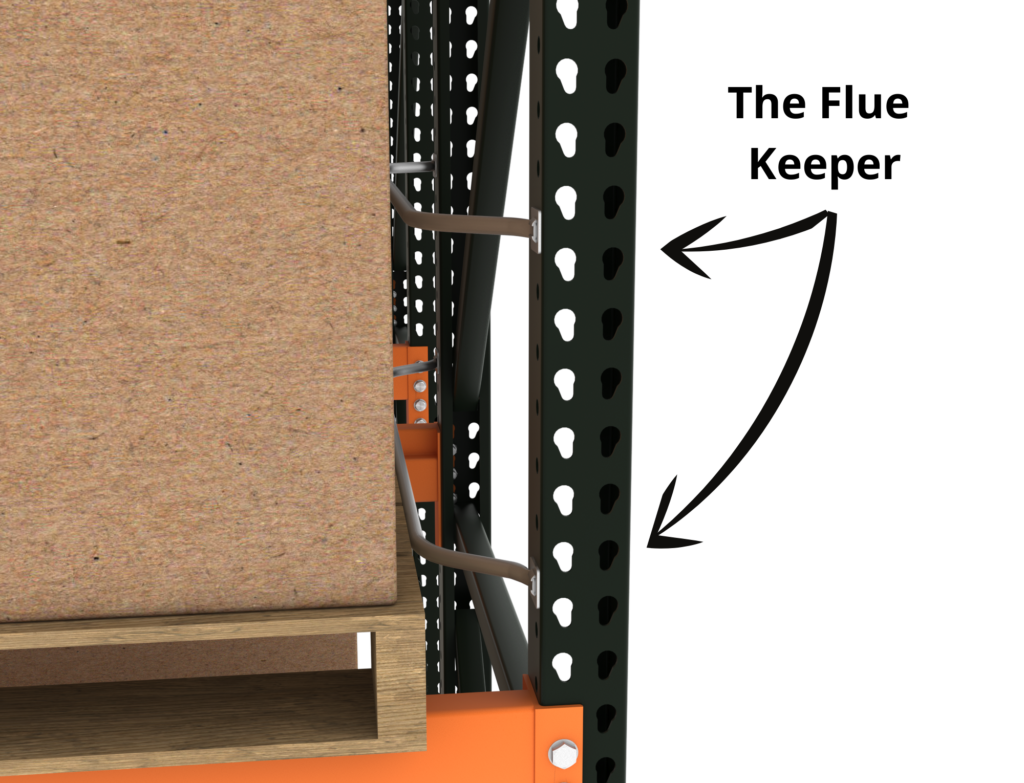 |
The Flue Keeper prevents boxes and pallets from encroaching on the transverse flue space. These flue stops meet NFPA standards. | |
 |
Snap-on wire dividers simply clip into place to create orderly SKU slots. These heavy-duty steel dividers are often used in case picking but can also serve as a visual aid for forklift operators for loading pallets. |
Longitudinal Flue Space – What’s Behind Your Rack Design?
When designing a rack system, the first place to start is with the local city ordinances regarding fire safety regulations. Design criteria may change depending on the items being stored, so be sure to confirm the inventory specs before setting on a design. For example, a highly combustible commodity may require greater than usual space to support in-rack sprinklers. NFPA dictates a minimum longitudinal flue space of 3” to allow fire ventilation and water penetration from ceiling sprinklers.
Load depth will also affect your flue space design. Standard pallet loads are 48” deep; however, longer pallets may require additional longitudinal flue space to accommodate overhang in the front and rear of the system.
Commonly, designs account for a few inches of pallet overhang over the back beam and into the flue space in a back-to-back rack configuration. While the flue opening is typically 6” (again, confirm the local fire codes), that means that the distance between the racks must be 6” plus the overhang depth on both sides of the system.
For example:
42” deep upright with 48” deep pallets loads
Pallet overhang is 3” off the front and rear beam for pallets on both rack rows.
Therefore, 3” overhang x (2) pallets (front and rear) + 6” Longitudinal Flue = 12” flue spacing is needed between rows.
Give Your Rack Some Space with Longitudinal Spacers
 |
Row spacers help maintain Longitudinal Flue Space. They come in a range of standard sizes but can be custom ordered if needed. Various manufacturers have different requirements for the number of row spacers used, but the most common guide is to install one row spacer per 10 feet of frame height. | |
 |
Pallet stops prevent pallets from being positioned too far into the flue space. The depth of the offset can vary as well as the design of the pallet (load) stop accessory. |
Where to Go for Expert Pallet Rack Design and Installation
The Apex Colorado team has your back for all your back-to-back rack design and storage solution configuration projects. We will work directly with your team to ensure that your system is constructed to the proper and safe design parameters that will ensure long-time use and warehouse safety. Our professional rack installation teams are experienced and work seamlessly with Apex project managers and your staff to follow all your safety and work protocols and meet your timelines and budgets.
Call your local Apex Colorado team today to get started on your next pallet racking or warehousing design project.
