
Layers of Optimized Order Processing – Choose Your Pick Module

Pick Module Design & Applications
Use warehouse space more effectively, meet faster fulfillment goals, and save labor costs in the process. It’s not a dream; it’s a pick module. Pick modules integrate storage solutions such as pallet racking, carton flow, and industrial shelving with conveyors to create a highly concentrated order-picking zone. While pick modules can exist on a single level, they are often multiple levels, incorporating mezzanines into the design. Automated picking applications such as pick-to-light, voice pick, and robotic picking can maximize pick module productivity.
Pick modules can organize hundreds to thousands of unique SKUs, making each easily accessible for stocking and picking with high accuracy. Powered conveyors efficiently transport picked items to packing stations streamlining order processing and reducing labor costs — ultimately trimming operating expenses.
Pick Module Benefits
- Reduce labor costs – minimized travel time
- Maximize space – consolidate SKUs & utilize vertical space
- Promote safe & simultaneous replenishment –separate forklift & picker aisles
- Increase order pick speed – less travel, organized inventory
- Improve pick accuracy – organized, accessible SKUs
- Customizable design – built to suit
- Automation compatible
How Does a Pick Module Work?

Pick modules are customized to the warehouse space, SKU count, SKU volume, and throughput. Pallet racking typically serves as the frame or structural support of the pick module. Conveyors can run between, alongside, and even integrated within the racking. Multiple pick modules can be built, or different levels can handle unique tasks or inventory.
Common Elements of a Pick Module
- Pallet rack supported – structural support for the pick module
- Mezzanine – rack supported structures maximize vertical space and optimize pallet rack use
- Pallet flow rack – feeds full pallets for case picking & reserve inventory
- Carton flow rack – medium to slow turn inventory for case & each picking
- Industrial shelving & bin storage for slow moving carton & each picking
- Conveyor – powered, gravity, spiral, transportation
Gravity flow products are often feature products within a pick module. Gravity flow is a FIFO solution that uses wheels or rollers to propel inventory from an outer load aisle down into the center pick aisle. Each SKU has a unique lane that holds multiple pallets, cases, or totes depending on the type of gravity flow system. As the front item is picked, the rear items flow forward to fill the pick slot. The separate load and pick aisles safely support simultaneous activity.
Single items, cases, and totes are ideal for carton flow rack, while palletized inventory fits on the larger pallet flow rack. Pallet flow rack is an effective option for case picking from pallets for fast- to medium-turn inventory, and it can also be used to store reserve inventory for stocking the carton flow rack. It is common for both flow rack products to have a role in a pick module.
Pick Module Design Scenarios

While each pick module is customized to your facility space, inventory, and processing needs, some typical applications and design scenarios can serve as valuable examples.
Multi-level Pick Modules
Each level of your pick module can be uniquely designed to satisfy a unique fulfillment process if required. However, the essential function is as follows,
Full Case Picking
Several scenarios serve the need for productive full case picking. As the illustration above demonstrates, pallet flow rack feeds full pallets to the pick aisle, and cases are picked to a cart or pallet jack. Pallets are loaded by forklifts from the outside aisle and flow inside to the pick aisle. This is a good solution for medium-turn, case-picked inventory.
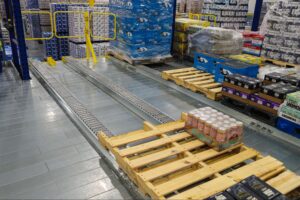
Another option is to use floor-mounted pallet flow lanes (flat, not pitched) on one of the pick module levels to support a cluster pick application, i.e., case-picking multiple orders simultaneously. Forklifts load a mix of SKUs onto the flow lanes, and workers pick from the palletized cases to nearby conveyor or pick cart.
 |
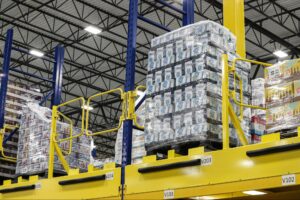 |
| Mezzanine Level Cluster Pick — Case Pick from Floor-Mounted Pallet Flow |
Split Case Picking
Split case picking can be accomplished on the ground level picked from carton flow to totes, conveyor, pallet jack, etc. Carton flow racking is often the go-to solution for single-item and split-case-picking order fulfillment. Orderly SKU lanes and automatic pick face replenishment support quick-moving order processing. It also pairs well with automation and wearable tech to further enhance speed and accurate item selection.
If you want to accomplish case or split case picking from upper levels, forklifts can load pallets to the drop zone, and workers break down the inventory by cases or item to load flow rack or shelving. Note the pick module area is consolidated, so while this is a labor function, it’s still efficient and can happen simultaneously with the pick operation.
Other options include industrial shelving or bin shelving for slower-moving SKUs. These storage solutions are more economical vs. carton flow rack, which you usually want to save for faster turn inventory.
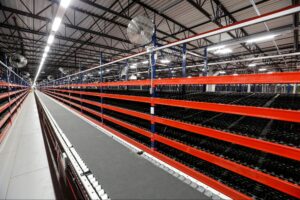 Carton Flow Rack |
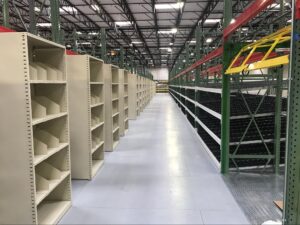 Shelving and Carton Flow |
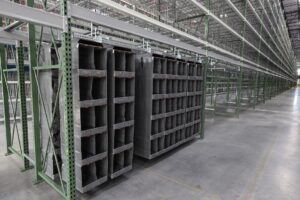 Bin Storage |
Kitting & Product Bundling
Specialized applications like kitting (grouping and packaging several products under one SKU and selling as a single unit –think subscription fulfillment) or product bundling, which is a group of SKUs packaged, sold, and shipped together are also great candidates for a pick module design.

Kitting Application
Special Design Considerations for Multi-Level Pick Modules

Rack Supported Mezzanine
Clearance Height Options
An important consideration when designing multi-level work platforms is clearance heights for each level. Your clearance considerations must include a comfortable workspace for team members as well as proper lighting, fire suppression, and air handling systems, where applicable. Here is more detail on the pluses and minuses to clear module heights.
Module Heights 10’, 11’, 12’, what makes the most sense?
Option 1 – 10’ Top of Deck
This is the lowest comfortable clearance for people to work in and also the most economical.
- Structure material costs less
- Fewer brace beams required
- Smaller footprint for stair runs
- Conveyor impact for elevation change is less
- Note: Inclines or spirals will require less vertical slope
Option 2 – 12’ Minimum
- More Flexibility
- Product Height
- ECC Lines
- More room for airflow
- More comfortable work environment due to clear heigh
Mezzanine Access – Means of Egress
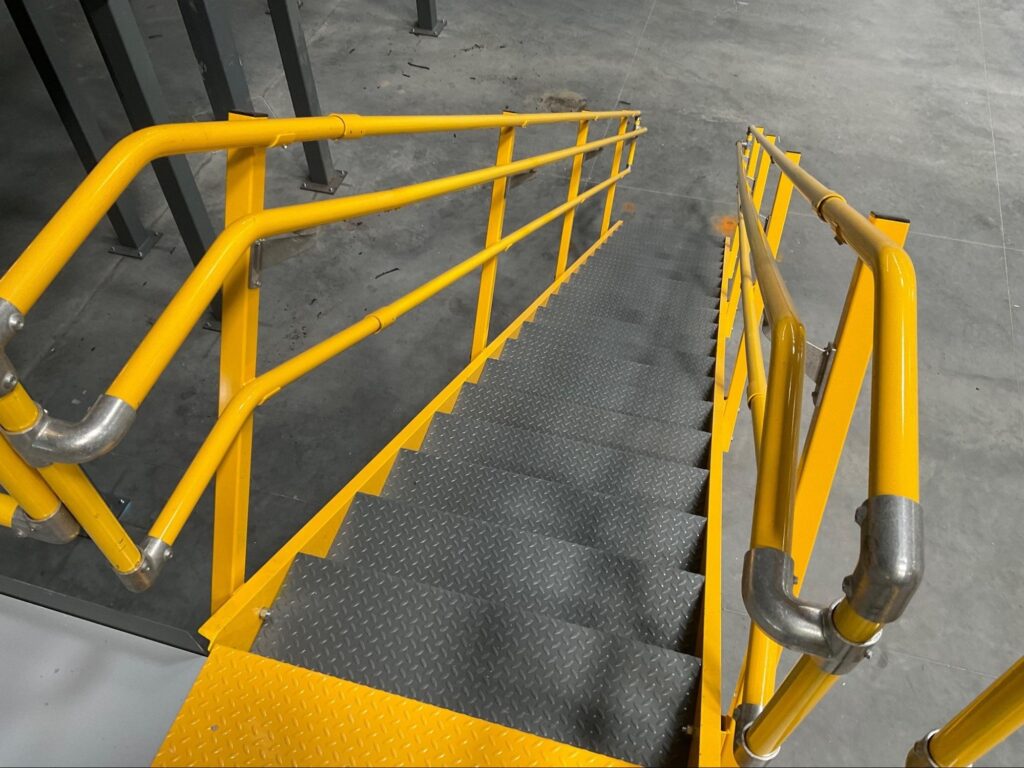
There are a few options for mezzanine access. While staircases are ubiquitous, you may also require a secondary vertical ladder for an emergency exit. Confirm with local building codes to ensure your mezzanine access meets the required safety guidelines.
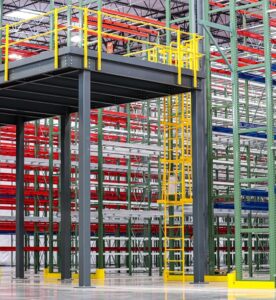
Vertical Cage Ladder
Mezzanine Staircases
Stair design – As the primary personnel access to and from mezzanine levels, it is critical that your stairs are safe and reliable. Staircase design includes the width, rail height, landings, step dimensions, and safety features such as gates and slip-resistant surfaces. Depending on the size of your platform, you may require multiple sets of stairs. The International Building Code (IBC) establishes the number of exits using occupant load and travel distance along the common path of egress. For example, a capacity of <49 allows for a single stairway. Higher occupancy can result in the need for two or more access points.
Vertical cage ladders – A streamlined option that helps you meet safety requirements without giving up space you may not have to give is to install a vertical cage ladder. These are safe and reliable, and customizable to meet your design specs.
Mezzanine Decking
Flooring options for mezzanine-level pick modules must be durable to withstand a lot of foot traffic, plus possibly pallet trucks, mobile carts, or AGVs & AMRs. The flooring should also be slip resistant and meet fire safety codes. Heat and humidity resistance are also important to prevent warping and rot, compromising safety. For more details on mezzanine flooring options, check out our blog – Mezzanine Flooring Options.
Make the Right Choice in Pick Module Design
There are a lot of options and decisions to make when customizing a pick module. The Apex team has extensive experience designing and installing these complex, multi-level work platforms. Our full-service approach ensures customers that each step of the way, there is a team of experts to take them through the process –from engineering and design through installation and including automation and material handling equipment if needed.
Contact Apex today to schedule a free consultation and on-site visit.
Visit the Apex Pick Module photo gallery for ideas and inspiration.
Related Content
Check out our design blogs for more information on mezzanine construction.
Mezzanines – Determining Capacity & Design
Freestanding vs. Rack Supported Mezzanines
