
Breaking Down the Barriers to Mezzanine Safety

It’s a Long Way Down – Prevent Accidental Falls with Mezzanine Safety Products
The Occupational Safety & Health Administration (OSHA) monitors workplace safety.
A critical concern for OSHA is the regulation around fall protection for open-sided elevated platforms, floors, and runways. It is such a ubiquitous hazard that OSHA requires fall protection regardless of elevation height. Yet, according to the National Safety Council (NSC) statistics, there were over 200,000 work-related falls in 2020, with roughly 800 being fatal. With elevated workspaces becoming more prevalent, mezzanine safety is essential.
 The good news is that mezzanine falls are PREVENTABLE with proper safety training and equipment.
Mezzanine Safety Products
- Guardrails
- Safety Gates
- Chutes & Ladders
- Flooring
- Signage
- Lighting
Safety Guard Rails
Guard rails are your first line of defense on an elevated, open floor like a mezzanine. The top edge of the guard rail must be at least 42” – 45” above the surface or work area. A toe-board should accompany the rail.
Safety Gates
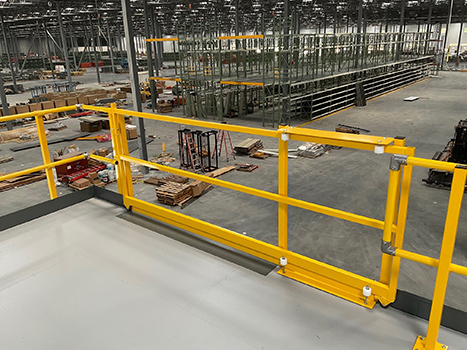
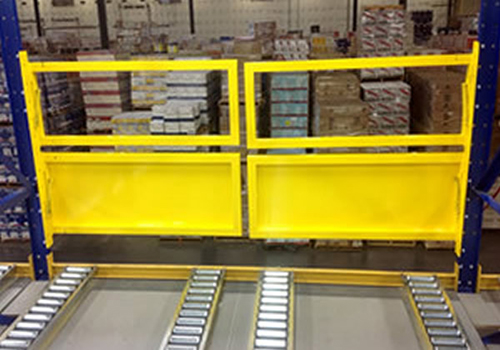
Safety gates protect loading and unloading areas of the mezzanine, also called the drop zone. Gates can be manually operated or automatic and should include safety latches to prevent workers from accidentally opening the gate when the load area is active.
Choosing the design style for your safety gate depends on the equipment you use to load/unload from the mezzanine. Gates can open side-to-side or drop down from overhead.
An overhead (pivot) gate is a smart choice for forklift access because it opens on only one side at a time. When the gate is open to the floor below, for example, the access from the mezzanine level is restricted and vice versa.
If you use an overhead crane to load/unload, a horizontal gate allows the crane to access the load area while preventing workers from entering the space simultaneously.
Impact Gates, also called pallet loading gates, allow for safe, efficient pallet transfer to and from elevated platforms and mezzanines. When closed, the gates provide dependable fall protection. For example, Apex uses these gates in conjunction with mezzanine-level pallet flow rack. Gates open and close on spring-loaded mounts without forklift operator assistance.
 Overhead Pivot Gate |
 Horizontal Gate |
 Impact Gate |
Chutes & Ladders
Besides the drop zone, access to and from the mezzanine is primarily via a chute (for non-human material) or a sturdy set of stairs or ladder for all those humans. Tailoring your safety accessory to each area provides the best fall protection.
Chutes – If you’re using a conveyor on your mezzanine, chutes are an effective way to remove corrugate and trash. Like any other open areas on the raised level must be surrounded by safety guarding to prevent accidental falls –this is an OSHA mandate.
Ladders – When space is tight or you need a second egress for safety compliance, vertical cage ladders are a great option. Sturdy and reliable these ladders have a variety of mounting options and can be customized to meet your specs.

Stairs – These are the primary exit/entrance access to your mezzanine. In addition to the above-mentioned fall prevention requirements from OSHA, if your mezzanine is an active workspace (vs. an equipment or mechanical access, i.e., catwalk), you must also comply with the International Building Code (IBC). The IBC sets the number of exits based upon occupant load and the travel distance along the common path of egress. Typically, 49 or fewer people require a single stairway with two or more exits for higher occupancies.
Stair tread should be slip-resistant for mezzanine safety. Additionally, OSHA requires the following specifications:
- Step depth – 9.5” minimum
- Tread width – 22” minimum
- Riser height – 9.5” maximum
- Nosing – straight leading edge
- Vertical rise – 30° to 50°
Handrails must be 30” – 38” tall and
- Stairway width <44” – One handrail required
- Stairway 44” – 88” – Handrail on each side
- Stairway 88”+ – Handrail on each side and one down the middle
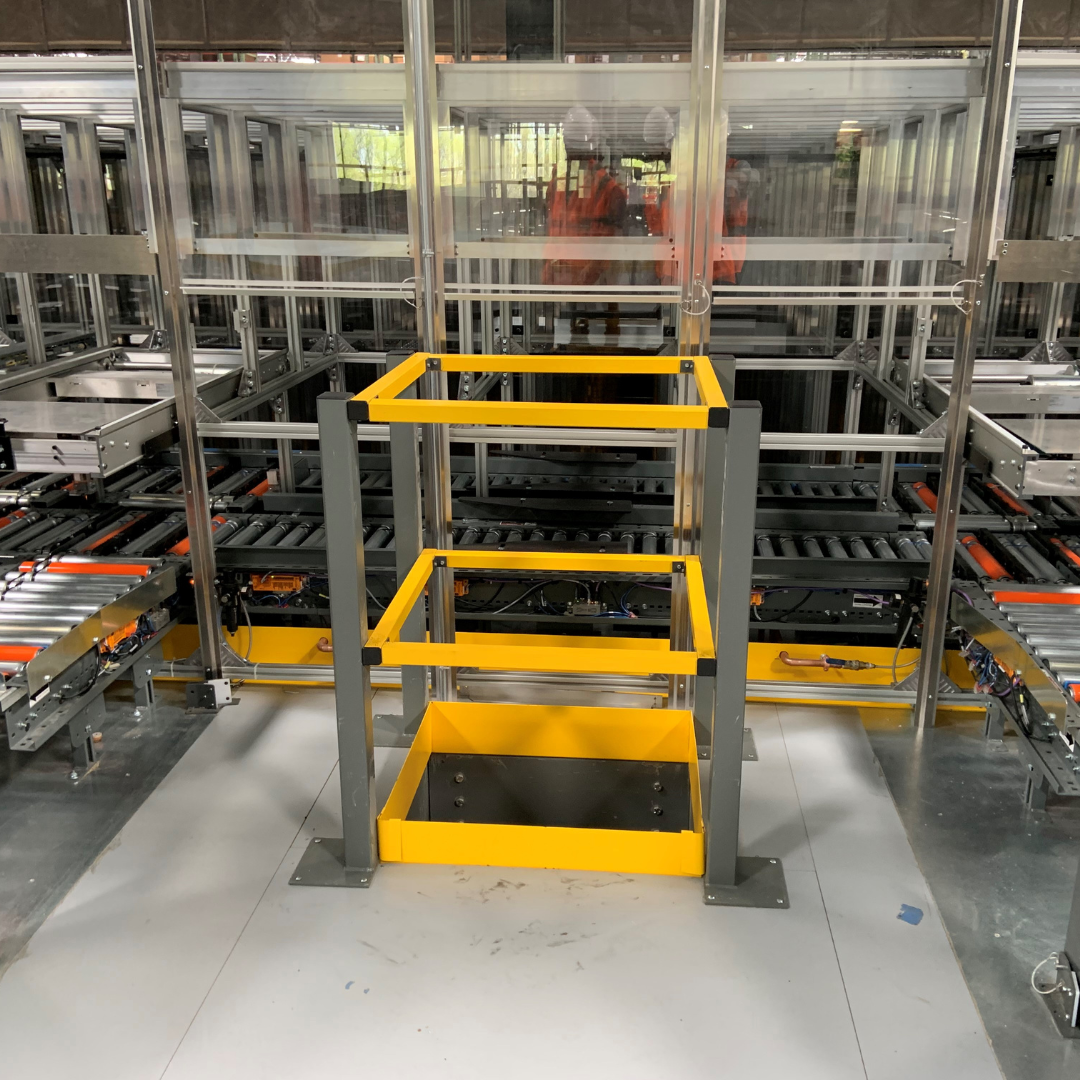 Chute Guarding |
 Vertical Ladder |
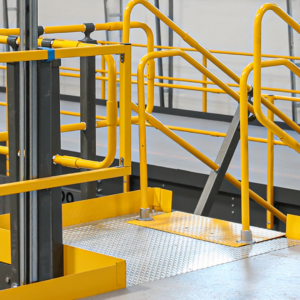 Stairs & Slip Resistant Flooring |
Mezzanine Flooring
The type of mezzanine flooring you use is dependent upon the activity on the platform. For a deep dive into flooring options, take a look at our blog: Mezzanine & Industrial Platform Flooring. However, you want a durable surface that will hold up to the level of activity expected on the platform. You can choose between permeable or solid surface material, depending on your needs. However, it is critical to remember to use slip-resistant materials around entry and exit points and loading or drop areas.
Permeable Surfaces:
|
Solid Surfaces:
|
Safety Signage
Your safety equipment should be accompanied by easy-to-see and understand signage. You can choose to color code signs and equipment for an additional safety measure. OSHA provides some general guidance on this, suggesting that it is important to be consistent with color-coded safety signs and to use the following universally recognized patterns:
- Red – fire-related dangers
- Yellow – physical hazards, aisles, & passageways
 Fire Safety |
 Fall Safety |
Lighting
Mezzanine heights alone are a potential risk, making it even more critical that these areas are intentionally well lit. Mezzanines often have low clearance and space constraints that can hamper light dispersion. It is important to create a lighting plan that ensures your workspaces, all entry/exit areas, and drop zones have sufficient direct lighting.
Apex is Your Home for Mezzanine Safety
From the initial design to the installation of your industrial platform, safety is a paramount concern. The Apex team provides full-service expertise for each step of the process. We have extensive experience customizing mezzanines to enhance customer workflow while optimizing warehouse space. Take a look at our photo gallery for inspiration, and give our team a call. Let’s discuss your goals and ensure you get to the finish line safely.
For more information on mezzanine design, check out our related blogs:
A Look At Warehouse Mezzanines From A Whole New Level
Going Up? Mezzanines – Looking At Free Standing Vs. Rack Supported
