
Industrial Mezzanines – Weighty Decisions to Determine Capacity & Design


Industrial Mezzanine Design – Building for Safe Load Capacities
As everyone strives to maximize warehouse cube space, mezzanine design has emerged as a popular solution to create highly functional and economical workspaces while taking advantage of floor space, vertical space, and everywhere in between. From single-level storage and personnel spaces to multi-level pick modules and sophisticated order processing solutions, the way to match the full spectrum of customer needs is often found by looking up.
Since mezzanine spaces are fully customizable, permanent structures, it’s important to clearly define your intended use to help determine the design style and anticipated load capacity.
That Mezzanine Has Style
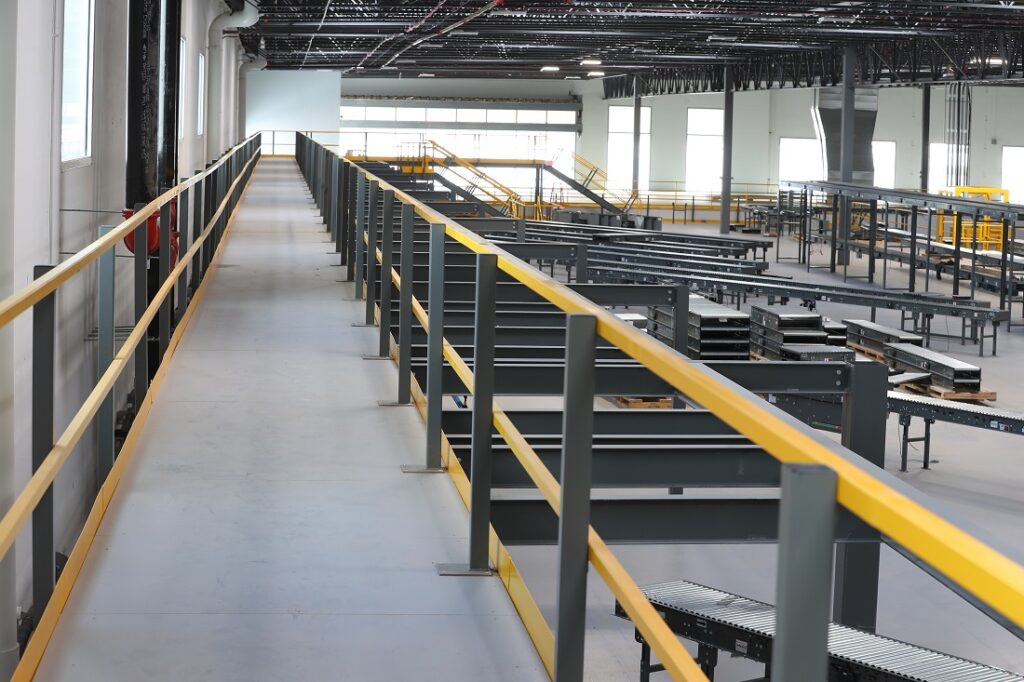
Installation in Process – Catwalk Mezzanine
Industrial mezzanines will vary by size, structure, and function but will take form in one of the three construction styles:
Mezzanine Styles
- Freestanding Industrial Work Platform (IWP)
- Rack Supported
- Catwalk
Freestanding IWPs and rack-supported structures can be used for similar functions, but they differ in construction style and cost. Both types are typically well-equipped with safety gates and guarding and can be fitted with various decking surfaces depending on the intended use. Choosing a freestanding IWP vs. a rack-supported structure is more about tomorrow’s plans than it is about today’s needs.
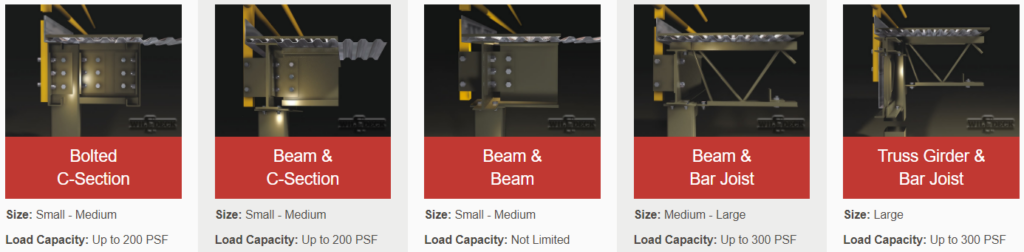
IWPs are freestanding structures that typically cost more to build initially, but they are easier to move and reconfigure if future plans suggest that will be necessary. IWPs are multi-purpose industrial mezzanines. They can be designed and constructed for smaller, light-duty applications up to large-span, heavy-duty functions. The five structural framing options are:
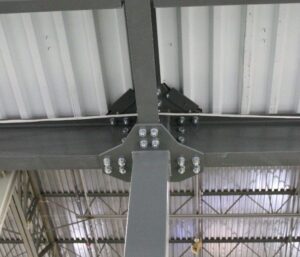
Moment Connection for Seismic Regions
In areas where seismic conditions require special considerations, the Moment connection will provide the necessary support and rigidity to allow your operation to still benefit from mezzanine use.
Using moment connection framing secures a rigid connection at the column to prevent rotation and the ensuing overturn at the column base. Typically, a smaller baseplate can be used with a moment connection, and it may also eliminate the need for footings.
Rack-supported mezzanines are less costly to build initially, but with more columns in the design than IWPs, they are more difficult to reconfigure. For a deeper dive into the pros and cons of IWPs and rack-supported mezzanine, check out our comparison blog. The Apex team is also available to help you make the best choice for your operation.
Catwalks are light-capacity passageways built to allow workers to safely move from one point to another without interfering with operations or encountering vehicle traffic. Catwalks are a cost-effective way to improve warehouse safety and take advantage of available vertical space.
Mezzanine Load Capacities
When looking to add additional functional space to your warehouse or manufacturing center, you can use a mezzanine(s) for personnel spaces, picking and processing, manufacturing, equipment, and storage. Space and corresponding load capacities will be engineered for the particular function and the structural, mechanical, and safety equipment requirements.
Mezzanine Uses
- Office space/breakroom (social distancing)
- Manufacturing
- Automation
- Order picking, kitting, assembly
- Equipment storage
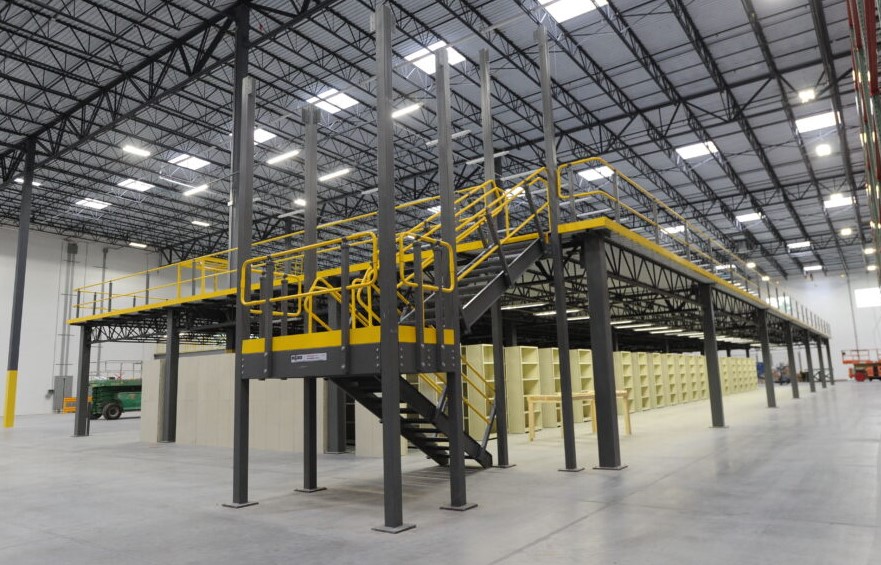
Freestanding Mezzanine
In general, the International Building Code (IBC) parameters specify load capacities from minimum to heavy-duty use in pounds per square foot (psf) distributed across the platform. For example,
- 60 – 90 psf (minimum use – conveyors or maintenance with limited access)
- 125 psf (storage warehouse – light/light manufacturing)
- 250 psf (storage warehouse – heavy/heavy manufacturing)
Mezzanines should be built to the full expected load capacity of the intended use. It is far more cost-effective to build for heavier capacity from the beginning vs. adding load capacity to an existing structure.
Factors that determine mezzanine capacity:
- Intended use
- Weight distribution across the mezzanine (UDL & point load)
- Dead load & live load weight
- Warehouse floor – slab thickness and potential for soil compression
- Work platform height
- Columns – number and spacing between
In addition to intended use, several other factors add to the equation to establish the load capacity of the work platform. From how the weight will be distributed across the mezzanine to the thickness of the warehouse floor and the soil quality underneath, all of these factors are critical in engineering for the desired load capacity. Let’s drill down a bit.
Slab Capacity
The slab thickness of an industrial facility floor is typically 6”, with 4,000 psi. While this is sufficient for operations up to 25,000 lbs. of rated capacity, the soil quality and/or water table level underneath the floor may reduce the capacity and dictate whether footings are required to erect an IWP.
Uniformed Load / Columns – Spacing & Quantity
The next step is to find the uniform load. For example, using the IBC parameters, a light-duty mezzanine has a 125 lbs. per square foot capacity. Taking that number and multiplying it by the projected total sq. ft. of the mezzanine will give you the column loading.
Column loading: total (sq. ft) * 125 (lbs./sq. ft) = lbs. supported by each column.
Note: This is an estimate only. A licensed engineer should always calculate actual load capacity.
Using the column loading, you can then determine the number of columns needed and the spacing to properly support the load uniformly across the total mezzanine and on the specific slab.
The interior columns bear the most weight of the structure even though the columns are usually evenly spaced. Use the interior columns to establish the load capacity. If the warehouse floor can support the interior column loads, it can handle the exterior column load. But remember, the longer the span between the columns, the lower the uniform load.
Point Loads
You will also need to account for concentrated load areas. These are areas where stacked items or machinery will exert extra load in a specific place on the mezzanine over and above the distributed load capacity. Concentrated load areas are considered point loads, and the structure must be designed to support and distribute that weight safely. While considering the load distribution, also delineate between dead vs. live loads. Dead loads are permanent features such as walls, while live loads are moving or movable.
We’ve Got Just Two Words for You… Think Ahead

One of the most important cost-saving measures of industrial mezzanine design is to Think Ahead. Anticipate greater mezzanine load capacity where it makes sense. It is more cost-effective to include a higher load capacity in the initial construction than to “add” extra load capacity to the existing structure or deal with construction complications while in the process.
The Apex team is experienced in all aspects of design, engineering, project management, and installation of your industrial mezzanine structures. If you are building new or adding a mezzanine, we will work within your schedule and budget. Give our team a call for a free consultation, and be sure to check out our mezzanine gallery for some inspiration.
