
How to Determine Your Loaded Pallet Capacity for New and Used Pallets

What Warehouse Teams Need to Know About Pallet Capacity
Can your pallets actually handle the weight of your inventory, in your building, on your racking, with your equipment?
Warehouse managers need to know that their pallets are up to the task. That includes understanding whether pallets can safely handle the loads they carry throughout handling, storage, and transport within the facility. It’s a critical part of maintaining safety and efficiency — and it may come into question during an OSHA inspection. When pallet capacity isn’t clearly understood or documented, the risk extends to your operations, your people, and your compliance standing.
In this piece, we’ll break down how pallet capacity is rated, what standards exist, why grades can be misleading, and how to align pallet quality with the racking and conveyor systems.
How Is Pallet Capacity Determined?
Pallet capacity isn’t a single number — it’s a range of ratings that depend on how the pallet is supported and used. To evaluate whether a pallet can safely carry your load, you need to consider:
- Load type – static, dynamic, or racking
- Pallet material & construction
- Load weight and distribution
- Support conditions
- Environmental factors
- Markings or documentation
Let’s break it down.
Types of Pallet Load Ratings: Static, Dynamic & Racking
These are the three main capacity ratings provided by pallet manufacturers:
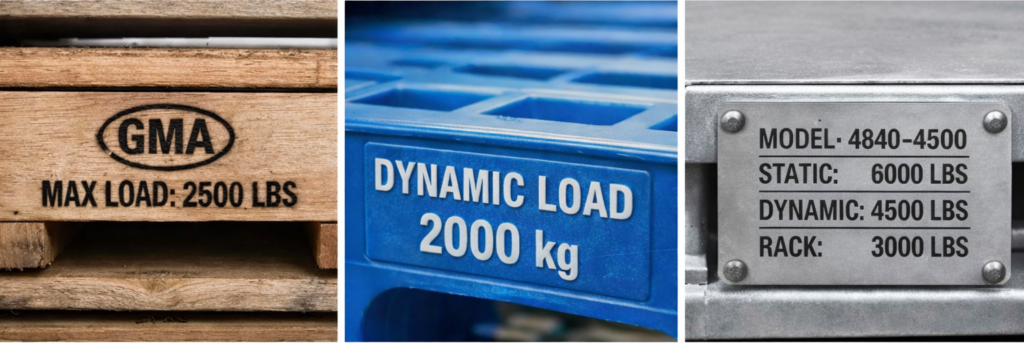
- Static Load – The weight a pallet can hold when sitting on a flat surface (floor, solid deck), fully supported across its base.
- Dynamic Load – The weight a pallet can carry while being moved, typically by a forklift or pallet jack. This rating is lower due to stress from impact, vibration, and limited contact points.
- Racking Load – The weight a pallet can support when stored in racking, typically with support at only the outer edges. This is often the most critical rating in warehouse environments.
Support drives stress. A pallet performs differently when it’s fully supported versus resting on tines or rack beams. This is why the same pallet has multiple capacity ratings.
What Influences These Ratings?
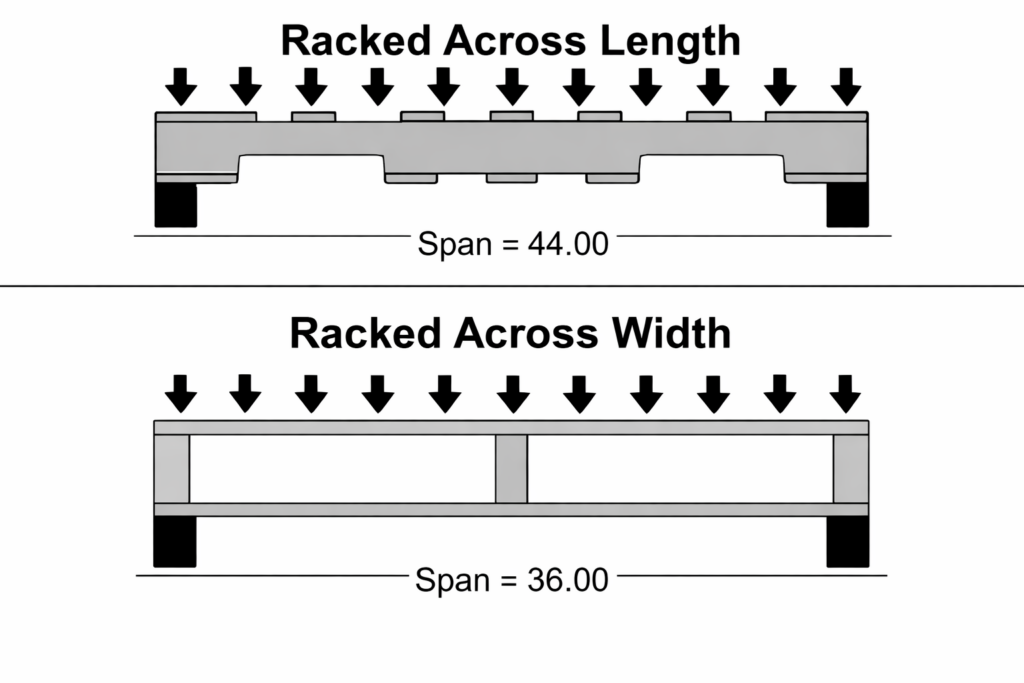 Several real-world factors can increase or decrease actual pallet performance:
- Material and design – Wood, plastic, and metal all have unique behaviors under load. Design (stringers, bottom deck, reinforcements) also affects strength.
- Load distribution – Even weight distribution across the pallet surface is safest and typically required for racking systems and forklift handling. Uneven stacking or concentrated point loads increase the risk of deflection, tipping, or structural failure.
- Total weight – Obvious but critical: you need to calculate the full load the pallet is carrying, including product and packaging.
- Environmental conditions – Exposure to heat, cold, humidity, or chemicals can affect pallet strength over time. Plastic may become brittle in freezing temps; wood may absorb moisture and warp; metal can expand or corrode. Consider your warehouse or transit environment when evaluating pallet suitability.
- Support conditions – Floor, fork, or rack? Each introduces different stress points and failure risks.
How Material Impacts Pallet Capacity
 |
 |
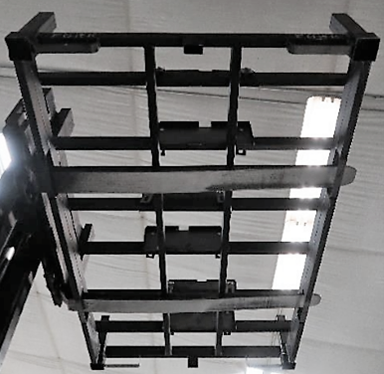 |
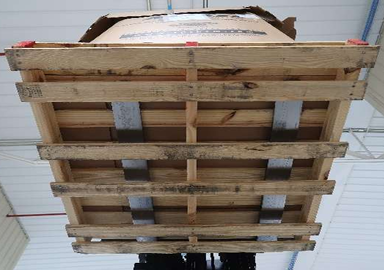
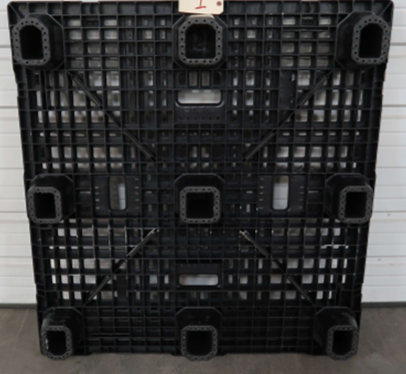
| Wood Pallet | Plastic Pod Pallet | Metal Frame Pallet |
- Wood pallets: Common, economical, and repairable. Strength can be high, but performance depends on pallet quality – contributing factors include lumber grade, fasteners, moisture control, repair standards, and pallet repair history.
- Plastic pallets: Usually more consistent in dimensions and structure from pallet to pallet, which can be a big advantage for conveyors and automation. Depending on design, plastics can deflect more under load and can behave differently in cold or hot environments.
- Metal pallets: Typically stiff and durable, often used in specialized industrial loops. They can handle tough environments and repeated handling well, but they are heavier and usually cost more.
Where to Find Pallet Capacity Specs
Many new pallets include a manufacturer’s stamp or label showing rated load capacities and other data, such as treatment codes. These markings can be a helpful reference — but:
When in doubt, request supplier specifications or test documentation to verify load capacity |
Are There Governing Standards for Pallet Capacity?
Yes, and while warehouse teams aren’t responsible for conducting the tests themselves, these standards offer a clear, defensible way to document pallet capacity when asked. If your pallets are rated or certified using one of these methods, you can reference the following to support your documentation.
- ASTM D1185 – U.S. standard for pallet performance testing, including static and dynamic loading.
- ISO 8611-1 – Global standard for simulating real-world pallet use to determine performance.
- ANSI MH1 – Defines consistent terminology and classification methods to support supplier documentation and communication.
If you’re sourcing pallets with these ratings, these references are the cleanest way to confirm how capacity was determined.
What about OSHA?
OSHA doesn’t define exact pallet load limits — but it does require that stored materials be stable and secure. The most relevant regulation is 29 CFR 1910.176(b), which requires materials to be stacked safely to prevent sliding or collapse. That means if a pallet fails in use, inspectors may look at how you determined it was safe to begin with.
Pro tip: Just because a pallet looks sturdy doesn’t mean it meets your application needs. “Looks fine” is not a capacity rating.
Understanding Pallet Grades: A vs. B vs. C
Before evaluating suppliers, it is helpful to understand what grading typically means in the real world.
Pallet grades are commonly used in the market, especially for recycled pallets; however, grading systems are not regulated by OSHA and can vary among suppliers. So treat grades as a starting point, not proof.
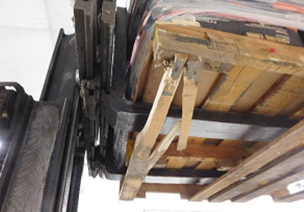 Grade A pallets: Typically used once with minimal or no repairs, so they’re usually the most consistent option for facilities that need predictable performance. They’re not automatically “safe for any rack,” but they’re the least likely to hide repair-related weak points.
- Grade B pallets: Repaired and reused, often with replaced deck boards or stringers, which means the grade tells you “usable,” not “uniform.” Grade B can work well, but capacity and reliability depend heavily on repair quality, fasteners, and pallet usage history.
- Grade C pallets: Heavily repaired and more likely to have structural compromises, Grade C pallets present a high degree of variability. They are not recommended for use in any racking system — especially dynamic systems like pallet flow or push-back, where consistent pallet quality is critical for safe operation. Due to their reduced strength and inconsistent construction, Grade C pallets are best suited for floor stacking or one-way shipping, where the risks are minimal and handling demands are lower.
Grade matters because it signals how much variability you should expect, not because it guarantees a capacity.
The real question is whether the pallet is rated and fit for your support condition (floor, fork handling, rack beams/rails) and whether its current condition still matches that expectation.
What If My Pallets Are Coming from Random Suppliers?
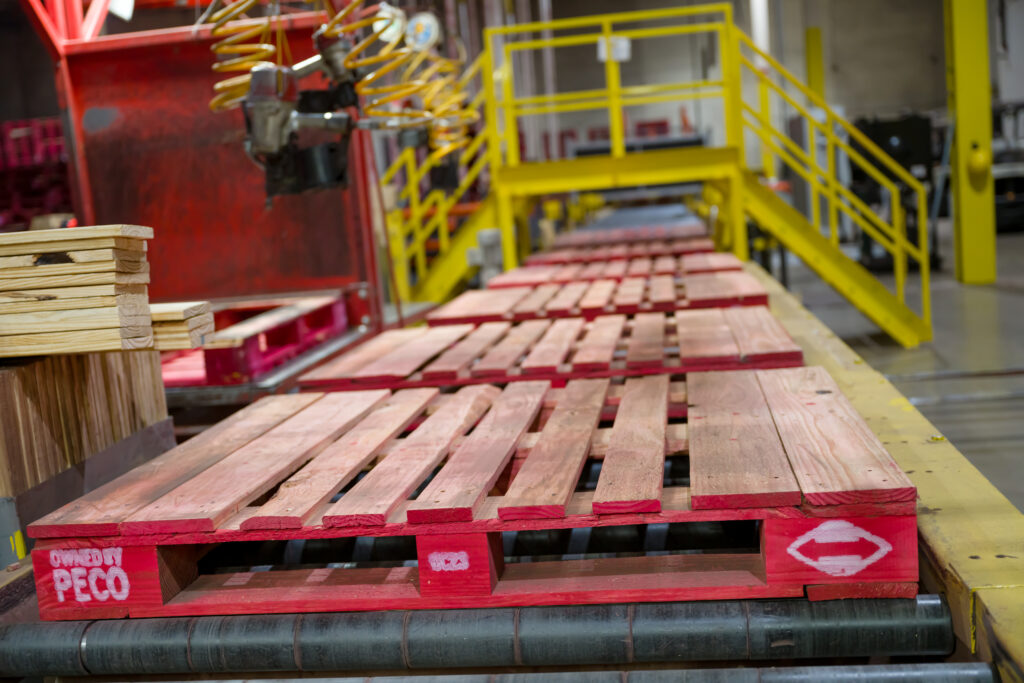
When pallets come from multiple regional suppliers, two things happen:
- Capacity consistency disappears. Even within the same footprint, construction and repair methods can vary enough to materially change performance.
- Documentation gets thin. Many recycled pallet streams do not come with test-backed load ratings tied to your use case.
If your operation relies on tight racking tolerances, pallet flow, push-back, conveyors, or ASRS, that inconsistency shows up fast as jams, product damage, system faults, and safety exposure.
Why pallet pooling programs make capacity determinations easier
Pallet pooling programs simplify capacity planning by providing consistent, standardized pallets and reliable availability. This reduces handling issues, downtime, and variability, while tracking and visibility support more accurate forecasting and throughput modeling, helping optimize pallet use and run operations more efficiently. Pooled pallet suppliers such as PECO Pallet can be a competitive and cost-effective option, particularly where reliable quality and consistent pallet performance are critical factors, such as in an automated handling or ASRS environment.
Pallet pool operators, with their focus on pallet quality, reliability, and responsiveness, help ensure consistent pallet availability and performance, removing a management burden from the client, and providing assurance and peace of mind through documented standards and continually updated record-keeping for inspections, maintenance, repair, and overall quality control. This supports pallet safety, usability, and applicability across various warehousing, storage, racking, in-house movement, and pallet transportation applications that a client may need to account for in their overall supply chain operation.
How to vet suppliers when you still need Grade B pallets
If Grade B is part of your cost model, you can still manage the risk. You just need to treat it like a controlled input:
- Ask what grading criteria they use and whether these criteria are documented.
- Ask whether they can provide load ratings tied to a recognized test approach (ASTM, ISO).
- Ask what repair practices are allowed and what disqualifies a pallet from resale.
- Require consistency in critical dimensions and bottom-deck condition, particularly if you run conveyors, flow racking, or automation.
How to Evaluate Pallet Safety in Your Warehouse
You should have a clear answer that is based on documentation and repeatable checks, not gut feel.
1. Documenting and verifying pallet specs: What to ask from suppliers
Start with what you can prove on paper. Ask suppliers to provide pallet specifications that include the load ratings relevant to your operation. That means static, dynamic, and racking capacity, plus the conditions those ratings assume.
Ratings are only meaningful if they match how you actually store and handle pallets in your facility. If a supplier cannot provide any capacity information or can’t explain how it was determined, treat that as a red flag.
2. Pallet inspection protocols: What your team should look for regularly
Capacity is not just a purchasing issue. It is a daily floor issue. Even a well-built pallet becomes unsafe when it is damaged, repaired poorly, or worn down over time.
That is why inspection needs to be simple enough to do consistently, and strict enough to keep compromised pallets out of high-consequence systems like racking, conveyors, and ASRS.
3. When to replace, retire, or repair a pallet
A pallet that might survive one more floor move is not necessarily safe to store several levels up in rack, or to send through a flow lane where shifting loads and repeated contact can turn small defects into failures.
The safest approach is to define clear criteria for when a pallet can be repaired, when it must be retired, and when it is only acceptable for limited, low-risk uses.
- Check for broken boards or stringers.
- Avoid reused pallets with an unknown history.
- Ensure compatibility with racking systems (see next section for full details).
How Pallet Standards Differ by Racking System
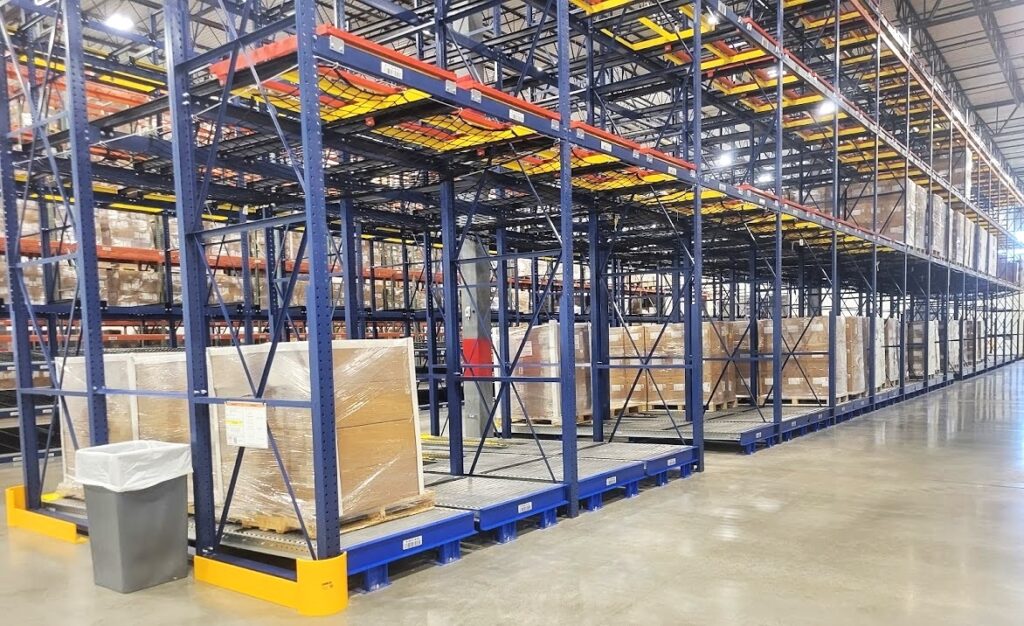
Pallet Flow Below Push-Back Rack
The same pallet that performs well in a selective rack can become a recurring problem in push-back, pallet flow, or automated handling, where pallets are under more stress, move more often, and have less tolerance for damage or inconsistency.
Here are common racking systems and pallet compatibility:
- Selective Pallet Rack
Most flexible. Works with standard 4-way entry pallets, but pallet condition still matters because the load is elevated and stability is non-negotiable. Pallets should be structurally sound, square, and consistent in bottom deck condition so they sit evenly on beams. - Push-Back Rack
Requires pallets with solid, uniform bottom decks to glide smoothly on nested carts. In push-back, pallets are repeatedly moved and stopped, which introduces impact and shifting forces that lower-quality pallets handle poorly. - Pallet Flow Rack
Demands structurally sound pallets for consistent flow and tracking down the pitched wheeled or roller lane. Flow lanes amplify minor pallet defects because the system depends on smooth contact and predictable movement. Missing boards, uneven bottoms, or excessive pallet deflection can cause hang-ups, product tipping, or erratic flow. - Drive-In/Drive-Thru Rack
Only supports the pallet edges, which makes the bottom structure and overall integrity critical. In these systems, pallets must span the rails safely and stay stable during forklift entry and exit. Damaged bottom boards, weak repairs, or inconsistent construction increase deflection and the chance of failure under load.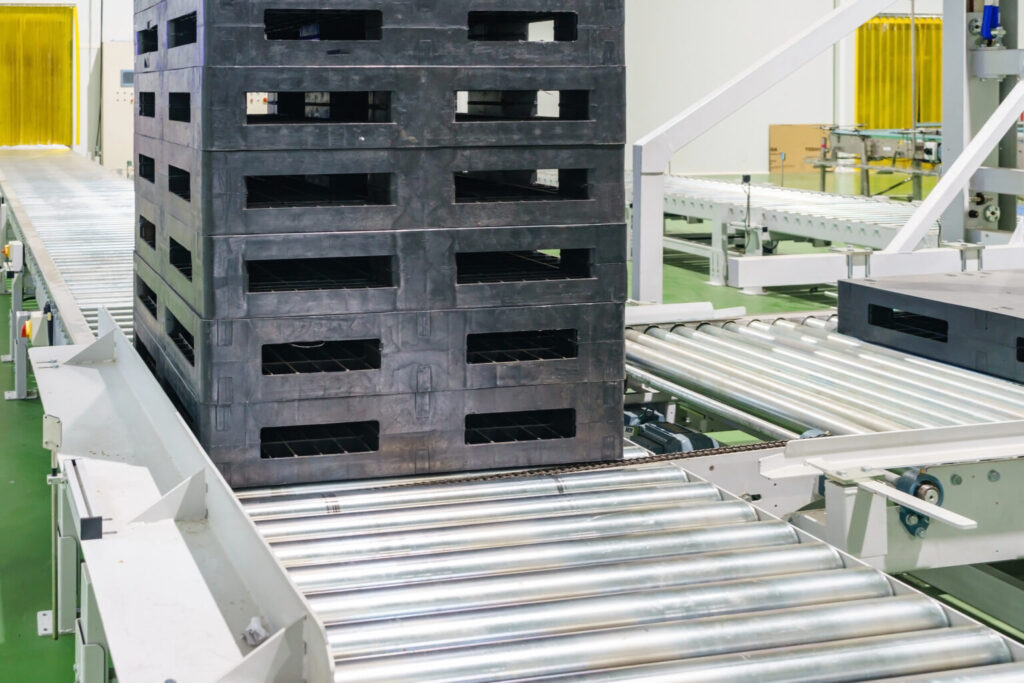
- ASRS Pallet Shuttle
Automated pallet-handling equipment needs uniform pallet dimensions and high integrity. ASRS depends on consistency because sensors, conveyors, lifts, shuttles, and cranes are designed around predictable pallet geometry and stable loads. Damaged pallets, non-standard repairs, protruding fasteners, or inconsistent bottom decks can trigger faults, stoppages, or mis-handling.
Also, don’t forget powered conveyors. Pallet weight and quality also affect conveyor system performance. Roller and chain conveyors need pallets that are flat, structurally sound, and within load specs to avoid damage or stoppages.
Uneven bottoms, missing deck boards, and loose components can cause poor tracking, impact points, and hang-ups that lead to downtime, product damage, or accelerated wear on conveyor components.
Take the Next Step With Confidence
 If OSHA asks you to prove pallet capacity, the worst answer is silence.
The best answer is a simple paper trail: pallet spec, load ratings for how you use it (static, dynamic, rack). You should have a documented inspection process that keeps compromised pallets out of high-risk storage and handling.
If stored materials can slide or collapse, that is a problem regardless of whether the pallet is Grade A or Grade B.
Safe Storage Starts with Smart System Design
Pallet quality is just one part of a much bigger safety equation. Your racking and material handling systems should be designed with your pallet specs, load weights, and operational flow in mind to ensure safe, reliable performance. At Apex, we build systems that account for these factors from the start — helping you reduce risk and improve efficiency across your operation.
We also offer comprehensive rack inspections to identify risks and optimize your storage strategy, all in alignment with OSHA guidelines and best practices.
If you have concerns about pallet performance, racking compatibility, or overall warehouse safety, our team is here to help.
Contact us to schedule a racking evaluation or speak with a warehouse systems expert.
Check out these related blogs for a deeper dive into warehouse pallets and their use:
