
Double-Deep Pallet Rack – Design Tips from your Local Apex Colorado Warehouse Experts

Is a Double-Deep Pallet Rack System Right for Your Operation?
Double-Deep Pallet Rack offers twice pallet positions in a more compact footprint than a standard selective pallet rack system. This design is ideal for inventory with a range of high-volume SKUs and is usually arranged back-to-back with another double-deep row to eliminate even more aisles and maximize space. The main benefits are utilizing your vertical space to open up valuable floor space and easy access to pallets for loading and unloading. However, the system does necessitate the use of a deep-reach forklift.
Here is a list of benefits and challenges to consider when exploring a double-deep pallet rack system.
Double-Deep Pallet Racking Advantages
- Vertical design & fewer aisles -maximize warehouse space
- Twice the pallet positions within the same space
- Easy to access FIFO storage
- Requires little maintenance
Double-Deep Pallet Racking Considerations
- Deep-reach forklift is required
- Longer pantograph on a deep-reach truck can limit capacity
- Decreased pallet selectivity vs. selective
- LIFO rotation
- May sacrifice floor-level pallet position depending on design
- Rear pallet utilization can be compromised
We’ve also compiled a list of guidelines and tips to ensure that your system is optimally configured for your warehouse.
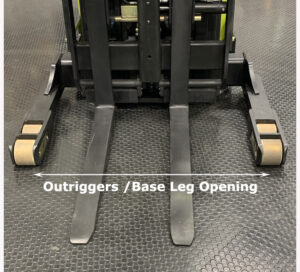
Forklift Safety & Deep-Reach Rack
A deep-reach forklift is designed with unique features that stabilize it when extending both vertically and horizontally into a double-deep storage system. The main components that enable this are the outriggers and the pantograph –let’s dig a little deeper into how these mechanisms work.
- Deep-reach trucks have two outer support legs called – outriggers which help distribute the load weight to stabilize the vehicle. The outriggers will have one or two wheels depending on the vehicle design. They also account for the base leg opening (BLO) width –which adjusts from narrow to wide. Choose your vehicle based on load capacity, warehouse traffic patterns, and overall lift height.
- The pantograph is the scissor-like mechanism of the deep-reach truck that enables the forks to extend out and into the deep racking.
Design Applications to Accommodate Deep-Reach Forklifts

Unlike a standard forklift that enters a rack system with just the forks, the outriggers of a deep-reach vehicle slide under the bottom beam for stability. The bay width of your pallet rack must be in sync with the BLO setting of the outriggers to allow them proper space beneath the rack system. For example, the BLO can range from an inside dimension of 42 ½” to an out-to-out width of 53 ½”. Be sure to consult manufacturer specifications when designing your system.
Double-Deep Pallet Rack Design Applications
There are three application options:
- Expanded Bay Opening – used with a wide BLO to enable floor-level storage
- Bottom Beam – 1st pallet level rests on beams
- Recessed Front Colum – design lower portion of the columns to remove outrigger obstruction
1. Expanded bay opening – The illustration below shows a widened bay opening of 102” to 104”. The BLO is wider than the pallet width, which creates enough clearance to place the pallets on the floor between the outriggers. Additionally, this design eliminates the need for a bottom beam. However, a bottom beam may be required to facilitate cleaning underneath the pallet rack system in certain environments, such as food production.

-
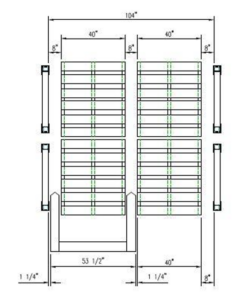 Bottom beam – As shown in the illustration (right), the 1st pallet level rests on beams, not the floor, to maximize capacity. In the illustration, right, we show how to use a 96” beam for this design —the columns are 5” wide with a 40” w pallet and 6” between the pallets.
However, depending on column width and pallet size, you may need 102” -104” wide load beams. Also, ensure that your baseplates are adequately sized to handle the load capacity, whatever your design.
A side-shifter attachment on your deep-reach forklift is necessary to position the load in the bay without moving the vehicle.
- Recessed front column – by redesigning the lower portion of the front columns, you expand the outrigger access to the system. Column designs can vary between — offset, slope, and raised I-beam styles.
-
- Offset/Cant leg upright – Sharp recessed front column creates a 90-degree angle to the rear post. The 90-degree offset makes it easier for forklift operators to turn into the rack and position outriggers safely without striking the front columns. The height of the offset can vary from 6” off the ground or higher. This design supports a first-level pallet position and beam.
- Slope leg upright – The front column slants back toward the rear column, opening up the forklift access and preventing strikes. The degree of the angle varies based on capacity limits and rack measurements. This option is also often used in drive-in pallet racking to provide a wider forklift turn radius.

-
- Raised I-Beam – this cleaver design provides outrigger clearance while minimizing the amount of aisle space needed. Take a closer look at the pros and cons of a raised I-beam design.
Raised I-Beam Pros
- Pallet supports provide abuse resistance in the horizontal direction
- Continuous load-bearing pallet support
- Bottom beam can be removed for floor-level storage
- Standard rack components for everything over base level
Raised I-Beam Cons
- Loss of 1” of vertical clearance on each level because interior beam is 5″ tall
- Monopost / frame design is limited to double-deep application
- First-level is higher than stacked I-beam base
- Trash and debris can get caught under the first beam level

Nail Down the Best Warehouse Design with Your Trusted Local Source
Apex Colorado is your local source for double-deep pallet racking and all your warehousing needs. Our experts are committed to warehouse function without sacrificing safety or cost-efficiency. Talk with our design team to customize your pallet racking systems to your unique inventory, warehouse space, and application goals. Apex Colorado will also install your warehouse systems to ensure proper function and meet your long-term needs. We also offer expert pallet rack and warehouse safety inspections and repairs through our Apex PROs. Call us today to discuss your pallet racking storage needs, and we’ll work with you to ensure the best solution.
