
Seismic Separation – Pallet Rack Design & Horizontal Clearance | Apex Safety Spotlight


Pallet Rack Design & Horizontal Clearance in Seismic Zones
Shake, rattle, and roll might be a fun song, but this type of movement is no fun inside a warehouse filled floor to ceiling with your inventory. That’s why buildings within seismically active areas require the expertise of seismic engineers. Your engineers will ensure that the facility and everything in it can shimmy if needed without catastrophe. One critical focus area is the positioning of pallet racking around fixed building features like walls and building columns. The space between these items is referred to as horizontal clearance or seismic separation.
According to the Rack Manufacturer’s Institute (RMI) design specifications: ANSI MH16:1, a certain amount of space or seismic separation must be allowed between the braced and unbraced rack sections and permanent building features.
The amount of allowance isn’t a constant. It is calculated based on several parameters, including the anticipated level of structure movement based on the seismic classification. The engineer’s calculations determine the required distance between the rack structure and columns, walls, etc. However, minimum clearance parameters for both down-aisle and cross-aisle positions can be used as a general guideline.
Down-Aisle & Cross-Aisle Horizontal Clearance – Pallet Rack Design
Horizontal clearance for pallet rack design relates to the relationship between the rack and the building column in both a down-aisle and cross-aisle position. The down-aisle perspective is from the view parallel to the shelf beam, whereas the cross-aisle is perpendicular to the rack bay opening.
 Down-aisle perspective |
 Cross-aisle Perspective |
The minimum clearance between racking and the fixed structure is calculated as:
- 5% of the racking height with the building in the down-aisle direction
- 2% of the racking height with the building in the cross-aisle direction
For example:
192” rack frame height would require 9.6” down-aisle clearance & 3.84” cross-aisle clearance
This minimum space between the rack and the building fixture allows for a degree of movement of the rack structure without striking the wall or column during a seismic event.
Again, each system design must adhere to the engineer’s specifications.
 Build Your Pallet Rack on Steady Ground
Call the Apex team for expert pallet rack design and full-service support for all your warehousing needs. Our systems engineers and design team will ensure your rack system is safe and meets your needs. We also offer professional rack installation, plus inspection and repair services as needed down the road. Just one call does it all, but we also have a way for you to take control over day-to-day rack safety –the Apex Rack Repair App.
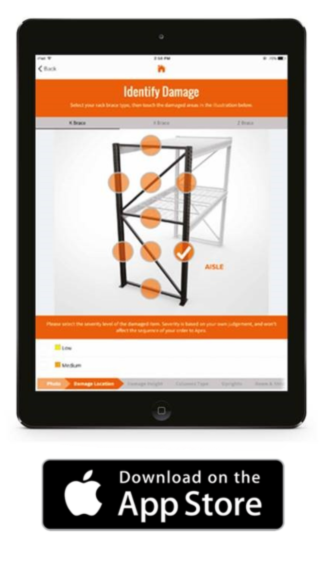
The Rack Repair App is a free downloadable app that guides you through a pallet rack inspection capturing all the details you need for a thorough evaluation and custom repair kit.
The Apex Rack Repair App lets you respond quickly to rack damage incidents to assess the level of safety concern. Just capture a few specs, upload pictures, and the Apex team will provide a thorough damage assessment.
If you prefer to leave your rack inspection to the PROs, our certified rack inspectors will come to you. Just Call the Apex PROs to schedule your full warehouse inspection today.
Give the Rack Repair Mobile App a try today! Easy to download from the App Store.
Related Blogs:
Pallet Rack Design and the Rocky Mountain Seismic Shift
Pallet Rack Inspection – Gauging Out Of Plumb & Height-Depth Ratio | Apex Safety Spotlight
