
Selective Pallet Rack in Utah | 100% SKU Access & Fast Installation
Statewide Design & Installation Services
What Is Selective Pallet Racking?
When warehouse operations juggle hundreds of SKUs and need every pallet on demand, storage systems that bury inventory quickly become a bottleneck. Selective pallet racking stores full pallets in single-deep rows across multiple vertical levels and gives forklifts direct access to every position, so there's no shuffling, no buried inventory, and no wasted time hunting the right SKU.
The system supports FIFO rotation through single-aisle put-away and retrieval, and back-to-back row configurations consolidate aisle space to add pallet positions without more square footage. Lower beam levels can be fitted with wire decking and converted from pallet storage to carton flow or piece picking as your inventory mix shifts. For distribution centers managing diverse stock, selective rack supports diverse SKU management in operations where direct access matters more than peak density.
How Selective Rack Works
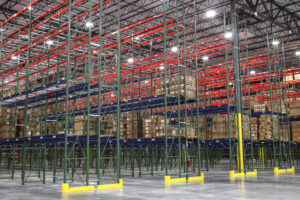
Understanding how load weight flows through a rack system helps you trust what's holding your inventory. Selective pallet rack uses vertical upright frames connected by horizontal beams at adjustable heights, with each beam pair supporting one pallet deep and forklifts accessing every position from a single aisle. Standard configurations work with common forklift types, so most warehouses can deploy selective rack without adding specialized vehicles.
Pallets sit on beams, beams transfer weight to uprights, and uprights carry it through footplates and anchors into the slab. Apex engineers size every component to your pallet dimensions, load weights, and storage height, so beam gauge, upright capacity, and anchor specifications match your specific inventory. Beam connectors lock with clips or bolts to prevent accidental dislodging during forklift operations.
Key Components
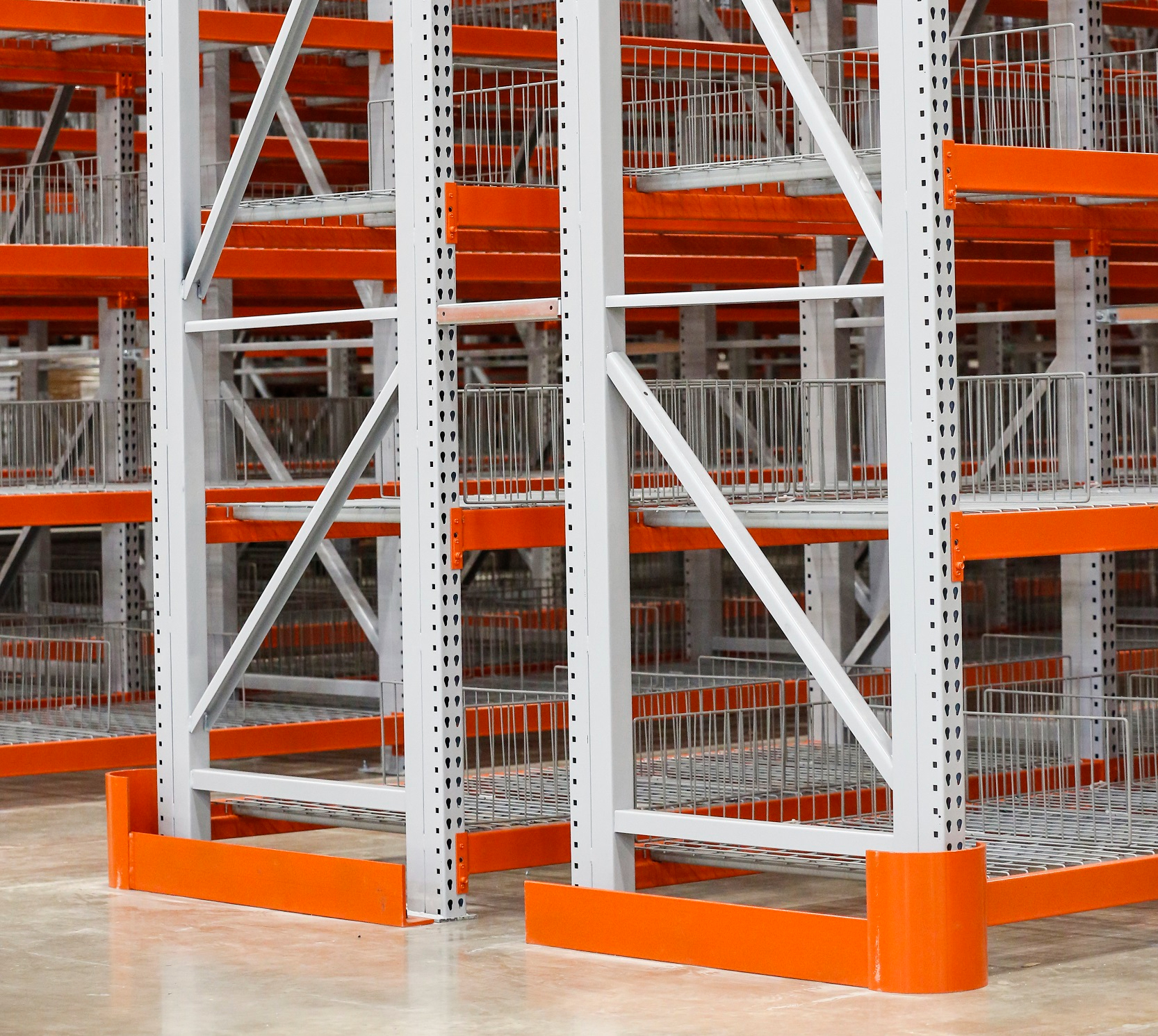
Selective rack components fall into two steel categories. Roll-formed uses lighter-gauge steel bent into shape, while structural uses heavier hot-rolled steel for higher load capacities. Column protectors bolt to the floor in front of uprights to absorb forklift impact before it reaches the column, and a single hard strike to an unprotected column can compromise an entire rack section.
End row guards protect the exposed ends of rack rows. Wire decking spans between beams to catch loose cartons, and its permeable surface meets fire safety code standards. Footplates anchor uprights to the slab; loose or missing anchors create safety risks. Beam connectors lock beams to uprights using clips in roll-formed systems or bolts in structural systems.
Roll-Formed & Structural Steel
Roll-formed steel is lighter to ship and faster to assemble. Structural steel uses heavier-gauge hot-rolled material for higher load capacity and impact resistance in heavy-traffic environments.
Wire Decking
Spans between beams to create a stable surface that prevents loose cartons and pallets from falling through. Improves fire suppression performance.
Column Protectors
Bolt to the floor in front of upright columns, absorbing forklift impact before it reaches the structural steel.
Footplates & Anchors
Secure each upright to the warehouse slab. Anchoring is not optional—unanchored rack is an immediate safety risk regardless of load status.
Row Spacers & End Guards
Connect back-to-back rack rows for stability and protect exposed ends of rack rows where forklift traffic crosses.
Beam Connectors
Lock beams to uprights using safety clips or bolted connections. Prevents accidental dislodging during forklift operations.
Selective Pallet Rack in Utah
Salt Lake City & Statewide Coverage
Utah warehouse projects need partners who understand local seismic requirements and can execute on tight timelines. Apex has a dedicated sales team based in Salt Lake City that works on-site to evaluate your facility, scope your project, and coordinate delivery from initial consultation through installation. Quick Ship selective rack components ship from stocked warehouses in Aurora IL, Denver CO, and Hickory NC, with Denver providing the shortest transit time to Utah facilities.
Installation crews cover Salt Lake City, Ogden, Provo, St. George, and the I-15 and I-80 distribution corridors, and engineers factor seismic zone requirements into every Utah pallet racking design, including base plate sizing, anchor specifications, and bracing configurations.
Where Selective Rack Fits Best (And Where It Doesn't)
Not every warehouse layout benefits from the same rack system, and selective pallet rack is widely applicable across warehouse operations, but it isn't the right answer everywhere.
Selective rack works well when:
Selective rack is not the best fit when:
The right storage solution depends on your inventory profile. We evaluate your operation and recommend the configuration that fits how you actually move product, whether that's selective rack alone or different types of storage products working together across zones.
Selective Rack Configuration Options
Selective pallet racking adapts to nearly any warehouse floor, and the configuration decisions you make during design directly affect storage capacity, equipment compatibility, and warehouse efficiency. Single rows work along walls, while back-to-back configurations pair two rows separated by a flue space to eliminate one aisle and add pallet positions per square foot, helping you maximize storage capacity without expanding your footprint while keeping fire suppression access open. Aisle width determines which forklifts can operate. Counterbalance trucks need 12 to 13 feet, reach trucks operate in 9 to 11, and VNA turret trucks work in as little as 6 to 7.
Roll-Formed vs. Structural Steel
When load weights run high or forklift traffic is heavy, the steel type you choose can mean the difference between a rack that lasts a decade and one that gets replaced. Roll-formed steel is lighter to ship and faster to assemble, lowering cost and prioritizing easy assembly for most warehouse storage applications within typical load ranges.
Structural steel uses heavier-gauge hot-rolled material for greater load capacity and impact resistance, recommended for extreme heavy loads, cold storage, or facilities with elevated column-strike risk. Your Apex engineer sizes every component, including quality-built heavy duty beams, to your actual pallet weights rather than a general rule.
Aisle Width Planning
Aisle width drives layout density and equipment requirements, and a few feet in either direction can shift your pallet position count by double digits across a full warehouse floor. Recommended minimums by forklift type:
| Equipment Type | Minimum Aisle Width |
|---|---|
| Standard Counterbalance (Cushion) | 12'-9" |
| Standard Counterbalance (Pneumatic) | 13'-9" |
| Sit-Down Electric (3-Wheel) | 11'-0" |
| Sit-Down Electric (4-Wheel) | 12'-0" |
| Stand-Up Reach Truck | 9'-0" |
| Stand-Up Electric | 10'-4" |
| VNA Swing-Mast / Turret | 6'-2" |
Tighter aisles fit more pallet positions but require equipment capable of operating in the reduced space. Converting to reach trucks or VNA equipment opens significant vertical space and density gains as your operation scales.
Height is capped by clear ceiling, lift capacity, and the 6:1 height-to-depth ratio, beyond which overhead ties and row spacers are required. Double-Deep Pallet Racking is a different system that stores two pallets deep per position and requires a specialty Deep-Reach forklift with rack designed specifically for it.
Safety & Compliance Requirements
Rack failure isn't theoretical. Every selective rack installation must meet structural and safety standards that protect your people, inventory, and operation. Apex engineers design to RMI guidelines, factoring load weight, beam span, upright height, and seismic zone. OSHA requires warehouse storage equipment and practices to be kept in safe condition and free from recognized hazards. Standard requirements include floor anchoring, capacity placards on every row, and removing damaged components until repaired.
RMI Standards
Rack Manufacturers Institute standards govern rack design, load capacity calculations, and structural specifications. Apex engineers design to RMI guidelines, factoring in load weight, beam span, upright height, and seismic zone.
OSHA Requirements
Racks must be anchored to the floor. Load capacity placards must be posted on every row, visible to forklift operators. Damaged components must be unloaded and taken out of service until repaired or replaced.
Anchoring Specifications
Determined during engineering based on slab thickness, concrete strength, and rack height. For Utah installations, seismic requirements often dictate larger base plates and additional anchoring beyond standard specifications.
Impact Protection
Column protectors absorb forklift strikes before they damage structural uprights. End row guards shield exposed rack ends. For additional protection in heavy-traffic aisles, consider column bracing or reinforced columns (backers).
Regular Rack Inspections
Regular inspections catch damage before it becomes a safety hazard. Our Apex PROs, trained through a SEIZMIC Engineering-certified program, perform OSHA-compliant inspections that cover structural integrity, damage assessment, and load compliance. Each report is a detailed Pallet Rack Safety Audit with independent repair recommendations.
What to Consider Before You Decide
Selective rack is a practical solution for most warehouse operations, but the right system starts with the right evaluation:
Inventory Profile
SKU count and pallet volume shape your layout; load weights determine beam and upright sizing; rotation requirements affect system type. Plan for peak inventory volume, not average.
Facility Constraints
Clear ceiling height sets your storage levels and how far you can push vertical space. Column placement affects aisle layout, floor slab condition determines anchoring requirements, and fire suppression may require flue space between pallet loads and rack tops.
Equipment Compatibility
Your forklift fleet dictates aisle widths and lift heights. Design for the equipment you plan to run, not just what you have today. Narrower aisles require more experienced operators for safe material handling.
Budget & Timeline
New rack offers full configuration flexibility through engineered design. Used rack cuts costs when available sizes match your specs. Quick Ship Pallet Rack inventory and phased installation keep your operation running while sections come online.
Accessories & Protection Options
The right accessories extend rack life and protect your people. Build them into the initial design:
For a full range of protection components, see our Rack Safety Accessories.
Protection Essentials
Column Protectors
Absorb forklift impacts
Wire Decking
Fire code & pallet support
End Row Guards
High-traffic zone protection
Safety Netting
Prevent falling items
See Selective Pallet Rack in Action
Selective Rack vs. Other Storage Systems
Every pallet racking system trades off density, selectivity, and cost. Here's how selective rack compares to other warehouse storage solutions:
Selective vs. Double-Deep
Selective Rack Systems provide 100% selectivity with direct aisle access to every pallet. Double-deep is a separate system that stores two pallets deep, increases density, and requires a Deep-Reach truck with rack engineered specifically for it.
Selective vs. Drive-In
Drive-in suits low SKU variety, high volume per SKU, and LIFO rotation. In most configurations it provides higher density by eliminating aisles but increases column-strike risk.
Selective vs. Pallet Flow Racking
Pallet Flow Rack uses gravity-fed flow rack systems for automatic FIFO rotation and greater density, often the stronger choice for high-volume, date-sensitive inventory where carton flow or full-pallet flow rack management is needed.
Selective vs. Push-Back
Push back stores 3 to 5 pallets deep on LIFO inclined carts, delivering better density for medium-volume SKUs but sacrificing direct access to every position.
No single system is the best solution for every operation. A side-by-side evaluation of your inventory profile, throughput targets, and rotation requirements usually clarifies which system earns its place in each zone of the warehouse.
Integration with Material Handling Equipment
Selective pallet rack works with standard counterbalance, reach trucks, order pickers, and walkies, so it fits most existing forklift fleets without equipment changes. Counterbalance trucks handle put-away and retrieval in standard-width aisles, reach trucks operate in narrower configurations to fit more rows per warehouse floor, order pickers lift operators to upper beam levels for case and piece-level picking, and walkie stackers carry lighter loads in tighter spaces.
Narrow aisle and VNA configurations pair selective rack with turret trucks or swing-mast equipment, compressing aisle widths to as little as 6 feet, though they require Forklift Wire Guidance Systems and higher operator training. For operations exploring Warehouse Automation, the same rack structure can integrate with automated guided vehicles and mobile robots that handle repetitive put-away and retrieval. Automation integration is typically premature when SKU velocity data, throughput baselines, and pick-pattern analytics haven't been established, or when the operation hasn't stabilized enough to validate where automation will pay back. Most warehouses benefit from running manual selective rack operations first, then layering automation where specific bottlenecks show up in the data.
New, Used & Quick Ship Options
Budget, timeline, and project scope all shape which option makes sense for your storage needs. New components come engineered to your specifications and ship from the manufacturer to match your project requirements.
Used Rack components can save up to 50% vs. new, with refurbishment available on request when needed, though availability depends on current stock. Quick Ship isn't the right path when your project requires non-standard punch patterns, height configurations outside stocked sizes, or matching to existing rack where used inventory or custom fabrication is the better fit. Our Online Quote Builder prices new components directly, or call our team at (833) 903-5246 for used inventory or larger projects.
Apex Installation & Project Management
Projects that get handed off between disconnected teams stall out, which is why Apex runs selective rack work from initial design through final installation under one project team. 3D AutoCAD layout and modeling gives you a complete visual before a single component ships, with engineers confirming beam levels, aisle widths, column clearances, and load configurations. PE certification is available when required by local permitting.
3D AutoCAD Layout
Complete visual of your rack system before a single component ships. PE certification available when required by local permitting.
Permitting & Compliance
Built into the project timeline. Our team handles code review, permit applications, and inspections.
Utah Installation Teams
Operate statewide with experience in local building codes and seismic requirements. Minimize disruption to your operations.
Permitting and compliance are built into the project timeline through code review, permit process, and project scheduling, and Utah installation crews operate statewide with experience in local building codes and seismic requirements. Custom fabrication and in-house painting match new components to your existing system color, and with deep team experience across Engineering and Design and National Pallet Rack Installation, you get one point of contact from start to finish.
Frequently Asked Questions
Selective rack stores one pallet deep per aisle face, giving you immediate access to every position. Double-deep stores two pallets deep, requiring a Deep-Reach truck but providing increased density. Choose selective for high SKU variety and FIFO rotation. Choose double-deep when you have medium-volume SKUs and can accept reduced selectivity.
Get Expert Help with Your Selective Rack Project
Not sure if selective rack fits your unique needs? Our Utah sales team provides on-site consultations covering layout review, system sizing, and budget planning for warehouse projects statewide. Whether you're working with a new facility or reconfiguring existing shelving and storage racks, we start with your inventory and your operation, then build the right rack system around it.
Schedule a facility review with Apex's Utah team. We Got This!