
Push-Back Racking in Utah | High-Density LIFO Storage Solutions
When Utah warehouses run out of floor space before they run out of inventory, storage capacity becomes the constraint on the whole operation. Push-back racking in Utah gives high-volume facilities a path to denser warehouse storage without giving up SKU selectivity, keeping warehouse efficiency steady on a single aisle.
Talk to an Apex engineer about your warehouse project.
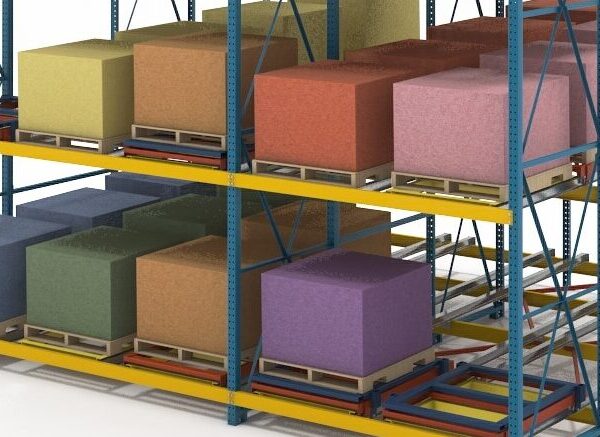
Push-Back Racking: High-Density Storage Meets SKU Selectivity
Push-back racking is a dynamic racking system built on nested carts that ride inclined steel rails. Loading a pallet pushes the cart behind it deeper into the lane. Pulling the first pallet lets gravity bring the second pallet forward. The result: high-density pallet racking systems that load and unload from a single aisle, with every lane dedicated to one SKU.
Standard configurations run 3 to 4 pallets deep, and some pushback rack systems extend up to 7 depending on your inventory profile and available space. Because each lane operates independently, you keep full SKU selectivity across the system while reducing aisles, tightening forklift moves, and raising warehouse racking density without consuming valuable floor area.
Push-Back Racking Advantages
Organized SKU lanes
Each lane is dedicated to one SKU. The lane structure organizes inventory for quicker access and reliable picking accuracy.
Higher density with consolidated footprint
Push-back maximizes space by consolidating pallet storage and eliminating aisles.
Ideal for high-volume, lower-SKU operations
Push-back performs best in high-volume, lower-SKU environments.
Reduced rack damage
The forklift doesn't enter the lane, so rack damage is reduced compared to drive-in systems.
Reserve inventory in-lane
Deep lanes store reserve inventory directly, and the pick face is automatically replenished, which eliminates downtime between picks.
Low maintenance requirements
Fewer moving parts than powered systems means less ongoing upkeep.
Utah Warehouse Storage: Apex Push-Back Racking Solutions
Utah facilities face tight floor plates, real seismic considerations, and aggressive timelines. Apex supports warehouses across the greater Salt Lake City area, West Valley City, West Jordan, South Jordan, Spanish Fork, and Eagle Mountain with design, engineering, and installation from a local Salt Lake City team that knows how Utah buildings and sites behave.
Rack systems installed in Utah should meet the seismic design requirements that apply to your site, and Apex engineers factor building conditions, floor slab specifications, and local code into the layout from the start. Push-back racking is engineered and built to spec for each Utah facility, and your local Apex contact coordinates the full project scope from design through installation.
Request a Project ReviewLocal Salt Lake City Team
- ›Design, engineering, installation
- ›Seismic-aware system layouts
- ›Building, slab, and code review
- ›Single point of contact through install
Your Apex contact in Salt Lake City coordinates the full project scope, from design through installation.
Push-Back Racking vs. Other High-Density Storage Systems
Choosing the right storage solution starts with understanding the trade-offs between density, selectivity, and equipment cost. Here is how push-back racking compares to common alternatives:
| System | Density | Selectivity | Est. Cost/Position | Equipment Needed | LIFO/FIFO |
|---|---|---|---|---|---|
| Selective Pallet Racking | 3/10 | 10/10 | ~$150 | Standard forklift | N/A |
| Double-Deep Pallet Racking | 4/10 | 7/10 | ~$150 | Deep-reach forklift | LIFO |
| Drive-In Pallet Racking | 6/10 | 2/10 | ~$200 | Counterbalance forklift | LIFO |
| Push-Back Racking | 5/10 | 5/10 | ~$275 | Standard forklift | LIFO |
| Pallet Flow Rack | 7/10 | 5/10 | ~$375 | Standard forklift | FIFO |
Push-back is the stronger fit when you need density and selectivity together, your rotation is LIFO-compatible, and you want to avoid the equipment investment that double-deep systems require. For FIFO operations, pallet flow rack is the right direction. When maximum density is the only goal and per-pallet access is low priority, drive-in racking may fit better.
Where Push-Back Racking Works Best (And Where It Doesn't)
Ideal Applications
Push-back racking performs well in operations running high-volume inventory with a low number of SKUs. Distribution centers moving high-velocity product through a consistent pallet configuration get strong returns, and cold storage facilities benefit from consolidating inventory into fewer aisles and less conditioned space to maximize operational efficiency.
Push-back also works in facilities where available space is scarce and selective racking would demand too many aisles to hit the required pallet count. If your operation checks those boxes, the system pays for itself through density and throughput gains on a single aisle.
Not a Fit When
Push-back racking is not the right choice when FIFO rotation is required. LIFO is built into the system, so the first pallet loaded comes out last. If your products or processes can't accommodate that, pallet flow rack is the better direction.
Operations with only one or two pallets per SKU won't see meaningful density gains from push-back. Variable pallet sizes are another mismatch, since the system is configured for uniform pallet specifications and inconsistent dimensions compromise alignment and safe operation. For inventory requiring access to every pallet at once, Selective Rack Systems are usually the more practical solution.
Facility Requirements and Operational Constraints
Push-back rack design starts with the building itself. Clear height, floor condition, and column placement all affect how the system fits the space. Aisle width requirements are then shaped by the lift equipment in use and the size of the loads being handled. Because those factors vary by facility, Apex engineers review the building, equipment, and operating conditions before the design is finalized.
Building Conditions
Clear height, floor slab condition, and column placement set the envelope. Apex reviews the building shell before any system design is committed so the layout works inside the real constraints, not theoretical ones.
Equipment & Aisles
Aisle width depends on the lift equipment in use and the loads being handled. Push-back is engineered around your existing fleet, not the other way around, so equipment changes are not forced by the rack design.
Operating Conditions
SKU velocity, pallet quality, and throughput patterns affect long-term system health. Apex engineers factor your operating profile into the layout so the system performs the way it was specified.
Request a project review to evaluate whether push-back fits your operation.
Request a Project ReviewHow to Properly Load and Unload Push-Back Racking
Single-aisle operation is one of push-back racking's core advantages, and using that aisle correctly keeps the system running efficiently. Forklift traffic moves in one direction, loading and unloading happen from the same aisle, and operator training makes a measurable difference in throughput, cart condition, and long-term system health. Apex offers operator training videos in English and Spanish on our website.
Steps to Load Push-Back Rack
- Square the forklift with the lane opening.
- Load the first pallet into the front position.
- Pick up the second pallet and push the first pallet back by driving forward slowly until the next cart is available.
- Lower the second pallet into position.
- Repeat for each pallet until the lane is full. The final pallet is placed directly on the rails.
Steps to Unload Push-Back Rack
- Square the forklift with the lane opening.
- Pick up the front pallet and back out slowly. Controlling your backup speed controls how fast the rear pallets advance.
- The remaining pallets roll forward under gravity to fill the front position.
Push-Back Racking System Components
Push-back racking systems are built from a straightforward set of components that work together to guide pallets safely through the lane.
Wheeled carts
Nested carts with polyurethane or steel wheels ride the inclined rails and carry each pallet through the lane.
Steel tracks (inclined rails)
The slope drives gravity-fed retrieval and guides cart movement throughout the system.
Roll-formed or structural steel frames
Upright frames form the backbone of the system. Structural steel is used in heavier-duty applications.
Cart stops or bumper plates
Positioned at the front of the system to help absorb the force of pallets during loading.
Load beams
Horizontal beams connect the uprights and support the rail system.
Push-Back Racking FAQs
Frequently Asked Questions
Three to four pallets deep is the most common configuration. Systems can be designed up to seven pallets deep depending on your inventory profile, ceiling height, and pallet specifications.
Get Expert Push-Back Racking Design and Installation in Utah
Utah warehouses face tight timelines and real space constraints, and push-back execution demands design precision, proper engineering, and trained installation to achieve the storage density the system is engineered to provide. Apex covers the full scope of warehouse projects, from Engineering and Design through National Pallet Rack Installation, with the kind of project management our largest national accounts expect.
Schedule a warehouse walk-through with Apex to review layout, seismic scope, and installation sequencing. We Got This!