
Pallet Flow Rack Systems in Utah
High-Density FIFO Storage
When a Utah warehouse runs high-volume SKUs with strict rotation requirements, traditional selective rack burns through floor space and stalls throughput at the pick face. Pallet flow rack solves both issues: a gravity-fed, high-density storage system where pallets load at one end and flow forward on pitched rails, always presenting the oldest inventory first. That's FIFO storage (first in, first out) engineered directly into the rack structure, and it's how operations across industries increase pallet positions within an existing footprint.
Apex serves Utah operations from our Salt Lake City team, providing pallet racking solutions, custom system design, regional installation, and ongoing support across the Mountain West. If pallet flow is the right warehouse storage solution for your operation, we'll confirm it before you commit. Talk to a storage expert at (833) 903-5246 or contact us online.
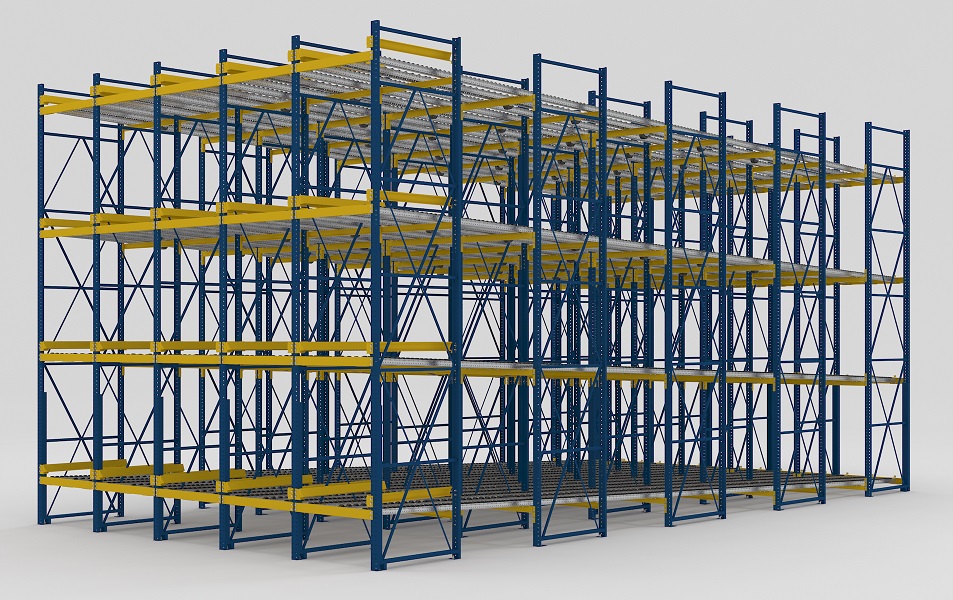
How Pallet Flow Rack Works
Pallet flow racking uses rails pitched at a slight downward angle from the charge (load) end to the discharge (pick) end. Gravity does the work. A pallet entering the charge side flows forward under its own weight, and each new pallet lines up behind it in the lane. When the front pallet is removed at the discharge end, the next pallet advances automatically. No forklift repositioning. No reaching into the system.
The result is a continuous, self-managing storage lane that keeps your oldest pallets at the front for access at all times. Understanding how pallet racking works in a flow configuration comes down to one principle: gravity replaces labor. Lane depth, rail pitch, and flow speed are all engineered to your specific load and operational requirements before installation.
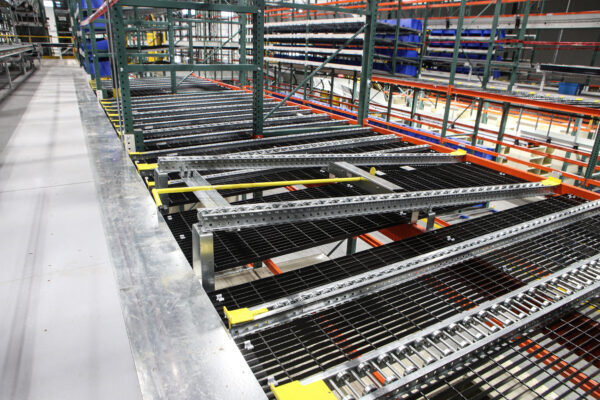
Loading Process
Loading starts at the charge side. The forklift squares to the opening, lifts the pallet slightly above the rails, centers it in the lane, and allows it to advance as the mast tilts back and withdraws. The system is built for durability across the full structure.
Flow rails absorb direct pallet contact every time a load enters the lane, upright frames carry the cumulative weight of every pallet stored in the system, and heavy-duty beams anchor the rails and define lane height under dynamic loading. Operational efficiency over time depends on all three components holding up to consistent forklift and pallet use, not just one of them.
Unloading Process
Unloading happens at the discharge end. The forklift squares to the pick face, lifts the front pallet clear of the end stop, and backs out. As the front pallet exits, the rear pallets automatically begin to flow forward and the next pallet moves into position.
Warehouse efficiency comes from the system itself. Your team isn't repositioning loads or navigating deep into lanes to reach inventory. Access stays at the front, and productivity holds steady across shifts because the flow racking does the work between cycles.
Where Pallet Flow Rack Fits Best
Pallet flow rack is designed for high-density storage where FIFO rotation is required. It is a strong fit for operations with higher pallet volumes, a manageable number of SKUs, and a need to maximize storage within a limited footprint.
Common applications include:
Food and beverage distribution, where product rotation is regulated or date-sensitive
Cold storage and freezer warehouses, where high-density storage reduces costly conditioned cube
Consumer packaged goods (CPG) fulfillment with fast-moving, uniform pallet loads
Industrial and manufacturing storage where consistent raw materials cycle through on a defined rotation schedule
Pallet flow works best with relatively uniform pallet loads and inventory that turns frequently, though the system can be designed to accommodate some variation when application details are reviewed upfront. By storing pallets in depth, it reduces aisle space and uses the footprint more efficiently.
Not a Fit When...
Pallet flow rack isn't the right storage solution for every operation. It's worth ruling out if:
SKU Count Is High, Volumes Are Low
SKU count is high and volumes are low per SKU. The system dedicates lanes per SKU. Too many low-volume SKUs means underutilized lanes and wasted available space.
Poor Pallet Quality
Pallet flow depends on pallets in good condition. Broken boards, damaged runners, exposed nails, and overall poor pallet quality can disrupt flow and increase the risk of jams or product damage.
FIFO Rotation Isn't Required
If your operation can manage LIFO and density is the primary goal, push-back or drive-in may better serve your unique needs and budget.
Space Constraints Limit Depth
Limited space constrains lane depth, which reduces the business case for flow racking relative to other storage solutions.
Case or Piece Picking Is Primary
Pallet flow is engineered for full pallet loads. For case or piece picking applications, carton flow rack is the more appropriate solution.
Throughput & SKU Patterns Are Stabilizing
Throughput and SKU patterns are still stabilizing. Pallet flow is engineered to specific inputs per lane, so without several months of reliable pallet-in/pallet-out data per SKU, lane depth and speed-controller specs become guesswork and reconfiguring after install is costly. Operations in a growth or reshoring phase are usually better served by selective or push-back racking first, with pallet flow revisited once the throughput data is firm.
Pallet Flow Rack vs. Other High-Density Systems
Pallet flow isn't the only high-density option, and it isn't always the right one. The two alternatives buyers weigh alongside it are push-back racking and drive-in rack, each with different mechanics, selectivity, and cost profiles. The table below shows how the three compare.
| Pallet Flow | Push-Back | Drive-In | |
|---|---|---|---|
| Inventory method | FIFO (gravity-fed) | LIFO (cart-based) | LIFO (forklift-driven) |
| Storage density (1–10) | 7/10 | 5/10 | 6/10 |
| Selectivity (1–10) | 5/10 | 5/10 | 2/10 |
| Pallets deep | 2-20+ | Up to 10 | 6-20+ |
| Est. cost/position | ~$375 | ~$275 | ~$200 |
| Best application | Date-sensitive, high-turn SKUs | Mixed-product LIFO operations | Single-SKU bulk storage |
Pallet flow is the right call when FIFO is non-negotiable: food, beverage, and date-sensitive pharma. Push-back racking is a cart-based, high-density LIFO system that stores pallets in dedicated lanes accessed from a single aisle. It is often a stronger fit than pallet flow when FIFO rotation is not required and floor space is limited. Pallet flow is typically better suited to high-volume, high-productivity FIFO storage, with separate loading and picking aisles. Drive-in pallet racking is a high-density storage system that minimizes aisle space by allowing forklifts to drive directly into the rack lanes. It works best for high-volume, low-SKU storage where LIFO is acceptable and dense storage is the main priority. The trade-offs are lower selectivity and slower pallet access than pallet flow, which can support deeper lane configurations and higher-productivity FIFO operation.
Weighing pallet flow against push-back or drive-in? Our team can walk through the tradeoffs against your SKU mix, pallet spec, and building depth before you commit.
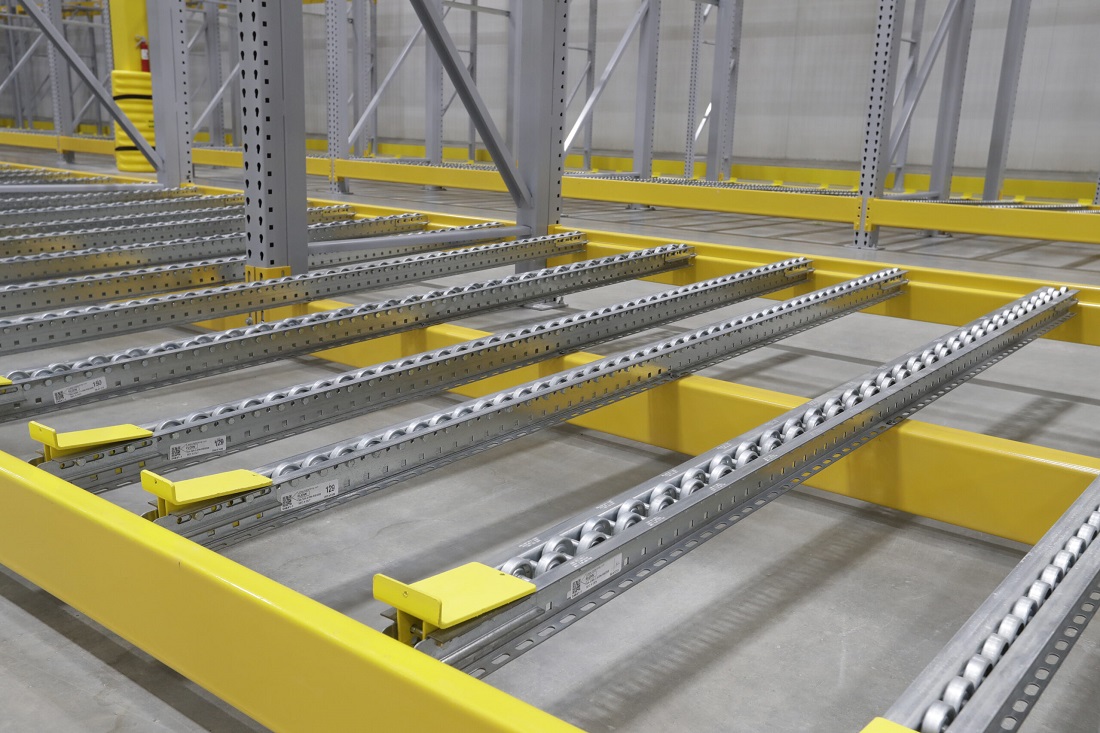
System Components and Accessories
A complete pallet flow system combines structural and functional components that work together under load. Every piece, from upright frames to speed controllers, is engineered to the demands of the application.
Structural components:
Optional accessories based on system design needs:
Wire decking, column protectors, and row end guards complete the installation. All components are sourced from manufacturers with documented load ratings matched to your facility conditions and safety standards. Weight capacity and component specs for every system are documented before the build begins, giving your ops and safety teams a clear reference during operation and future inspections.
Selection Criteria: What to Measure First
Before requesting a layout or quote, gather this data. It determines whether pallet flow is the right warehouse storage solution for your operation, and it drives every configuration decision.
Pallet Specifications
- Pallet dimensions (width and depth) and type (GMA wood, plastic, block, stringer, 2-way, 4-way)
- Load weight per pallet
- Load height, from top of pallet to top of product
- Pallet condition: are they uniform and well-maintained, or mixed quality?
Facility Constraints
- Available building depth per storage lane (this sets pallets-deep capacity)
- Clear ceiling height and any overhead obstructions above the storage footprint
- Floor condition, slab thickness, and rated PSI for anchor loads under heavy systems
- Column spacing and any irregularities that affect lane count and layout
Operational Data
- Number of active SKUs going into the system
- Throughput per SKU (pallets in and out per shift or day)
- Target pallets deep per lane
- Forklift type, lift height capability, and aisle width available at the charge and discharge faces
This data drives lane depth, rail pitch, speed controller spec, vertical space utilization, and total system footprint. If you don't have all of it yet, our team can help you identify what to measure and explain how each input affects the solution.
Common Issues and How to Prevent Them
Flow interruptions can result from pallet damage, poor pallet condition, load issues, dangling plastic wrap, or other application variables that affect pallet travel through the lane. Prevention starts with forklift operators checking pallets before loading to identify debris or other issues that could interfere with smooth flow.
Random Hang-Ups
Usually point to pallet quality. Wrong pallet style, poor board condition, or inconsistent load weight creates uneven contact with the rails. Prevention: standardize your pallet spec before commissioning the system. GMA wood pallets in good condition are the baseline recommendation.
Same-Location Hang-Ups
Indicate a physical issue in that lane section, typically debris accumulation, a damaged speed controller, or a broken wheel or roller. Resolution: inspect the specific area, clear debris, and assess component condition. Speed controllers and rollers are field-replaceable.
Pallets Advancing Too Quickly
Usually means speed controllers are under-specified for actual load weight, or load weight or pallet type changed after installation. Contact Apex to retest the system with current inventory specs. Running the system with mismatched speed controllers accelerates component wear and creates safety risks.
Recommended Maintenance Schedule
Consistent safety standards during maintenance protect both the system and the people working around it. Catching small issues on a regular schedule keeps productivity steady and avoids the downtime that follows component failure.
Pallet Flow Rack Solutions in Utah
Pallet flow rack is a highly customized system. Lane depth, rail type, speed controller configuration, and structural specs all need to be engineered to your facility, your pallets, and your throughput requirements. These are not stocked inventory systems pulled off a shelf, and Apex serves Utah operations from our Salt Lake City team.
Our team provides custom engineering, system design, and professional installation across Utah and the Mountain West. For standard warehouse pallet racking components, Apex carries new and used equipment including used pallet racking frames, beams, and accessories available for immediate shipment from stocked locations in Aurora, IL, Denver, CO, and Hickory, NC, with timely delivery to Utah job sites. Build your quote at apexwarehousesystems.com/shop. With 1,000+ years of combined experience across storage, engineering, and installation, Apex has the bench to get your system configured and installed correctly from the start.
Design and layout: 3D AutoCAD modeling and flow analysis for your facility
Professional installation: Regional teams handle permitting and coordinate labor requirements
Rack inspection: OSHA-compliant inspections by SEIZMIC-certified PROs
Repair and maintenance: Component replacement and system retesting when needed
Request a Quote
Get expert help with your Utah warehouse storage project. Our team provides layout guidance, specification support, and a full facility review.
(833) 903-5246Schedule ConsultationEngineering, Installation, and Ongoing Support
Before installation, Apex's engineering and design team uses 3D AutoCAD modeling and flow analysis to configure system depth, lane count, rail pitch, and level count, feeding ceiling height, column spacing, forklift specs, and SKU data into the model. Apex provides national pallet rack installation, with regional teams handling permitting, coordinating union or non-union labor requirements, and managing the schedule to minimize disruption to active warehouse racking operations.
After go-live, Apex PROs trained through a SEIZMIC Engineering-certified program conduct OSHA-compliant rack inspections covering structural integrity, load compliance, and damage assessment. When a component takes damage, speed controllers need adjustment, or the system requires reconfiguration after an inventory change, these rack inspection and repair services cover damage assessment, component replacement, and system retesting to restore full productivity quickly.
Ready for next steps? Request a system design and quote from our Utah team at (833) 903-5246 or contact us online.
Frequently Asked Questions
New or like-new GMA wood pallets in good condition are the standard recommendation for most pallet flow systems. CHEP and PECO pallets also perform reliably. The key factors are consistent dimensions, intact boards for even rail contact, and load weight within the system's design range. Plastic pallets can work but require testing with your specific rail and speed controller configuration before the system goes live.
Talk to a Storage Expert
Pallet flow rack is a purpose-built, high-density system. Getting it right means confirming fit and sizing before you configure it. Apex can review your facility constraints, pallet specifications, and throughput data to determine whether pallet flow is the right warehouse storage solution, and how to size it if it is.