
Cooler Storage: Climate-Controlled Vertical Lift Module or Walk-In Cooler?

IT’S MORE THAN A FRIDGE – IT’S A REFRIGERATED VERTICAL LIFT MODULE
Walk-in coolers (WICs) have been around for nearly a century – preceded by their ice-packed straw and sawdust ancestors; they are now a well-established option for cold storage. Insulated walls, airtight doors, and precise temperature and humidity controls make them suitable for storing a wide range of products. In comparison, the Vertical Lift Module (VLM) is a considerably newer technology that offers an automated approach to cold storage.
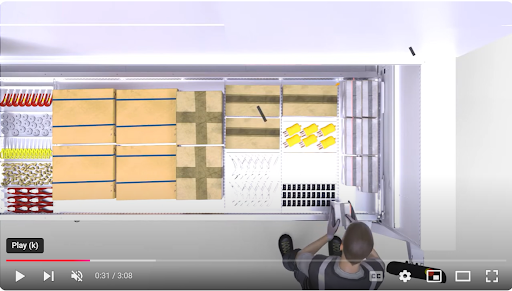
Climate-controlled VLMs are a type of Automated Storage Retrieval System (ASRS) with a compact vertical structure filled with horizontal storage trays that are automatically delivered to an operator at the face of the machine. The speed and efficiency of the VLM vs. requiring a worker to physically enter a cooler, search out an item, and make the pick can be considerable… but at what point does it make the best economical choice?
This is the question recently posed to the Apex team by a customer. Take a look at our comparison of the two systems… and be sure to read to the end to review our case study of our customer’s application.
Challenge #1 – Creating & Maintaining a Cold Climate
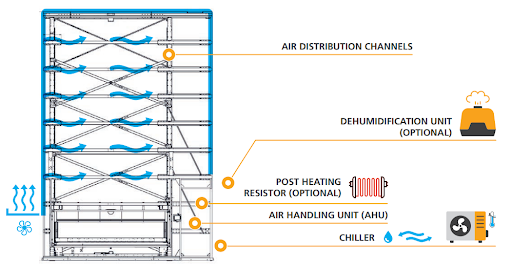 Photo from Modula Climate Control Brochure
Climate control is essential to prevent contamination and deterioration of the inventory. Maintaining a consistent temperature and humidity throughout the storage unit is critical.
- Cold spots can degrade medicines or chemicals quickly.
- Hot spots can spoil food items.
- For electrical components like semiconductors, moisture levels must stay within acceptable limits.
With the climate control bar set relatively high, let’s examine how these systems keep their cool… and how they compare if something does go wrong.
VLMS |
Walk-In Coolers |
|
Mechanics |
Use a chiller, air handling unit, and dehumidifier. The unit has insulated cladding and enclosed retrieval bays providing precise temperature control (+/- 2 degrees). |
Cooler rooms are insulated and cooled using split or self-contained refrigeration, air handling and dehumidifier. Split systems can be mounted anywhere, even on the building roof above the cold room. Self-contained WICs have built-in cooling and drainage (top or side of unit). |
Maintenance |
The maintenance door beside the main bay provides easy access and quick repairs. | Installation and maintenance can be a challenge depending on the refrigeration unit location. |
System Monitoring |
Features alarms and sensors to monitor failure in a cold environment. | Features alarms and sensors to monitor failure in a cold environment. |
Access |
Emergency removal of items – faster access to inventory stored in independent bays. | Executing emergency protocol is more challenging –cold air is released each time the door is opened. |
Challenge #2 – Maximizing Storage Capacity & Efficiency
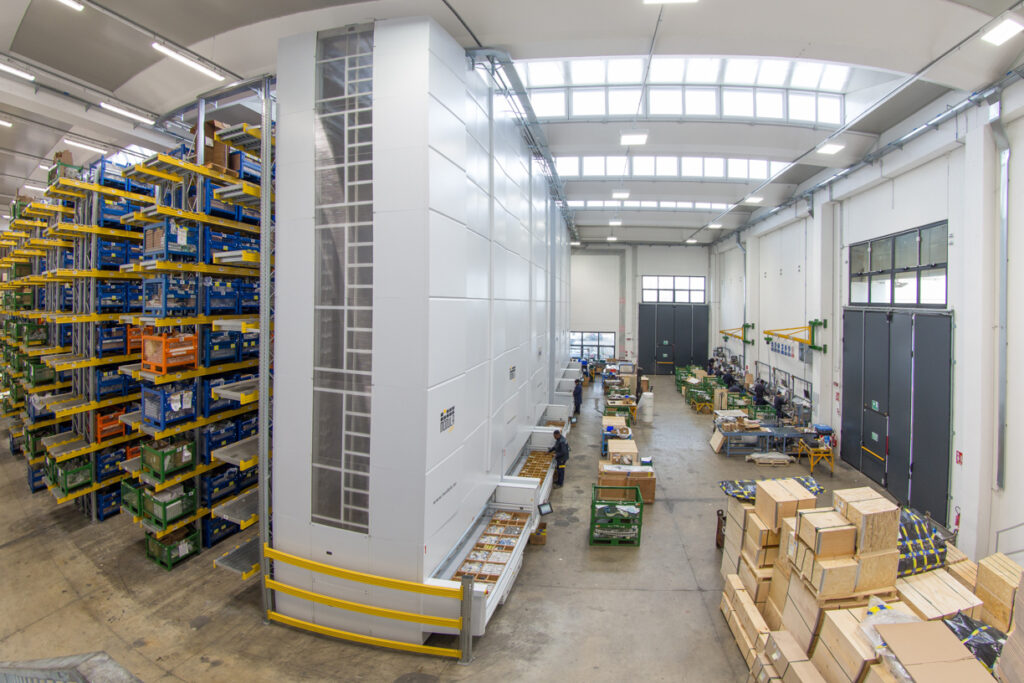
Vertical Lift Modules
The overall design of the VLM favors high-density storage saving up to 90% of floor space when compared to alternative cold storage systems. The unit uses sensors to detect the height of the items and automatically adjusts the spacing between trays to maximum capacity. This makes dynamic VLM storage a great choice for operations with future growth or seasonal inventory. Trays are stacked in two columns up the front and rear of the machine, leaving space in the center for a retrieval elevator.
Unit sizes range from 13 to 45 feet tall, with trays from 5 to 13 feet wide. Trays can be as shallow as 2 feet deep, minimizing the floor space required for a unit. On the ground side, an operator can use the operator interface to have items delivered. Depending on the configuration, they can reach up to 120 cycles per hour. Energy savings exceed WICs as VLMs only cool the limited product storage area and feature smaller bay openings vs. full-door access.
Walk-In Coolers
Walk-in coolers feature shelves surrounded by open space for workers to access items. The units can be outfitted with custom shelves for storage optimization, but they lack dynamic storage capabilities.
There are various styles of WICs available: prefabricated units are insulated panels that bolt together for most size configurations. The panels fit together to form a tight seal and can be soft-nose or hard-nose. Built-in styles are custom-tailored in size, flooring, insulation type, and style – but are not able to be moved or reconfigured easily.
Prefab WICs usually begin at 6’x6’ and can increase in one-foot increments. You can add future panels for expansion, provided the refrigeration unit supports the added capacity. Otherwise, expanding the unit requires costly upgrades. Built-in units offer less scalability since they are custom-fit to your space.
Challenge #3 – Ensuring Performance
Vertical Lift Modules
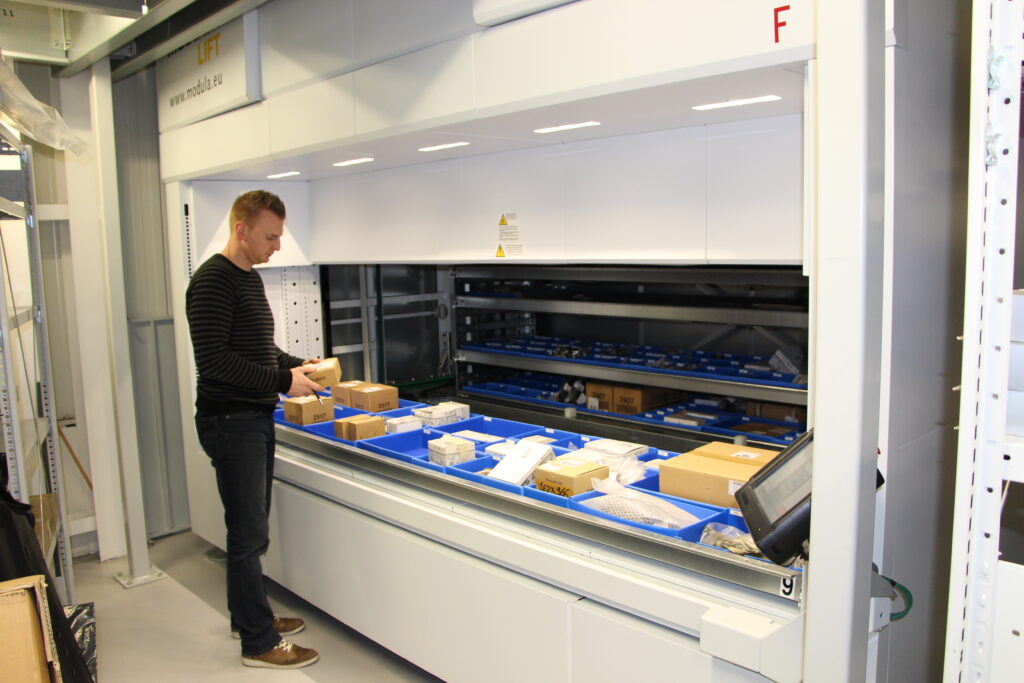
VLMs are capable of uniform temperatures between 2-40°C (+\- 2°) and 5% relative humidity depending on the desired temperature. VLMs can be outfitted with temperature alarms or light warnings to notify operators if the retrieval bay has been open too long or if the climate deviates from the desired conditions. For industries where a cold chain break is critical, the tray will not descend into the bay when conditions are not within range, preserving integrity.
The storage units are designed to make storage safe: security features like RFID readers and warehouse management software prevent loss due to mishandling. They are also fully enclosed and lockable. Items are delivered at an ergonomic height for workers working in ideal room temperatures. Options like pick-to-light, laser pointers, and data loggers streamline workflow and reduce picking errors.
Walk-In Coolers
WICs offer a cost-effective and straightforward solution for cold storage needs, providing ample space for storing perishable goods. While they lack the advanced features of Vertical Lift Modules, WICs are designed for easy access and organization, making them suitable for operations with lower turnover rates. Their customizable configurations allow businesses to tailor the size and layout to fit specific needs, ensuring efficient use of available space.
Case Study: VLM vs. WIC for Cold Storage
As we explore the practical implications of these differences, let’s delve into a real-world case study that highlights how a customer evaluated the benefits of switching from walk-in coolers to vertical lift modules for their cold storage needs.
Background: The fulfillment center currently stores refrigerated items in walk-in coolers (WICs). This study aims to assess whether using vertical lift modules (VLMs) would save space and increase order-picking efficiency compared to the existing WIC method.
Objective: To evaluate if implementing VLMs for refrigerated storage would improve space utilization, reduce manual labor, and handle anticipated growth compared to workers manually picking items from WICs.
Study Parameters:
- Applied Metrics: Historical data on pick rates and SKU volume from the previous quarter provide the baseline for comparison.
- VLM Configuration: VLMs were configured based on current inventory and building specifications. Each VLM could utilize 95% of the available space (leaving a 5% margin for safety).
- Space Utilization: The study calculated how much space could be optimized using VLMs for both forward and reserve refrigerated inventory storage.
- Throughput Capacity: The throughput of each VLM was calculated to ensure it could meet daily order fulfillment demands.
Key Data:
- Volume Growth: Used a projected 15% increase in inventory volume over the next two years.
- Inventory Turn Rate: The total inventory turns over every 10 days.
- Daily Throughput: Based on an average of 100 orders per day (5,000 orders per quarter), with 1-2 lines picked per order. The center processes over 100 lines per day from more than 6,000 inventory lines.
- SKU Volume: The fulfillment center handles over 300 refrigerated SKUs, with a total of nearly 20,000 sales units.
- Average Order: 3-4 units per order, with each line containing approximately 3 units.
Project Pick Rates:
VLM Tray Capacity: Fully loaded VLM trays can present 40 trays per hour at 30-second intervals. Even in a worst-case scenario (1 tray = 1 line), each worker could pick more than 40 lines per hour per machine. Most trays, however, will hold about 4 items, so actual pick rates are expected to exceed this minimum.
Pick Time: The study concluded that a worker using the VLM system could complete the daily orders within just 2 hours, significantly reducing time spent in cold storage environments compared to the current WIC-based process.
Results:
Efficiency Gain: Using VLMs, one worker can process the entire daily order volume in 2 hours, compared to the more labor-intensive WIC method.
Space Savings: VLMs maximize vertical space utilization, reducing the overall footprint required for cold storage.
Scalability: The VLM system would accommodate a projected 15% growth in inventory volume over the next two years, making it a scalable solution for future demands.
Conclusion:
The shift from walk-in coolers to vertical lift modules would significantly improve labor efficiency and space utilization. VLMs not only speed up order processing but also provide enough capacity for anticipated growth, offering a clear advantage over the current manual picking method in walk-in coolers. This transition would reduce the time workers spend in cold environments while optimizing the fulfillment center’s operational footprint.
Contact Apex for data-backed support to choose the most effective cold storage solution for your warehousing and distribution needs.
