
Smart Storage, Fresh Results: Pallet Shuttle Systems for Food & Beverage Manufacturing

Unlocking New Efficiencies in Food & Beverage Manufacturing with Pallet Shuttle Systems
Behind the scenes, food and beverage manufacturing facilities are juggling more SKUs, tighter traceability rules, shrinking space, and labor shortages. It’s a daily puzzle: store everything safely, move it fast, and never miss a beat. That’s why more facilities are turning to Automated Storage and Retrieval Systems (ASRS).
ASRS pallet shuttle systems boost capacity without new construction, cut energy use in cold storage, and keep people out of sub-zero aisles. Let’s explain how it works and why it’s bringing much-needed refreshment for food and beverage manufacturers.
Let’s Get to Know Pallet Shuttle ASRS
Automated Storage and Retrieval Systems (ASRS) are essentially warehouse robots that automatically put away and pick inventory. In the context of palletized goods, an ASRS often means a system of racks, shuttles, or cranes, and software working together to handle pallets with minimal human intervention.
A pallet shuttle ASRS is one subtype of these systems. Instead of a big crane covering an entire aisle, you have shuttle carts (think of them as robotic platforms) that run on rails inside the storage racks. These shuttles carry pallets into deep storage lanes and back out again, so forklifts no longer need to drive into every aisle. The shuttles are battery-powered and can handle heavy pallet loads (often up to around 3,300 lbs). They access every level of the racking system, enabling a consolidated, high-density storage cube-style design that maximizes floor and vertical space.
Software and sensors control shuttle movements, directing them to pallet positions for loading and extraction. Depending on the setup, they may operate through personnel-directed remote controls (semi-automated) or integrate with a warehouse management system (WMS) for full automation.
There are a few common variants of shuttle systems…
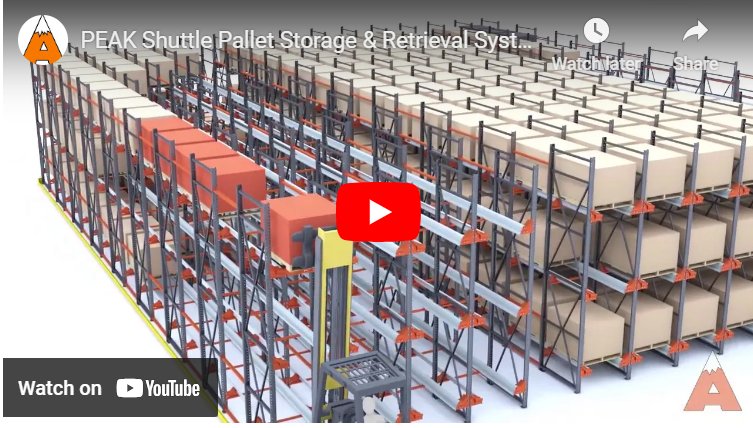
| PEAK 2-Way Shuttle – Semi-Automated |
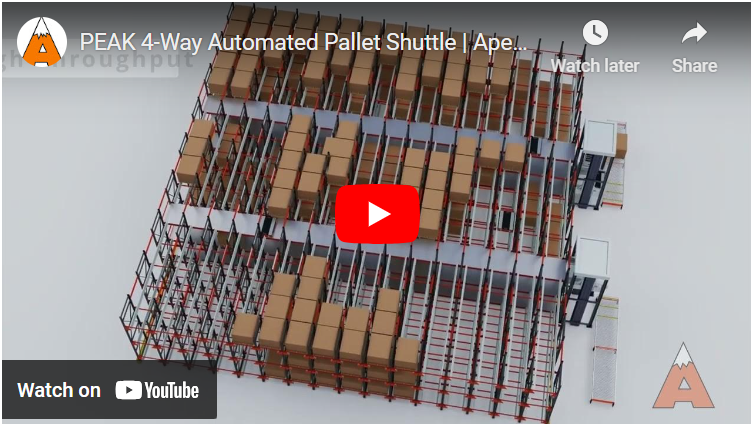
PEAK 4-Way Shuttle – Fully-Automated |
 |
 |
- 2-Way Shuttles – Forklifts place shuttles into storage lanes, where they move forward and backward to deposit or retrieve pallets. This semi-automated option is cost-effective and easy to set up, making it a good entry point for automation. However, flexibility is limited since shuttle activity is confined to single lanes.
- 4-Way Shuttles – Shuttles are transferred between rack levels by a vertical lift, then travel forward, backward, and side-to-side within the system. This design offers greater flexibility for managing high-volume SKUs and high throughput. While more expensive in equipment and training, it reduces reliance on forklifts and labor, delivering long-term savings.
- Mother/Child Shuttle Systems – Mother vehicles positioned on rack levels receive shuttles from a vertical lift, carry them along the main aisle, and deploy them into deep lanes. The process reverses for pallet extraction. This fully automated solution is ideal for large-scale or deep-lane storage (such as cold warehouses), offering very high throughput. The trade-off is a more complex design with higher costs and multiple moving parts.
4 Reasons Why Food & Beverage Manufacturers Are Turning to Pallet Shuttle Automation
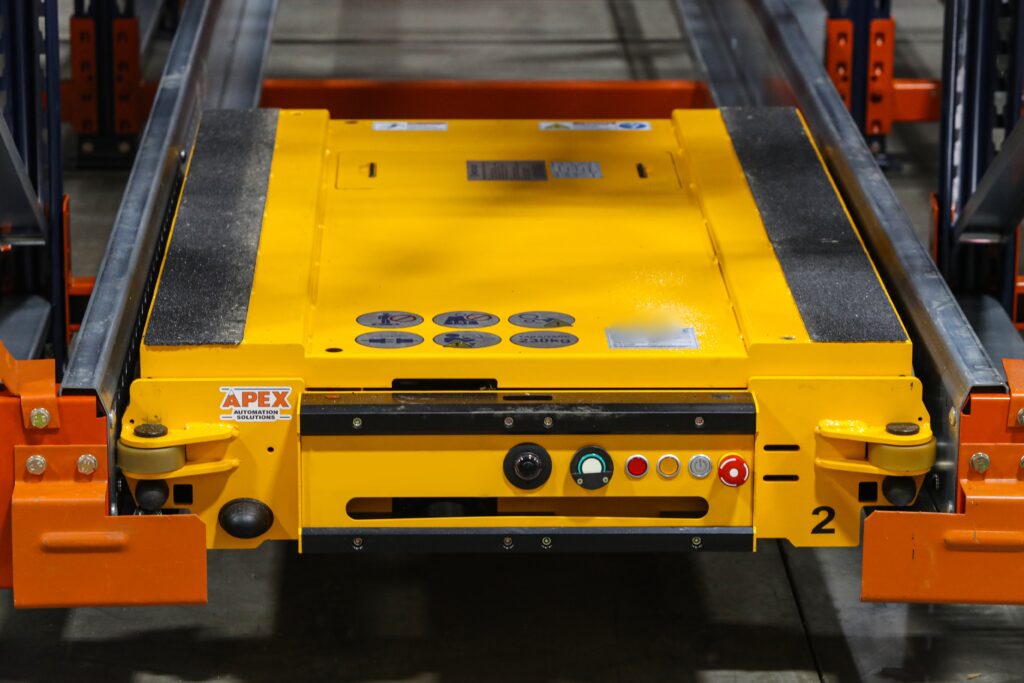 PEAK Pallet Shuttle in ASRS Racking
Food and beverage companies have unique warehousing needs, and shuttle ASRS technology is well-suited to meet them. Here are a few of the key reasons manufacturers are adopting shuttle systems:
1. Cold Storage Optimization
Many F&B operations include refrigerated or frozen warehouses. These are expensive to build and operate.
Shuttle ASRS allows a compact, high-density layout that squeezes more pallets into each cubic foot of cold store. By minimizing aisle space and using tall, deep racks, companies can drastically cut the square footage per pallet in cold storage.
This not only increases capacity but also reduces energy usage, since there’s less empty air to keep cool. In fact, high-density automated systems can “drastically cut the energy required to cool unused areas,” delivering both cost savings and sustainability benefits.
Another bonus is that when freezer warehouses are automated, employees spend less time in sub-freezing temperatures.
2. FIFO/Expiration Date Compliance
In food storage, FIFO (First-In, First-Out) or even FEFO (First-Expiry, First-Out) is critical to ensure freshness and compliance with expiration dates. Shuttle ASRS comes with sophisticated inventory management software.
Here’s what that means in practice:
- The system tracks each pallet’s age or lot code and prompts operators to retrieve the oldest batch first, reducing spoilage.
- Every pallet movement is digitally recorded, so you have a complete trace in the event of a recall or audit.
- The software maintains stock rotation and batch tracking, giving you end-to-end traceability for food safety.
3. SKU Velocity Management
Not all products move at the same speed. Some SKUs (like a top-selling beverage flavor) fly off the shelves, while others (like a specialty ingredient) move more slowly. Shuttle-based ASRS is flexible enough to handle both.
- Dynamic allocation: High-throughput pallet shuttle systems assign more slots or resources to fast movers, while keeping slower movers stored densely until needed.
- Multi-aisle access: A 4-way shuttle setup can service multiple aisles, so the busiest SKUs are always accessible without dedicating a shuttle to every lane
- Smart zoning: Inventory can be segmented into zones – high-flow areas for fast picking or batch orders, and long-term lanes for slower goods.
The result is better order picking efficiency for fast-moving products and smarter space utilization for everything else.
4. Labor Efficiency & Safety
Warehousing labor is both costly and in short supply. Shuttle systems help reduce reliance on manual labor, particularly forklift drivers.
In a traditional manufacturing facility, operators spend all day rushing around in forklifts, which is labor-intensive and introduces safety risks (tight aisles, heavy loads at tall heights). ASRS shuttles replace all that and reduce accidents like collisions or dropped pallets.
Comparing Shuttle System Types
Now that we’ve outlined the types of shuttle ASRS and why they’re beneficial, let’s compare the shuttle variants side-by-side. Each system type has its sweet spot:
System Type |
|
Best For |
|
Key Benefits |
|
Considerations |
| 2-Way Shuttle | Basic high-density storage (single aisle) | Lower cost, simple to install & operate |
Limited flexibility (fixed to one lane) | |||
| 4-Way Shuttle | High-throughput, multi-aisle environments | Flexible access to any lane; redundancy if one shuttle down; scalable throughput | Higher investment cost; more complex controls |
|||
| Mother /Child | Large-scale, high-turnover facilities (deep lanes) | Fast, fully automated operation with no need for forklifts; excellent deep-lane storage and throughput | Most complex design; requires precise coordination and higher upfront cost |
Flexible Storage Solutions for Every Stage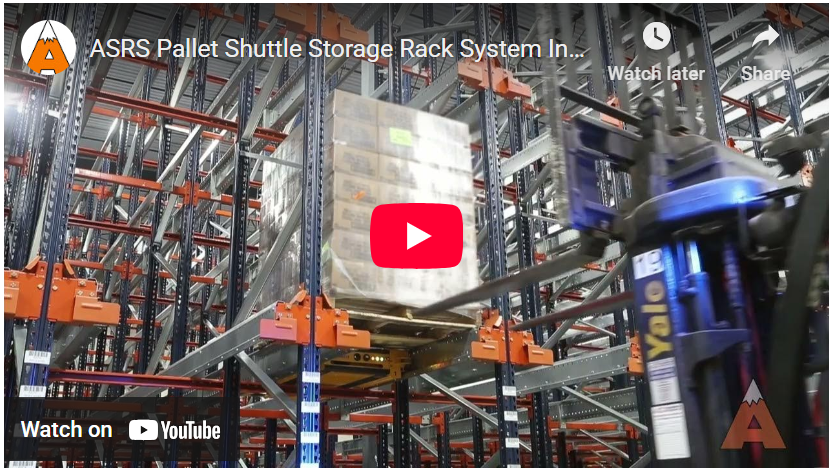
One common misconception is that ASRS pallet shuttle systems are only useful for storing finished goods. In reality, these systems can add value at multiple stages of the production and distribution process.
Below, we consider how shuttle systems can be configured for different stages of food and beverage operations:
Raw materials storage
Shuttle ASRS is a smart way to manage inbound ingredients and packaging before production. Standard palletized goods and storage containers like super sacks, drums, or film rolls can be stored densely, especially in refrigerated or frozen zones where space is precious.
The system supports FIFO rotation ideal for raw materials with shelf life, cutting waste and ensuring food safety. By automating bulk storage, manufacturers save labor and feed production lines just in time. It’s most effective when raw inputs are high-volume, uniform, and palletized.
Finished goods storage
This is the most common use case. ASRS provides high-density, secure storage for days, weeks, or months of dwell time for packaged products. Shuttle software links with inventory systems for real-time pallet tracking and can stage outbound orders by pulling from multiple lanes simultaneously.
For example, 10 different SKUs can be assembled much more quickly for a retailer’s order than relying on manual forklift retrieval. With FEFO and traceability built in, shuttle ASRS ensures accuracy and freshness while optimizing outbound flow.
Aging and maturation applications
Certain products need time in storage as part of their process—cheese aging, wine or whiskey maturing, and meat curing. Shuttle ASRS supports this by creating a controlled environment with automated dwell-time tracking. The software alerts operators when products reach their required age and triggers retrieval, removing the manual tracking burden. By compactly storing aging goods and monitoring them precisely, shuttle systems maintain quality and consistency while saving space.
Key Factors to Get Your ASRS Right
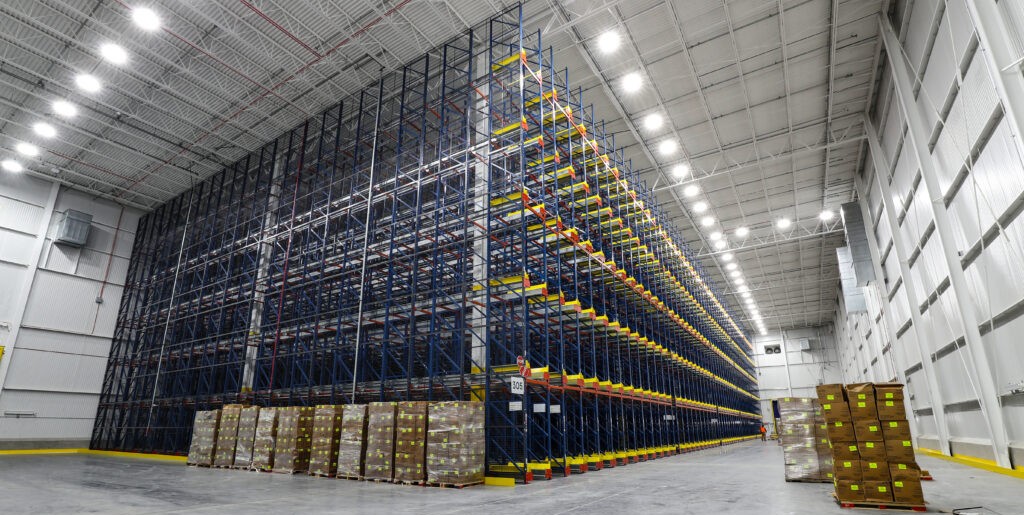 PEAK Pallet Shuttle in Cold Storage Facility
Implementing a pallet shuttle ASRS in a food & beverage facility isn’t just about choosing the shuttle type – it also requires careful design and planning to ensure the system will meet operational needs and regulatory standards. Here are some key design considerations:
Pallet specs & load stability
Consistency is crucial in automated systems. Pallets must be uniform in size, quality, and condition. Unlike a human, a shuttle can’t adjust for a warped or broken pallet. Poor pallets cause jams or misreads, so investing in durable options (like plastic pallets) pays off.
Loads also need to be stable and well-wrapped, since shuttles move them quickly. In short, warehouse automation loves consistency. The more standardized your pallets and loads, the smoother your ASRS will run.
Rack & rail layouts
The racking structure and shuttle rail layout must match your throughput, load types, and footprint. Key questions:
- How many pallet positions do you need?
- How deep should each lane be?
- How many levels can you build given your ceiling height?
Facilities with tight footprints might lean toward taller systems or 4-way shuttles for flexibility. High-throughput sites may add more aisles or extra shuttles per level.
Every design is custom-engineered, factoring in aisle width, number of aisles, entry/exit points, and building columns to ensure smooth flow in and out.
System software integration
The fully automated shuttle systems need to talk to your WMS or ERP. The control software manages real-time shuttle movements, but higher-level systems decide what to store or retrieve.
Seamless integration keeps digital inventory in sync with physical goods. In practice, this can include barcode scans, handshakes between WMS and shuttle controllers, and integration with conveyors or AGVs. Operators get real-time visibility, while the software handles inventory updates, FIFO/FEFO enforcement, prioritization, and alerts.
Cleaning & hygiene requirements
Food and beverage facilities demand strict hygiene. If your shuttle runs in washdown areas or cold rooms, it must be built for it. That can mean stainless steel components, sealed bearings, food-grade lubricants, or IP-rated enclosures to protect electronics.
Designs should avoid crevices where debris can collect, following food-grade principles like smooth welds and sloped surfaces. It’s also worth discussing cleaning procedures up front:
- Can shuttles be removed for deep cleaning?
- Can sensors handle washdowns and temperature swings?
Building hygiene into the design ensures your ASRS enhances operations without becoming a sanitation problem.
Apex Automation Services: From Design to Deployment
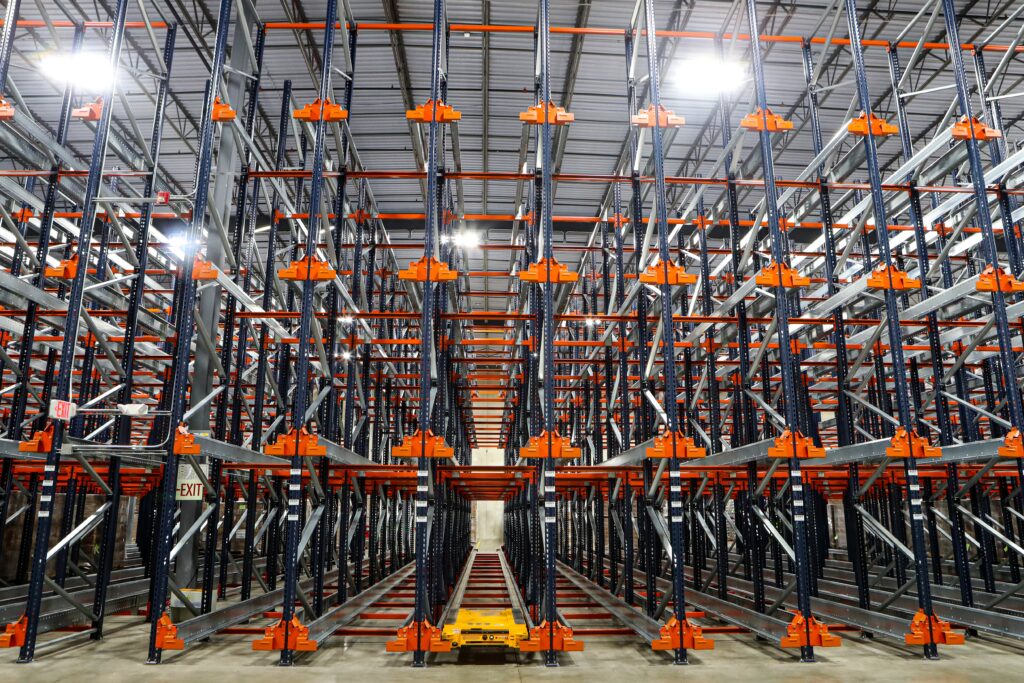 2-Way Pallet Shuttle Rack System
Designing and implementing an ASRS shuttle system might seem daunting, but that’s where the Apex automation experts come in. We provide end-to-end support to take your project from initial concept all the way through successful operation. Here’s how we did it for our existing clients and how we can partner with you:
Data-driven design & consultation
Every facility has unique needs. At Apex, we start by analyzing your data. Think SKU profiles, order volumes, growth projections, and facility constraints. We do this to design a system that truly fits.
Using industry expertise and advanced modeling tools, we can predict how a 2-way, 4-way, or mother/child system will perform in your operation and design rack layouts and throughput accordingly. The result is a custom-engineered solution aligned with your space, workflow, and long-term goals.
Turnkey system integration
We handle integration from start to finish, so you don’t have to manage multiple vendors. That includes system engineering, equipment sourcing, installation, and commissioning.
Our team ensures that racks, shuttles, lifts, and conveyors work seamlessly together and that your new ASRS integrates flawlessly with your WMS, ERP, and other automation. Thus, the process stays efficient, and system performance stays optimal.
Training, support & maintenance
Introducing automation is a big shift for staff, so we provide thorough training for operators and managers. Once the system is live, we back it with preventative maintenance, 24/7 emergency support, and routine service. Our technicians understand both the technology and the demands of food and beverage environments, including cold storage. With regular check-ups and quick issue resolution, we keep your shuttle ASRS running at peak performance and ensure you get the ROI you expect over its life.
From the first warehouse analysis to the day you go live (and beyond), we work as an extension of your team to deliver a successful automation project.
Ready to Maximize Your Storage Potential?
If you’re looking to maximize your storage potential, now is a great time to explore what shuttle ASRS technology can do for you. Our team of experts is ready to analyze your data, engineer a tailored solution, and support your automation goals.
Contact Apex today and let’s unlock new efficiencies in your food or beverage operation!
