
Palletizing and Storage of Bagged Inventory — What To Consider?

Effective Palletizing and Storage for Bagged Inventory in Colorado Warehouses
Automation continues to transform warehouse operations across Colorado and beyond. While the shift toward automated systems has been ongoing for years, it accelerated significantly after 2020. Palletizing is one area where automation has made a clear impact—boosting throughput, enhancing consistency, and minimizing injury risks. But what happens when your products aren’t in neat, stackable cartons? Bagged goods present unique challenges due to their soft, unstable form. How can you palletize and store these items safely and efficiently? The following tips can help you implement a reliable system tailored to bagged inventory.
7 Key Practices for Palletizing Bagged Inventory Efficiently
Bagged products can still be palletized effectively with full or partial automation—as long as the right strategies are in place.
- Distribute Weight Evenly
Ensure the load is balanced across the pallet, avoiding gaps or uneven weight that can lead to instability and point loading—localized pressure that can compromise pallet integrity. - Place Heavier Bags at the Base
If your inventory varies in weight, always stack heavier bags first, followed by lighter ones. This maintains a low center of gravity and helps prevent tipping. - Eliminate Overhang
Bags should be arranged to stay within the pallet’s footprint. Overhang can create balance issues, increase the risk of damage, and interfere with scanning systems, potentially triggering shutdowns on automated lines. - Check for Sharp Edges
Any equipment used in the palletizing process should be inspected for burrs or rough surfaces that could tear or puncture bags during movement. - Choose the Right Wrapping Equipment
Wrapping palletized loads is essential, but bags can shift during rotation. A stretch wrap machine that circles the load instead of spinning the pallet may be a better choice, reducing motion and preserving stack stability. - Maintain Visibility
Although wrap is critical for safety, it should still allow visibility so that workers can identify if the load has shifted during palletizing or transport. - Use High-Quality Pallets
Strong, consistent pallets are essential for safe storage and transport. Placing a slip sheet between the pallet and load can also help create a smooth surface for stacking bagged items.
Storage Options for Palletized Bagged Goods
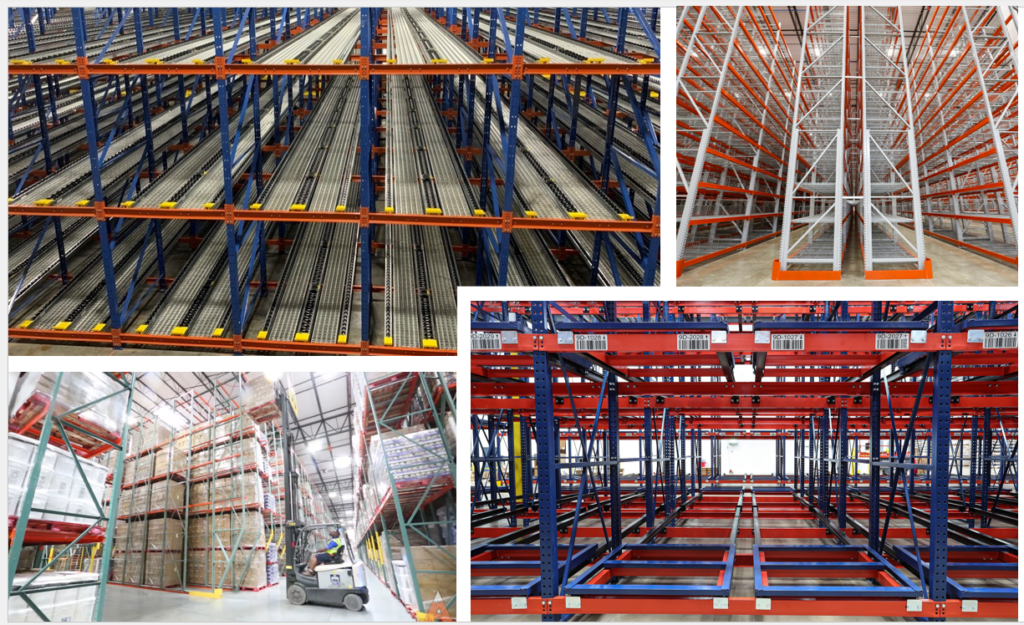
From Top Left – Pallet Flow, Back-to-Back Rack, Drive-In, Push-Back
Once your pallets are wrapped and stable, the next step is proper storage. Multiple racking systems are available to suit your operation’s layout and throughput needs.
Pallet Racking Types to Consider
- Selective Pallet Racking
This is the most straightforward racking design, allowing one pallet to be stored per position. It’s ideal for low-density storage with easy access, using standard forklifts from a single aisle. Systems can be arranged back-to-back to reduce aisle space, and double-deep configurations are possible with reach trucks.
- Drive-In Racking
Designed for high-density storage, this system allows forklifts to enter the rack lanes, storing up to 10 pallets deep and several levels high. Drive-in racking uses the LIFO (Last-In/First-Out) method and requires skilled operators due to the tight maneuvering required.
- Push-Back Racking
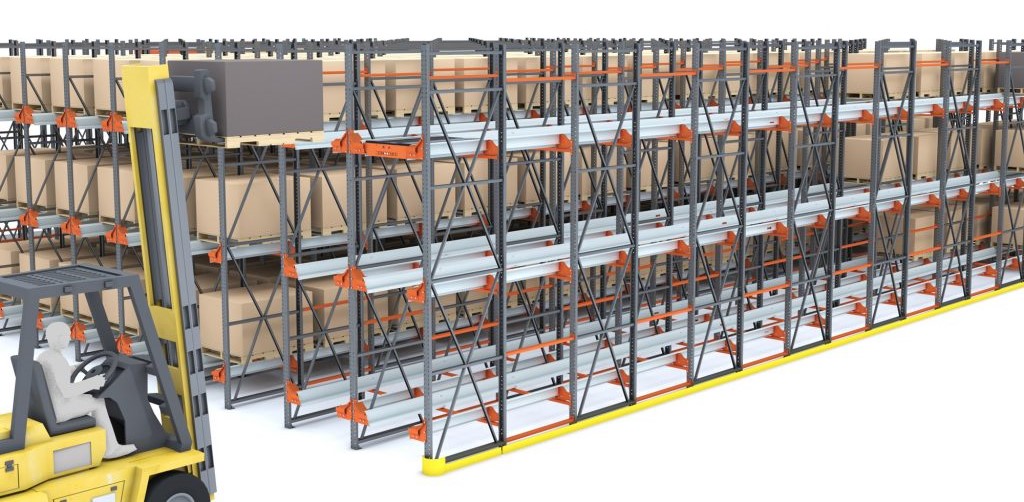
Also operating on the LIFO principle, push-back racks use a series of nested carts in each lane. As new pallets are loaded, existing ones are pushed back, and they move forward automatically as others are removed. This setup typically allows for 3 to 4 pallets deep per lane and improves storage density while limiting vertical levels.
- Pallet Flow Racking
For operations that require FIFO (First-In/First-Out) rotation, pallet flow racking is an ideal option. It uses gravity-powered roller or wheeled tracks on a slope to move pallets from the loading to the picking end. These systems can hold between 2 and 10 pallets deep per lane, maximizing both density and inventory turnover.
- ASRS (Automated Storage and Retrieval Systems)
These advanced systems handle pallet placement and retrieval automatically via conveyor-fed shuttles. Ideal for fast-paced, high-volume warehouses, ASRS is especially useful in temperature-controlled environments like cold storage facilities in Colorado, where minimizing worker exposure is key.
A Smarter Way to Palletize and Store Bagged Inventory
While palletizing may be the right direction for your operation, asking the right questions is essential to finding the best solution. Apex Warehouse Systems offers full-service support to Colorado facilities, helping you identify systems and layouts that maximize space, minimize labor strain, and boost efficiency. Our team considers your current workflow, future growth, and facility conditions to build a solution that fits your goals.
Contact Apex today to schedule a site visit or consultation. Explore our gallery of project photos, videos, and design illustrations for ideas tailored to Colorado warehouses.
