
Pallet Shuttle ASRS for Dock Staging: Safe, Efficient Buffering for High-Volume Shipping

Turn Your Dock into a High-Density Buffer with Pallet Shuttle ASRS
For high-volume shipping operations, a pallet shuttle ASRS replaces floor chaos with organized, vertical dock staging. The challenge at most docks is the same: pallets pile up, forklift traffic spikes, and detention risks grow as teams juggle wave picking and door availability. Traditional floor-stacking consumes valuable cube, obscures FIFO/LIFO control, and slows every trailer turn.
A pallet shuttle ASRS prebuilds outbound loads in multi-level, deep storage lanes, staged and picked in trailer sequence. Forklift operators access pallets at the pick face—no driving down aisles and searching—resulting in less travel, fewer touches, and fewer incidents. You free floor space, cut dwell time, and lift door turns without adding doors. In short, it’s a safer, smarter path to consistent high-throughput shipping.
What is a Pallet Shuttle ASRS?
An ASRS (Automated Storage and Retrieval System) is a powered solution that stores and retrieves inventory with minimal manual handling. Among the various ASRS designs, the pallet shuttle system is one of the most common—and the most relevant for dock staging.
In short, a battery-powered shuttle moves pallets into and through designated staging lanes, advancing them to the dock-side lane face for extraction and truck loading.
Shuttle Design Variants
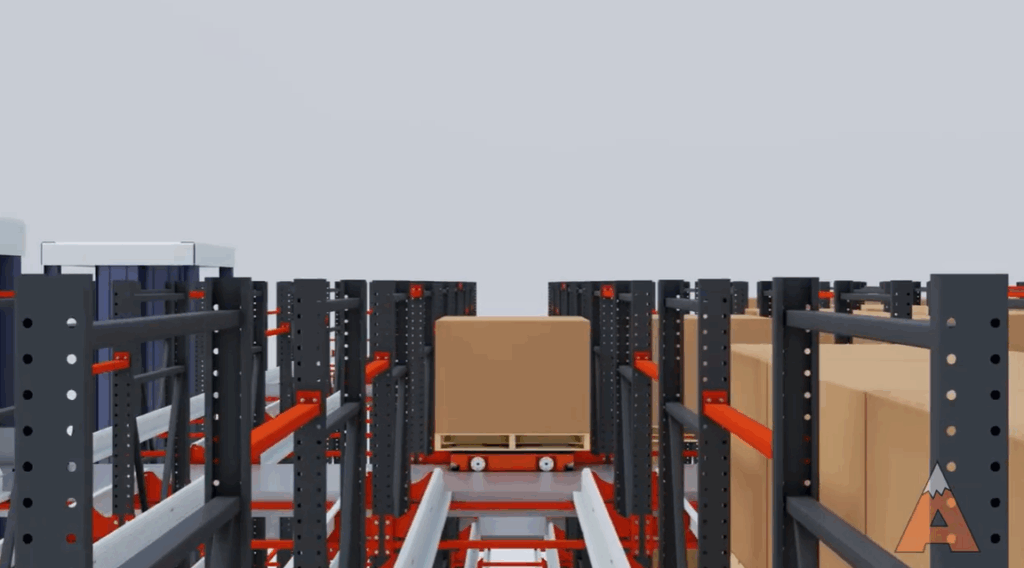
Pallet Shuttle ASRS for Dock Staging
2-Way Pallet Shuttles – Semi-Automated
A forklift places the shuttle in a designated dock-staging lane (channel) and sets a pallet on the shuttle. Using a remote control, the operator commands the shuttle to deposit the pallet in the next open position and return to the aisle face. As lanes fill, the forklift repositions the shuttle to other open lanes. When it’s time to ship, the shuttle advances pallets forward to the dock-side lane face for quick extraction. Two-way shuttles travel forward and backward only—an economical fit for staging full truckload quantities.
Mother-Child Shuttle Systems- Fully Automated

On each rack level, a larger carrier (mother) travels the main aisle, positions at the target lane, and deploys a smaller powered shuttle (child) to load or extract a pallet. The child completes the move in the storage lane, then re-docks with the mother, which redeploys it to the next lane.
The multi-level design is well-suited to high-volume dock buffers. With one mother per level, forklift touches are minimized or eliminated. Pallets can be delivered by forklift, conveyor, or AGV.
4-Way Pallet Shuttles – Fully Automated
A 4-way shuttle can move forward/backward and side-to-side within the rack level, while vertical lifts typically transfer shuttles between levels. This architecture enables high-density storage across many SKUs and flexible routing. It isn’t usually the most economical choice for dock staging, but it’s worth noting for operations that want shuttle automation across broader storage plus staging areas.
Why Use a Shuttle System for Dock Staging?
|
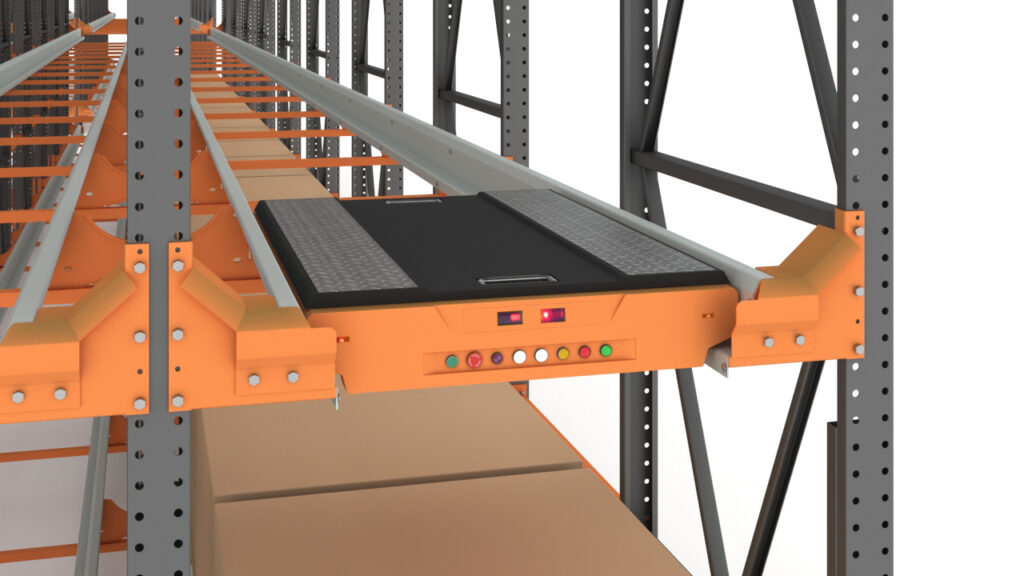 Pallet Shuttle System |
How It Works (Dock Staging with Pallet Shuttle ASRS)
Stage |
2-Way Pallet Shuttle
|
Mother-Child
|
4-Way Shuttle
|
|||
Lane assignment |
WMS/WES (Host System) assigns a dock-staging lane to the outbound load/route. |
Same | Same | |||
| Shuttle positioning | Forklift places shuttle in the target lane at the aisle face. | A mother carrier drives along the level and positions the child shuttle at the target lane (one mother per level). |
Shuttle may self-navigate side-to-side across lanes on a level; lifts reposition shuttles between levels.
|
|||
| Pallet induction | Forklift sets pallet on the shuttle. |
Forklifts, conveyors, or AGVs feed pallets into the rack for pickup by the mother/child carrier.
|
Similar to mother-child; pallet handoff at the aisle side. | |||
| Lane movement |
Shuttle moves pallet into and through the storage lane, compacts, and returns to the aisle face; operator may reposition shuttle to other lanes as needed.
|
Child shuttle moves pallets into/through the lane, compacts, and returns to the mother to pick up next pallet. | Shuttle moves forward/back and laterally to service multiple lanes on the level; system compacts automatically. |
|||
| Presentation to dock |
At ship time, forklift loads shuttle into the lane; shuttle advances pallets forward to the dock-side lane face for extraction.
|
System calls child shuttle to advance pallets in trailer sequence to the dock-side lane face for loading | System sequences and presents to dock-side lane face; vertical lifts move shuttles between tiers as needed. | |||
| Between moves | Shuttle parks at the lane face or buffers in-lane per SOP. | Child re-docks with mother at dock-side lane face to await next command. | Shuttle parks (face) or buffers (in-lane) based on throughput settings. |
Design Considerations for Dock Staging

Pallet Shuttle ASRS for Dock Staging
Use these quick rules of thumb to right-size a pallet shuttle ASRS for dock staging without over-engineering it.
- Lane depth — Size each door’s buffer for a full truckload (typically 26–30 pallets), then divide by tiers:
• 2 levels: ≈ 13–15 deep per level
• 3 levels: ≈ 9–10 deep per level
Add 1–2 buffer positions to absorb pallet count variability and loading patterns.
- Levels/tiers — Set the number of tiers to match daily wave volumes and door count. Verify clear height for lifts, shuttle carriers, pallet height, and any maintenance access.
- Sequencing logic — For dock staging, prioritize trailer/route sequence (stop order).
- Interfaces — Plan the handoff to fit your operation: forklift, conveyor, transfer cars/lifts, or AMRs/AGVs at the aisle face.
- Cold storage — Specify freezer-rated shuttles and controls, and align battery/charging strategy (opportunity charge vs. swap) to your dwell and throughput.
KPIs to Track
Use the KPIs below to validate ROI at the doors and guide adjustments to lane design and loading sequence.
|
✔ Door turns per hour ✔ Average trailer dwell time ✔ Lines or pallets per labor hour |
✔ Pick-to-ship cycle time ✔ Dock safety incidents ✔ Density (pallets per square foot) |
Ready to See It on Your Dock?
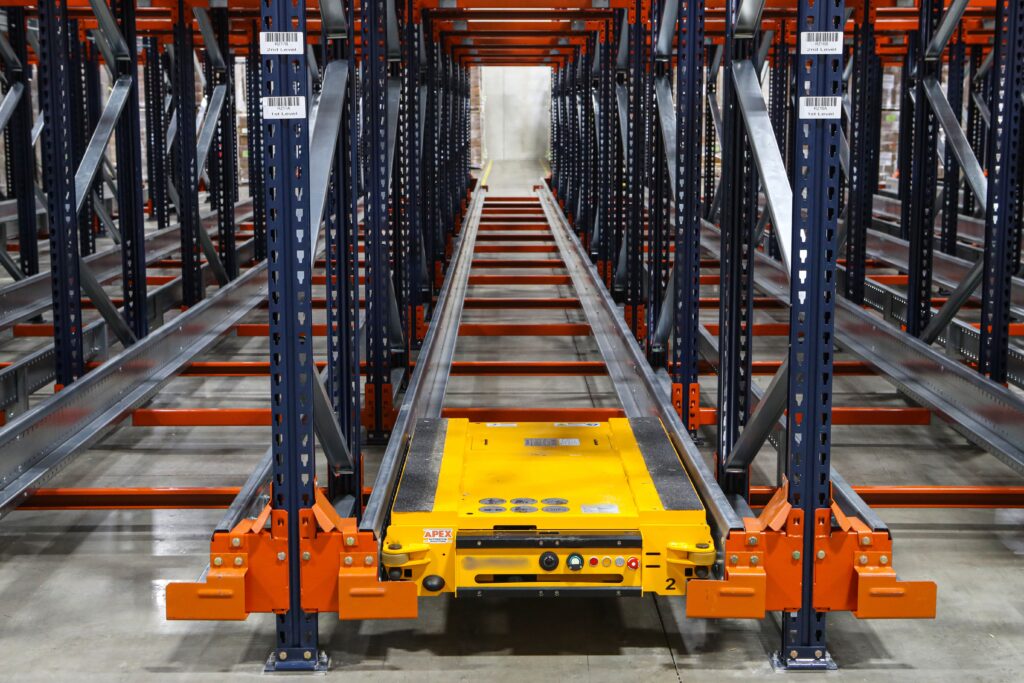
Request an Apex Dock-Staging Audit. We’ll model your operation and design a right-sized pallet shuttle ASRS buffer at the doors—then map the integration plan.
What’s included
- Door count & wave pattern review
- TL mix and load-sequence analysis
- Freezer/ambient split & clear-height check
- Lane-depth modeling by tiers
- Host System integration path
- Safety review at the dock
Next step: Contact Apex to schedule your audit.
Want more background first? See our blog: ASRS Storage Systems 101 – Your Complete Guide to Automated Warehouse Solutions.
