
How Load Distribution Affects Pallet Rack Design

Apex Carolinas Advice for Defining Load Specs for Safe Pallet Rack Design
Safety is a top priority in any warehouse or distribution center; therefore, it’s critical to ensure that your operational and storage equipment work in sync and are adequately equipped to manage the task. Take pallet racking, for example. While durable steel structures, the safety of these systems lies in proper design… and use. How and what the system is loaded with is elemental to maintaining structural integrity. To design your storage racking, you must first consider all the elements of your current inventory. Additionally, if possible, include plans for future needs to be able to quickly address inventory mix changes.
Once equipped with your load specs, determine the load distribution, i.e., how it will sit on the rack. This step is crucial to ensuring your pallet rack is adequately configured to safely handle your needs.
Load Specs Required for Pallet Rack Design
-
- Load dimensions & weights
- The type of loads -palletized, single item, etc.
- Quantity – load volumes
- Load distribution – how the load weight is distributed within the rack bay
To understand the significance of load distribution on your pallet rack system, let’s take a closer look at several common options.
Pallet Rack Load Distribution
The majority of warehouse inventory is stored on standard GMA-style pallets. Ideally, you want the weight of your inventory load to be evenly distributed across the pallet so that, once stored, it spreads evenly across the rack bay. However, non-standard pallets, bulk containers, crates, and unbalanced or shifting content can cause weight distribution concerns. That’s when it’s important to understand safe remedies for storage in your pallet rack.
Load Distribution Definitions
- Uniformly Distributed Load (UDL) – Items stored on standard-sized pallets generally fit into this category with the load weight evenly spread across the front and rear beams. However, even with a standard pallet, you can have a concentrated (point load) –think of a machine part where the heaviest part is on one side of the pallet. When you have an uneven load, ensure that it is securely placed on the beams, and consider using wire decking to form a shelf and disperse the weight within the bay. Even still, the load must fit within between the front and rear beams and not extend over. See below for more details.
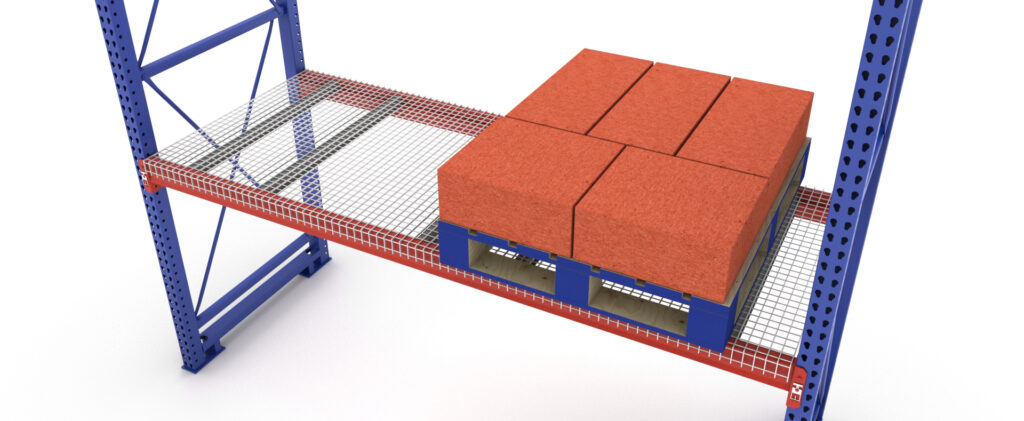
Example – Uniformly Distributed Load (UDL)
- Line load – Often the case when the load fits on a portion of a stinger pallet or skid, causing the weight to rest on a single or a few lines. Again, think machine tool or roll of material where the weight is concentred vs. distributed. Once loaded into the rack, the weight sits on one point of each beam, which can cause sagging. Using wire decking for flat-bottomed inventory or drum cradles for such items as wire spools is the best way to safely manage the load weight.

Example – Line Load
- Point load – Totes, wire container bins, and footed pallets have one or more point positions where their weight is focused. In these instances, solid surface decking or palletizing the loads are good options for distributing the load weight. Check out our Project Spotlight to see how we managed footed containers with shifting contents that created a point load concern.
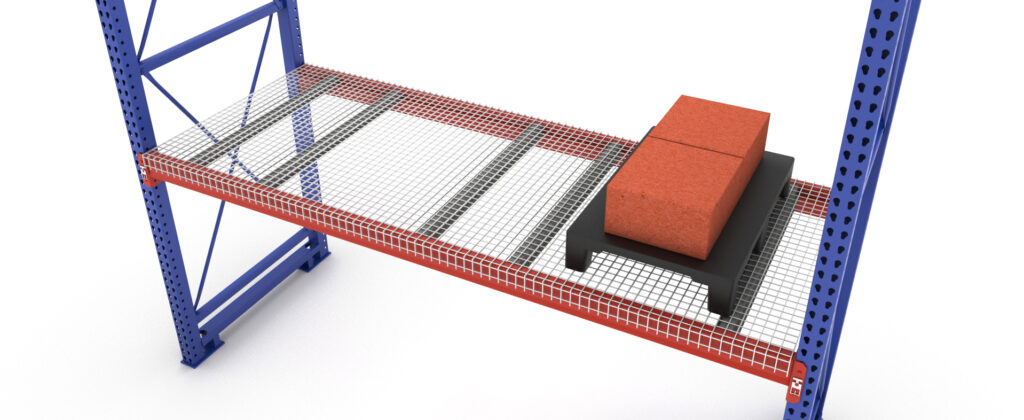
Example – Point Load
 Footed Containers with Shifting Contents |
 Custom Rack Solution – Solid Deck Surface |
- Concentrated load – A load is too small and isn’t wide enough to reach beams. A few examples of this type of load: are equipment in crates, loads that are on smaller than standard pallets, and import pallets. Bar-grating and wire decking are good options to provide uniform weight distribution for these load types.

Example – Concentrated Load
Pallet Rack Systems & Load Distribution Concerns
What do you need to know specific to your type of pallet racking system?

Push-Back Rack System
- Selective rack – Used for loads of various weights and sizes. The single pallet deep design enables easy placement of a load onto the beams or a decking.
- Drive-in rack – This last-in/first-out (LIFO) high-density storage system uses rails along the sides of open pallet lanes to hold the pallets. Since the pallets are only supported underneath the left and right sides vs. the front and back, it is imperative to use pallets of uniform size with uniform load distribution. Pallets should also be of good quality to prevent sagging which presents a safety hazard. Decking is not an option in these systems.
- Double-deep rack – Also called deep-reach, these systems are essentially two-deep selective systems. Due to the nature of this design, a deep-reach forklift is required to put and remove the loads. Load weight limitations might apply due to the forklift’s ability to handle the loads on extended forks. Note forklift drivers need to exercise caution loading the rack due to limited visibility of the rear of the system.
- Push-back rack – Brings together the density of drive-in with SKU accessibility of selective rack for high-volume, multi-SKU applications. Push-back is a LIFO system typically with 2 to 6 pallets deep per SKU lane. Each lane is comprised of wheeled carts that flow on top of inclined rails. Carts nest (stack) on top of each other when they’re empty. When a new pallet is loaded, the forklift driver puts the first pallet on the top cart. In order to add additional pallets, the driver pushes back the front pallet load to reveal the next available cart. The last pallet is placed directly on the push-back rails, i.e., a 6-deep lane would have 5 carts.
Unique Considerations for System Design

Here’s a brief overview of the basics of safe pallet rack design with a focus on load distribution.
The frame…
- Beams and uprights are the most integral components of a pallet rack system. They bear the weight of the entire system. It’s imperative to identify the maximum load volume and typical weight of pallet rack loads. For a deep look at where to start for configuring your pallet rack system, check out our blog.
- Learn more about the difference between roll-formed or structural steel used for pallet rack components –see our blog on the pros and cons of each option.
- Even a well-built pallet rack system is often vulnerable to forklift strikes –learn more about options for supporting and protecting your racking in our blog.
The Rack Bay…
- The width of each bay is a fundamental consideration in designing a pallet rack system, especially in the case of non-standard loads. Consider this example – a traditional bay configuration has 2 standard pallets that sit side-by-side on a 96-108” beam. If you decide that you’d like to store heavy non-standard loads three across, you’re going to have an issue. From the design stage, your pallet rack system would have to be built with added capacity, consider non-uniform load distribution and use extra-long beams.
- The height of each bay is an important factor in identifying the maximum load that a tall pallet rack system can handle. Note that as the height of a bay rises, the ability to store heavier loads decreases.
Anchoring & Safety
- Is the foundation of your pallet rack system secure? What do you need to know about the floor and baseplates used to anchor it in place? Always ensure your system is properly secured and routinely check for loose bolts, which can come undone over time due to floor vibrations.
Lastly, consider your location –are you in a seismic zone with specific design regulations for vertical storage systems –take a look at how seismic characteristics can affect your rack design.
More Ways to Ensure Pallet Load Safety

There are various elements that affect the storage of non-standard loads. They include the following:
- Forklift safety – Forklifts must be driven in a safe manner. Drivers must ensure that they properly and cautiously place loads on beams or other support structures. This is of even greater importance with non-standard loads and taller pallet bays. Check out our forklift operating videos for Drive-in, Push-Back, and Pallet Flow driving tips.
- Pallet quality – The quality of a pallet is a very important part of the equation as it relates to safe storage and movement of products in a warehouse. Broken or compromised pallets should be taken out of circulation or placed on skids to provide needed support. Take a look at our blog on everything you need to know about pallets for rack design.
- Observe load capacity – Ensure that pallet rack load capacities for each pallet system are clearly and easily visible –this is an OSHA safety requirement as well as simply smart operation tactics.
Your Local Experts
Your local Apex Carolinas team can answer your questions and help you to configure the pallet rack system that matches your unique warehouse needs. We have teams in Hickory and Charlotte, North Carolina as well as Greenville, South Carolina.
Apex offers full-service design and installation to streamline the process and ensure your complete project satisfaction. Contact us today to schedule an on-site visit or zoom call to get the ball rolling.
