
GIVE YOUR CAROLINA WAREHOUSE AN EFFICIENCY BOOST –LAYER-PICKING for Mixed-SKU Pallet Building


LAYER-PICKING APPLICATIONS SPEED UP OPERATIONAL EFFICIENCY BY 400%
Building mixed-SKU pallets can be a slow process – but using a layer-picking application in a high-volume mixing center or staging area can speed up that process exponentially! While hand-picking only allows for 250 case picks per hour, a layer pick application can complete over 1200 case picks per hour. This translates to a 400% increase in pick rate. The opportunities this allows for your business are endless – from increasing order fulfillment to eliminating shifts or improving turn rates. All these time savings may even give you the perfect chance to visit a North or South Carolina attraction – Myrtle Beach, anyone?
Advantages:
- Implement JIT (just-in-time) order fulfillment
- Boost productivity
- Reduce labor costs
- Improve accuracy
- Select one or more layers in a pick
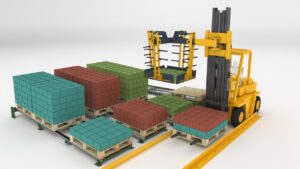
The main goal of using a mixing center or staging area design is to use a layer-picking attachment on a standard forklift or overhead crane to grab a layer or two at a time. Pallets located on the pick aisle supply the operation, and once a layer is picked, it’s loaded onto an empty pallet. Rinse and repeat until the order is complete and you’ve got yourself a mixed SKU pallet.
No two layer-picking aisles are the same – so let’s look at a few different configurations.
Layer-Picking Applications:
- Clamp or suction attachment on a standard forklift – Easy and effective. The forklift effortlessly grips one or more layers with these attachments. These selected cartons are then placed onto the mixed SKU pallet. Empty pallets for this configuration can be staged in the middle or at the end of the pick aisle. Once the pallet is full, a second operator picks it up and takes it for staging or storage. Empty pallets may also double as staging pallets. This configuration is well-contained and offers maximum productivity.
- Forklift with clamp & fork pallet –Similar to the clamp attachment design described above, in this variation, the empty pallet isn’t placed at the aisle’s center or end for load deposition. Instead, it’s directly positioned onto the forklift forks. The driver then places the finished mixed pallet at the lane’s end, ready for pickup.
- Overhead gantry with robot clamping or suction device – This application requires a little more automation than previous designs. The layer-picking is controlled via warehouse management (WMS) and warehouse control systems (WCS). The WMS gives the instructions to the WCS to create the custom pallet – once complete, the pallet is sent to the automated gantry for fulfillment. Since there’s little labor involved in this process, it offers a higher savings of time and money.
- Overhead gantry with automated storage and retrieval (ASRS) – Bump it up a notch from the previous configuration by adding automatic pallet replenishment. ASRS is fully automated, allowing it for custom programming, such as extracting completed mixed-SKU pallets and positioning them for distribution and/or storage.
Automation isn’t strictly necessary in a layer pick application, but it does have some added advantages, such as tracking products, material flow data, efficiency, and monitoring productivity.

5 Steps to Building a Mixed-SKU Pallet
- Arrange high-volume SKUs within the mixing area. The forklift will move along the lane with guidance from either the driver or an angled floor-mounted guide. In an overhead gantry setup, the clamp operates above the pallets.
- Order selection starts with extracting one or more layers from an SKU pallet. The clamp encloses the cases tightly on all four sides to ensure their secure transfer.
- The clamp moves the cases to an empty pallet positioned in the center or at the end of the aisle to begin building the mixed-SKU pallet.
- If necessary, the order is partially filled with layer picking and finished manually, adding flexibility to the application.
Once finished, a mixed SKU pallet may resemble this, for example:
SKU A in layers 1 & 2, SKU B in layer 3, and SKU C in layers 4 & 5.

Don’t Slow Down – Restocking and Replenishing Your Layer Picking Operation
Your stocking and replenishment plan is just as important as the type of layer-picking device you choose. In cases where SKUs are bulk-stacked, forklift operators need to remove the shrink wrap during restocking, which may slow down the process. However, a pallet flow rack can speed things up by automatically stocking the pick aisle. Pallet flow involves a gravity flow system employing inclined rails with wheels or rollers that transport pallets from a neighboring aisle to the pick area. Through pallet flow, your pick aisle maintains a continuous inventory supply, ensuring a seamless operation flow.
Likewise, a multi-level approach can be used to replenish stock with push-back rack positioned conveniently above your pallet flow lanes. This is an excellent way to maximize your warehouse space and to keep your pick area well stocked – every time! It’s important to note that this design is only helpful for full pallet applications, not partial pallet picks. Let’s take a closer look:

Push-Back Above Pallet Flow for Ready Reserve & Automatic Replenishment
- Ground level pallet flow lanes move high-volume SKUs toward the pick aisle. The trailing pallets are securely held a short distance from the front pallet using a pallet separator. This grants the layer picker access to all sides of the pallet. The operator can also safely and smoothly remove the empty pallet, triggering rear pallets to move forward in their gravity flow lane. This little bit of automation allows the operator to stay in the vehicle and allows maximum efficiency.
- Pallet flow lanes are quickly replenished from the adjacent aisle keeping the pick aisle clear for the layer picker. The push-back rack above the pallet flow lanes helps store ready reserve inventory.
Apex Has All the Layer Picking Equipment and Design Help You Need!
The Apex Carolina team understands that each warehouse has unique needs – and is ready to help! We offer full-service design, installation, and support – whether you’re located in North or South Carolina. Give our team a call to learn more about how we can revolutionalize your order-picking operation!
