
From Blueprint to Brilliance: Mezzanine Bracing Options for Safe, Efficient Industrial Spaces

Bridging Stability: Exploring Mezzanine Bracing for Industrial Design
Congratulations! You’re considering an industrial mezzanine for your facility. Mezzanines take space optimization to a new level (pun intended) by converting unused vertical space into valuable square footage with a raised platform. Freeing up otherwise congested space is always a plus whether you plan to use your mezzanine for ongoing activities or storage. However, your mezzanine will not materialize out of thin air. Like all material handling solutions and storage systems, they require a well-planned and thoughtfully engineered design…. which includes bracing. There are three main bracing options, each with pluses and considerations worth exploring before settling on a design. Let’s take a closer look at those options.
What Roles Do Bracing and Connections Play in Mezzanine Design?
Mezzanine bracing ensures stability and support of the raised platform. The right bracing will enhance safety, maintain rigidity, and optimize the structural integrity of the elevated platform.
- Structural Stability: Ensure stability by preventing component damage or failures.
- Load Transfer: Distribute horizontal loads to the base, minimizing sway and mezzanine movement. Horizontal loads include external forces applied at deck height, such as seismic activity or wind in outdoor structures.
- Prevent Overturn: Stop rotation and enhance stability in the event of excessive horizontal force or loading.
- Reduce Unbraced Height: Lower the unbraced height, optimizing load resistance.
- Footprint Optimization: Enable the use of smaller baseplates and potentially eliminate the need for additional footings.
- Seismic Considerations: Address special considerations in seismic-prone areas, providing necessary support for mezzanine use.
Special Bracing Patterns & Options
There are many mezzanine bracing styles and design considerations to evaluate when building your mezzanine. Several of these factors are covered in our previous blog – Industrial Mezzanines – Weighty Decisions to Determine Capacity & Design. Depending on the design, seismic location, and loads, your mezzanine may also require special bracing, as outlined below.
- Knee brace
- X-brace (a.k.a. cross bracing)
- Moment connection
Knee Brace
 A knee brace is created by connecting a diagonal support that begins at the vertical column several feet below the horizontal beam and extends diagonally up and across to the horizontal beam.
Knee bracing is an option in both roll-formed and structural steel mezzanine designs. Roll-formed mezzanines are economical due to the lighter-weight materials vs. structural members. However, they are restricted to smaller sizes and may require more columns (max 10′ – 15′ between) and footings under the column baseplates.
Structural, while a more costly material, typically does not require footings and will allow for greater openings beneath medium- to large-size mezzanines. Additionally, structural offers higher live load capacity and point loading support.
Pros —
- Space Efficiency: Knee braces occupy less vertical space underneath the mezzanine vs. X-bracing, allowing for more usable space.
- Ease of Installation: Installation is relatively straightforward, boosting faster construction times.
- Seismic Acceptability: Knee brace is permittable in certain seismic zones.
- Suitable for Small to Large Structures: Choose standard or structural materials to meet size needs.
Cons–
- Space Limitation: Roll-formed mezzanines may require more columns, limiting available space beneath smaller mezzanines.
- Restricted Flow: Although tucked up “knee height” from the horizontal beams, the diagonal extension of the brace can limit some access under the platform.
- Design Constraints: Knee bracing can require thicker baseplates, larger or longer anchor bolts, chemical anchors, footings
X-Brace
 An X-brace design in industrial mezzanine structures employs diagonal braces as an “X.” These components connect columns and beams, providing lateral stability, resisting forces, and enhancing structural integrity for heightened safety.
Pros —
- Cost-Effective: Often more economical vs. other options –do not usually require footings.
- High Stability: X-braces offer excellent lateral stability, effectively resisting horizontal forces.
- Seismic Acceptability: X-brace is permittable in certain seismic zones.
- Versatility: Suitable for various mezzanine configurations, accommodating different layouts.
Cons —
- Reduced Usable Space: The X-brace pattern must be repeated on at least 3 sides, which may limit the usable space beneath the mezzanine.
- Complex Installation: Installation may be more intricate than simpler bracing options, potentially increasing construction time.
- Cost Considerations: The complexity of the X-brace design can result in higher material and installation costs.
- Design Constraints: Architectural constraints may arise, impacting flexibility in layout and spatial arrangements.

Moment Connections
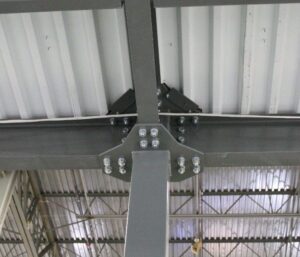
Moment connections create bolted, secure, rotation-resistant attachments between columns and beams. This enhances stability, reduces overturning risks, and allows for efficient load transfer, potentially enabling the use of smaller baseplates and optimizing structural support.
Pros —
Space Efficiency: Free up space for ideal column spacing and load distribution.
Enhanced Stability: Moment connections ensure a rigid column connection, preventing rotation and minimizing overturn risks at the base.
Optimized Load Transfer: Efficiently transfers loads, potentially allowing for smaller baseplates.
Seismic Performance: Well-suited for addressing seismic considerations and improving mezzanine resilience.
Cons —
Complexity: Installation and design of moment connections can be more complex, potentially increasing project complexity and cost.
Cost: Initial costs for moment connections might be higher than simpler bracing methods.

Choosing the Right Bracing Option Begins with the Right Team
For expert guidance in transforming your vision into an efficient mezzanine reality, trust Apex Companies. Our full-service approach, from design to seamless installation, ensures that your industrial space maximizes functionality while prioritizing safety and stability. Apex Companies brings expertise to every stage of your mezzanine project —Contact our team today for solutions that stand the test of time.
Related Blogs:
