Designing P&D Stations for Maximum Efficiency in VNA Pallet Racking

Streamlining Pick & Delivery in VNA Pallet Racking Systems
Very Narrow Aisle (VNA) storage systems are integral to modern warehouse designs, where maximizing space is a top priority. When configuring a VNA system, it’s important to consider how to receive and deliver stock efficiently. P&D stations (Pick and Deposit stations) allow for streamlined “pick up & delivery” within these tight spaces while maintaining high productivity.
This is where turret trucks come into play. These specialized vehicles are designed to safely navigate narrow aisles, typically using wire or rail guidance for forward and backward movement. While highly effective, turret trucks have limited flexibility beyond the confines of the aisle. P&D stations are positioned at the end of rack rows and act as temporary holding or staging areas where pallets can be dropped off by a less specialized piece of equipment for easy pickup by the turret truck, allowing the truck to stay within the aisle. As with most racking system designs, there is flexibility in configuring the P&D station to be most effective.
Let’s explore the pros and cons of the two main designs.
P&D Bay Design within VNA Systems

Cantilever P&D Stations
There are several ways to configure P&D stations in a VNA system, each with pros and cons depending on pallet type, equipment, and operational flow. The following overview outlines common design options, challenges related to pallet entry types, and how you can custom-configure your system better to support your inventory and material handling equipment requirements.
For optimal efficiency, P&D stations should ideally be placed on the rack side nearest to your dock doors to minimize vehicle travel. In some setups, however, P&D stations may be needed at both ends of the VNA racking, especially when inventory intake and dispatch are located at opposite ends, with the VNA system running centrally between them. Furthermore, a portion of your P&D stations can serve as temporary storage during peak demand, helping to ease pressure on the main storage areas.
1. Striped Floor-Level P&D StationThe simplest P&D solution is a striped location on the ground, where pallets are temporarily staged in marked zones at the end of rack rows. This design is low-cost and easy to implement, but may lack efficiency and organization in high-volume environments. Advantages: Low cost, easy to implement. Considerations: Limited capacity, less organization, and potentially slower pallet movement. |
 |
2. Cantilevered or Rear Post-Supported DesignThis design uses one-pallet-deep racking shelves located at the end of the narrow aisle rack, allowing for visibility and unrestricted access from the center aisle. These floating shelves are often used with pallets oriented in the opposite direction (pinwheeled) to facilitate drop-off and pick-up by turret trucks. Advantages: The cantilever design requires pallets to be loaded in the 48” wide x 40” deep orientation vs. the standard 40″ x 48”. This enables the turret truck to remain within the aisle while easily retrieving the pallets from the 40” side. Considerations: For use with 4-way pallets, providing flexibility for pallet orientation. The standard forklift can only access the P&D stations from the outfacing side (center aisle), meaning the forks enter the pallet from the 48” side when picking and placing. The narrow aisle truck, on the other hand, will access the pallet from the smaller 40” side, keeping the pallet in this position while transporting it between the P&D stations and racks. |
|

3. Sawtooth Design
The P&D shelves, essentially an additional rack bay, are added to alternating rack rows. This rack bay provides sufficient storage to accommodate multiple pallets per level. The design creates a sawtooth pattern at the ends of the aisles.
Advantages: Suitable for 2-way and 4-way pallets.
Considerations: It can be more expensive to implement compared to simpler designs.
Here is an example of a sawtooth VNA rack system design. Note the rows on the left and right that extend beyond the middle row… those are back-to-back P&D extensions. This is one type of sawtooth configuration, the other being the single-side extension. Continue reading below for more details of these two options.
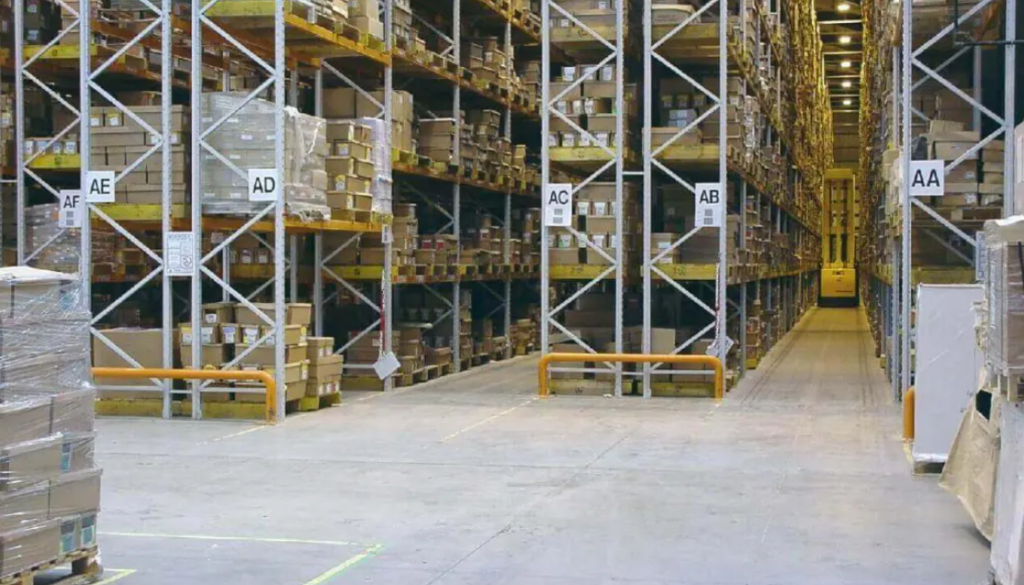
A. Back-to-Back P&D Extension:
In this configuration, every other back-to-back row has one bay that extends out to create a larger aisle at the end, providing more space for pallet drop-off and retrieval.
Here is a CAD drawing illustrating the back-to-back sawtooth design:

B. Single-Side P&D Extension:
This design involves extending the rack only on one side of the back-to-back rows, creating additional room for P&D operations at the aisle end.
Here is a CAD drawing illustrating single-side sawtooth extensions:

Truck Access in P&D Configurations: Optimizing Efficiency
In P&D stations, both standard forklifts (i.e., reach, stacker, or counterbalance trucks) and turret trucks play key roles in pallet pick-up and drop-off. Each P&D station design impacts how these trucks access the pallets, with varying levels of efficiency and flexibility. Here’s how they work in each configuration:
1. Striped Floor-Level P&D Station
- Standard Trucks: Your reach, stacker, or counterbalance truck can easily access pallets from the ground level. Once moved into the striped zones at the end of the rack rows, the equipment can pick and place pallets directly onto the staging area.
- Turret Trucks: Turret trucks have limited access here, as they typically operate within the aisle. They must position themselves carefully to ensure proper pallet handling.
2. Cantilevered or Rear Post-Supported Design
- Standard Trucks: The equipment access to the P&D stations is from the center aisle side, where the pallet is placed on the shelf in the 48” x 40” orientation.
- Turret Trucks: Turret trucks remain within the aisle and can easily pick up or drop off pallets from the P&D station as the pallet is oriented on the shelf in a pinwheeled position, leaving the 40” side accessible to the turret truck.
3. Sawtooth Design
- Standard Trucks: The fork trucks access the P&D station on the rack bays that extend beyond the narrow aisle, providing ample room to maneuver and pick or place pallets.
- Turret Trucks: Turret trucks pick up and drop off pallets from the same entry points on the same side of the aisle, facilitating smooth operations for two-way pallets.
Optimizing Your VNA System with Apex Companies
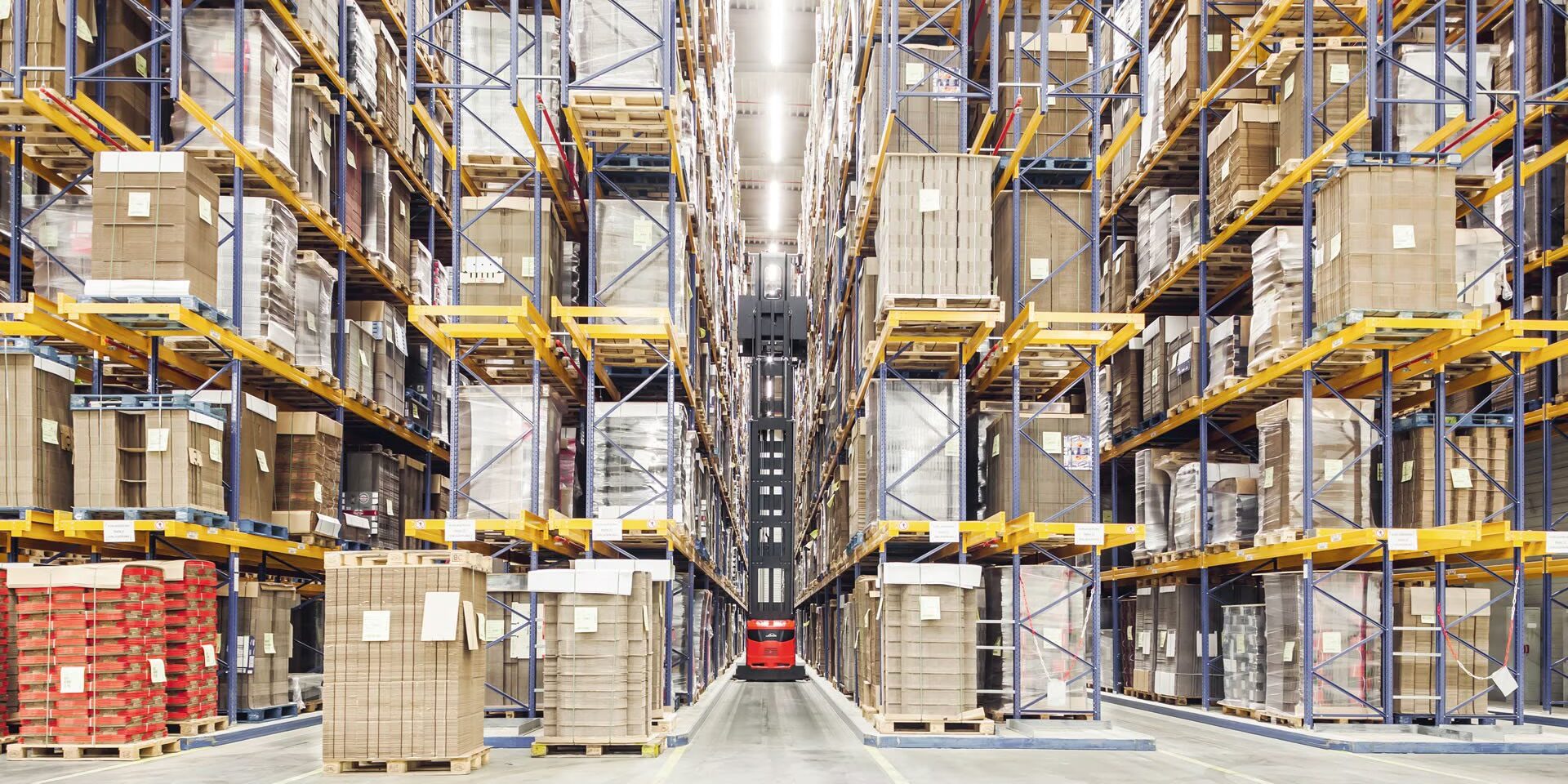
At Apex Companies, we specialize in designing custom racking solutions tailored to your unique inventory and pallet specifications. Our expert team works closely with you to understand your operational needs and create a system that maximizes space utilization, improves efficiency, and enhances safety.
Whether you’re handling standard or custom pallets, we ensure that each design perfectly suits your workflow, optimizing operations for seamless handling and quick access. Apex’s professional rack installation teams guarantee that your racking system is built for durability and safety, meeting the highest standards for quality and performance.
Let Apex Companies help you create a custom pallet racking system that meets your specific needs. Contact us today for a consultation and take the first step toward a more efficient, organized, and safe warehouse.
