
Conveyors 101–Your Guide to Selecting the Right Warehouse Conveyor System

Conveyor Systems – The Fundamental Building Blocks of Warehouse Automation
A wide variety of industries rely on conveyors and conveyor systems for moving products ranging from bulk materials to cartons and pallets. Conveyors are a staple of warehouse automation used in many innovative supply chain applications. In today’s blog, we’ll break down the basic types of conveyor systems and explore some of those warehouse automation applications.
There are five basic types of conveyor systems used in the warehouse:
- Transportation Conveyors
- Sortation Conveyors
- Accumulation Conveyors
- Pallet Conveyors
- Gravity Conveyors

Transportation Conveyors
These conveyors accomplish the most basic material handling task –moving products quickly and efficiently from one point in a facility to another. Transportation conveyors are customizable and can handle a variety of product sizes and weights. Design your transportation conveyor using these four system types.
- Belt – A belt conveyor is a mechanical system consisting of a continuous belt made of various materials, such as rubber, fabric, or metal, looped around two or more pulleys or drums. The belt can carry and transport bulk materials, packages, or objects from one location to another, typically horizontally or with a slight incline. Depending on the travel distance, they are powered by one or more motors and a series of belts and pulleys. Belt conveyors are ideal for boxes, cartons, odd-shaped products, and soft goods.
- Live Roller – A series of rollers driven by a motor that turns a continuous belt or chain attached to the rollers. They are best used with large, bulky, or heavy items that need to be sorted, queued, or stopped at some point in their travels.
- Motor Driven Roller Separate zones, with one or more powered rollers, allow items to stop or start. Other rollers are attached to this powered roller by belts or chains. They are ideal for light or medium-duty applications and use energy-saving low-voltage power systems.
- Line Shaft – A single power shaft along the length of the conveyor provides power to the rollers using bands or belts. The shaft can include a swivel joint to change direction. Simple to design and operate; suitable for cartons, boxes, or totes that need to move a long distance.

Sortation Conveyors
Sortation conveyors are widely used in picking, packing, manufacturing, receiving, and shipping. They can send boxes, cartons, parts, or assemblies in different directions. Powered by sensors, software, and mechanical sorting devices, these conveyors can send products to different destinations. The differences between them are in sorting technology.
- Right-Angle Transfer – Using pop-up wheels, pop-up bands, or rotating balls, these conveyors can change the direction of all or a selection of products as directed by sensors and control software. They are perfect for low- or medium-rate throughput and are inserted within transportation conveyors.
- Swing-Arm Divert – A mechanical arm sweeps across the conveyor and pushes a box or carton onto a secondary conveying line positioned at an angle. Sensors and software control the selection.
- Pop-Up Wheel Divert – Control software senses a carton that needs to be sent to an angled, secondary conveyor and engages angled pop-up wheels to accomplish the direction change. Economical for medium-speed sorting.
- Slat or Shoe Sorter – Mechanical shoes move sequentially across a metal or plastic slat conveyor to direct products or cartons to a secondary conveyor. Perfect for high-speed item sortation of various sizes, shapes, and weights.
- Tray Sorter – Products loaded onto trays are conveyed at high speeds. A number of different sortation technologies can be used: tilt tray to drop a box onto a chute; push bar to move product to a chute or secondary conveyor; or split tray that allows a product to drop to a lower level for packing or onto another conveyor.
Accumulation Conveyors
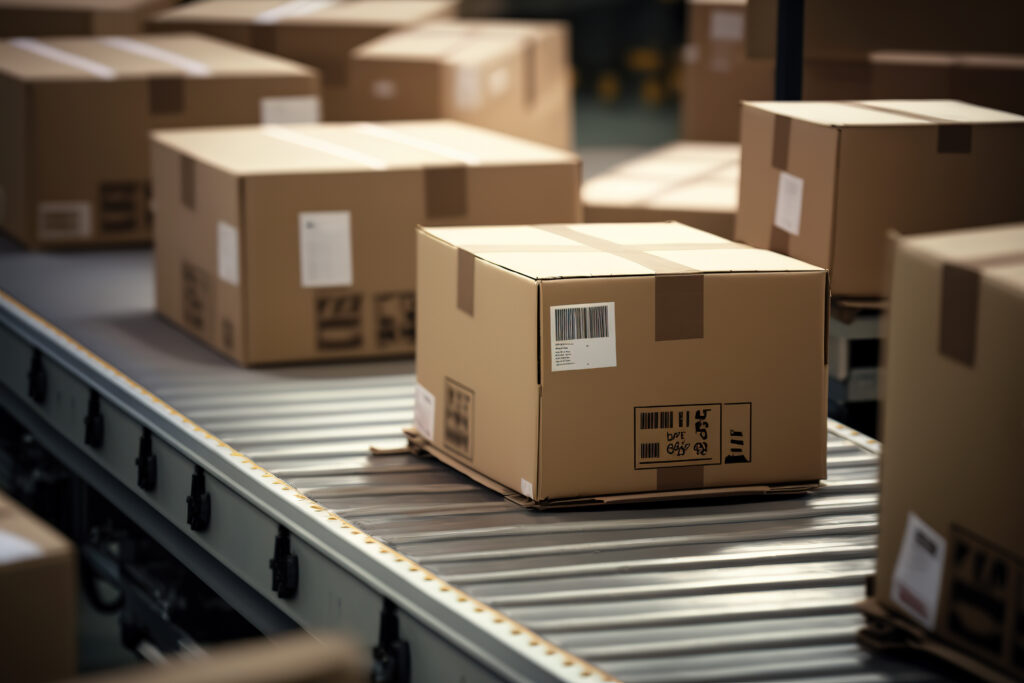
These conveyors can buffer a conveying line, facilitating the loading or labeling of boxes, creating batches, or accommodating a slowdown further down the conveying line. There are two accumulation conveyor design styles.
- Minimum Pressure – Allows items to touch lightly and can be used for products in sturdy boxes, cartons, or totes.
- Zero Pressure – Positioning software and zones keep a distance between adjacent products to prevent contact. Zero pressure conveyor is ideal for delicate items that might be damaged if stacked up on a conveying line.
Pallet Conveyors
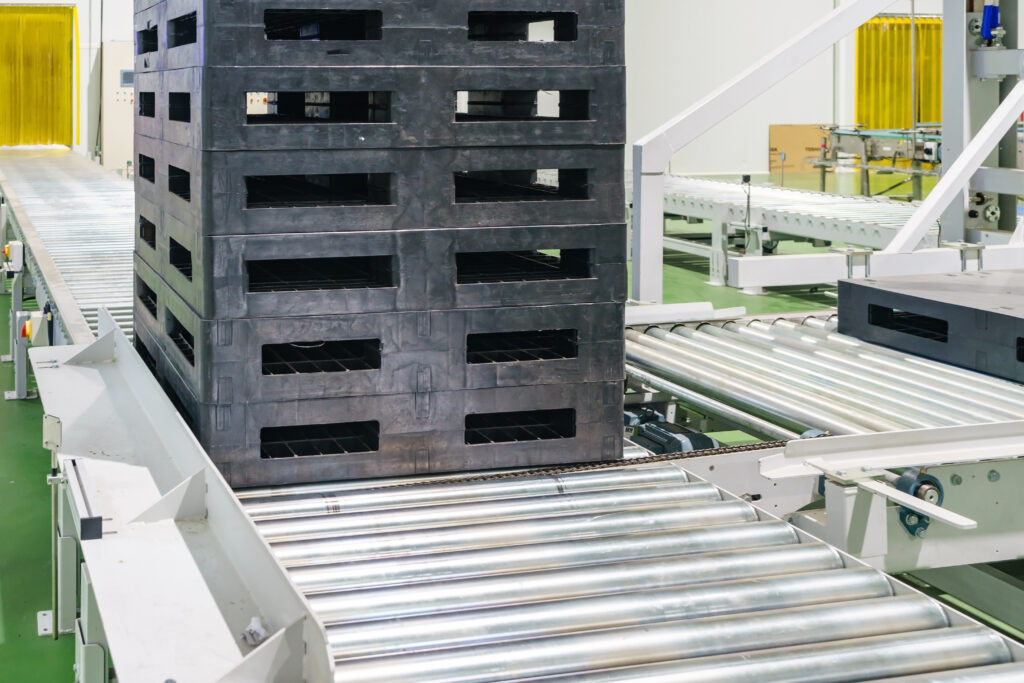
As the name implies, pallet conveyors handle large, heavy loads, like loaded pallets or crates. Pallets move on heavy-duty rollers, and chain drives provide the power. Pop-up chain drives move pallets at a right angle to the flow of the conveyor for loading, unloading, and transfer to trucks or rack systems using a forklift. Accessories available with pallet conveyors include turntables, transfer tables, and lift stations.
Gravity Conveyors
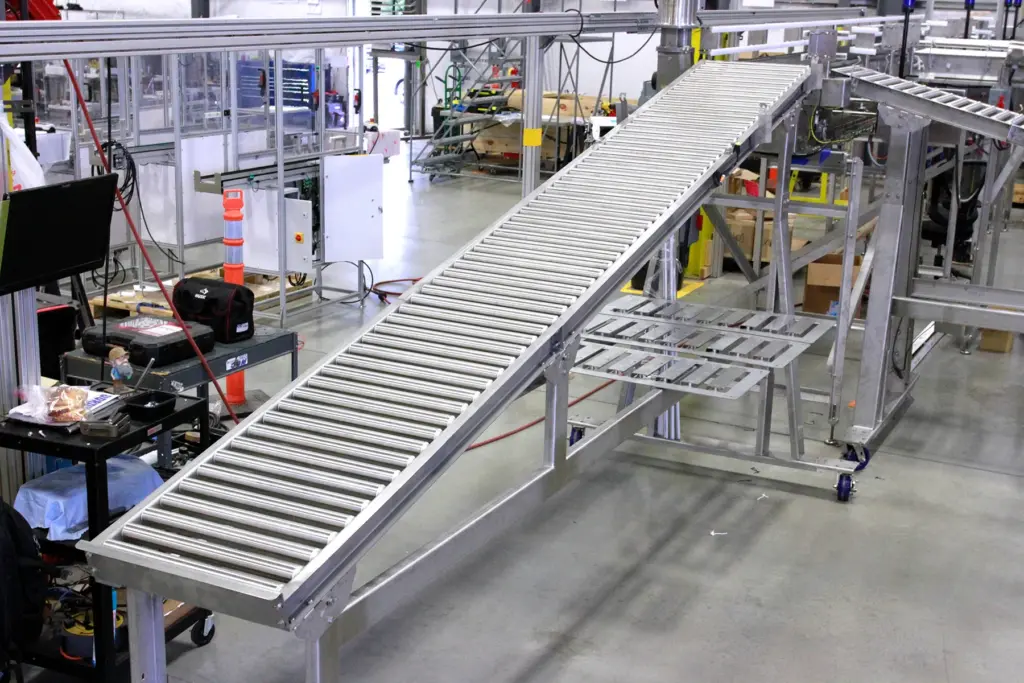
We’ve saved the simplest for last! Gravity conveyors are generally used to move items from a higher to a lower level. They can also be positioned horizontally to push-assist items manually. They can be floor mounted or raised to optimize ergonomics Applications include unloading trucks or railcars, moving products to assembly or packaging lines, or staging products in shipping and receiving areas. Gravity conveyors are available in straight-line frames with solid rollers or flexible frames with skate wheel rollers.
Apex is your full-service warehousing and automation solutions integrator. No matter what your material handling or warehouse automation needs are, the experts at Apex can help you to design the most efficient and economical solution. Give us a call to discuss your application.
