
Conveyor Systems Glossary: The Language of Smooth Operations

The Language of Logistics: Conveyor Systems Terms Demystified
Do you know what can go downhill fast—besides a conveyor? A conversation about conveyor systems when you don’t understand the terminology.
Whether you’re managing a warehouse, overseeing facility operations, or just trying to get a system installed without the headaches of miscommunication, knowing the right terms matters. That’s why we created this glossary. Our goal is to help you navigate key definitions, talk shop with confidence, and keep your operations moving smoothly.
How to Use This Conveyor Systems Glossary
The glossary is organized categorically and alphabetically for easy navigation. Each term includes a straightforward definition, and where applicable, a little contextual nudge to illustrate its application within conveyor systems.
Now, let’s get started!
Conveyor Types
Definitions and differences between powered conveyor systems used in material handling.
90-Degree Transfer Conveyor: A conveyor system designed to move items at a right angle from one conveyor line to another. It’s often used in sorting, palletizing, or merging applications where product flow needs to change direction without manual handling. These transfers can be achieved through pop-up belts, chain transfers, or roller systems and are essential for efficient layout design in distribution centers and packaging lines.
Belt Conveyor: Powered conveyor systems that use a continuous belt made of rubber, PVC, or other materials stretched over pulleys to transport goods. Belt conveyors are versatile and used across industries such as mining, agriculture, manufacturing, and logistics. They’re ideal for moving both bulk and unit materials over long distances or uneven surfaces with minimal vibration.
Chain Conveyor: A system that uses a chain (or multiple chains) to pull or push a product along a fixed track. Chain conveyors are built for heavy-duty applications and are capable of moving large, heavy items such as pallets, engine parts, or metal scrap. They are commonly found in automotive plants, steel mills, and industrial warehouses, where ruggedness and load-bearing capacity are priorities.
Cross-Belt Sorter: A high-speed sorting system that uses a series of short belts mounted on carriers that move perpendicularly across a main track. Each belt can independently discharge items left or right into specific lanes. This system is ideal for parcel sorting, e-commerce fulfillment, and postal operations that require rapid, high-accuracy sorting of items by destination or SKU.
Live Roller Conveyor: A powered roller conveyor where the rollers themselves are driven by motors or belts to move the product.
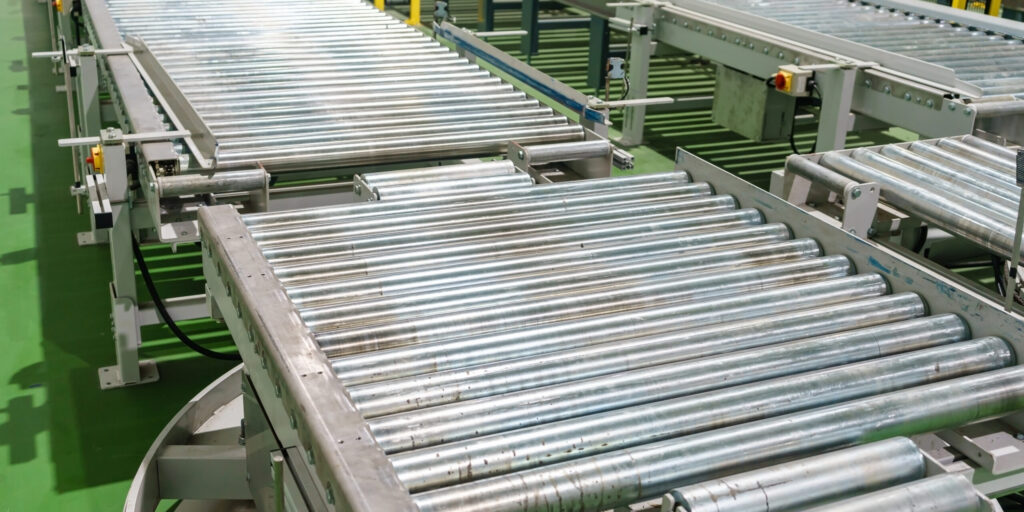
Merge Conveyor: A system designed to bring two or more conveyor lines into one unified line. Merge conveyors often use angled rollers or belts and are critical for managing flow from multiple production or packaging lines. They help streamline downstream operations by controlling the timing and spacing of incoming products.
Motorized Drive Roller (MDR) – In an MDR system, each roller zone has its own motorized drive roller, which powers a few slave rollers via belts or bands. This creates modular zones that can independently start, stop, or accumulate items as needed, without the need for a centralized motor. MDR systems are beneficial for e-commerce, 3PLs, and high-volume distribution centers.
Omnidirectional Sorter: A compact, high-tech sorting system capable of moving items in any direction — forward, backward, sideways, or diagonally — within a single footprint. It uses independently driven spheres or rollers to achieve this motion. These systems are commonly used in high-throughput environments like airport baggage handling or e-commerce fulfillment centers, where items vary in size and need to be sorted quickly.
Overhead Conveyor: A system suspended from the ceiling or support structure that moves items along a track above the work area. It’s commonly used for transporting parts or garments in automotive, apparel, and assembly-line applications. Overhead conveyors help free up floor space, reduce manual transport, and improve workflow efficiency.
Reversing Conveyor: A conveyor that can alternate its direction of movement, allowing materials to be transported forward or backward on command. Reversing conveyors are helpful in batch processing, dual-direction workflows, or when multiple workstations share the same conveyor line.
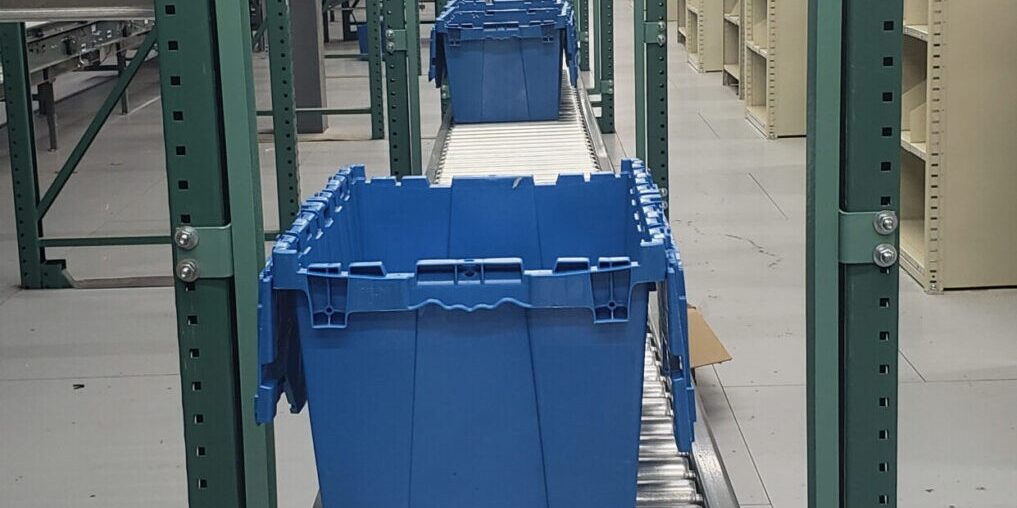
Roller Conveyor: A conveyor that uses a series of rollers, either powered or gravity-fed, to move products along a frame. Roller conveyors are widely used in warehouses, assembly lines, and packaging operations. They’re well-suited for handling boxes, totes, and pallets with flat bottoms, offering simplicity and durability for both light and heavy loads.
Slat Conveyor: A conveyor that uses slats or plates made of steel, wood, or plastic mounted on chains to move products. Slat conveyors are often used for handling heavy items or sharp materials that would damage conventional belts. They are ideal for environments like machining or metal fabrication where precision and durability are required.
Twist Conveyor (Product Orienters): A conveyor system or module designed to rotate or reorient items as they move, often using angled belts or pairs of opposing conveyors. Used to align, flip, or rotate flat products such as cartons, paper stacks, or trays before they enter the next phase of processing. Especially useful for preparing items for labeling, scanning, or packaging.
Turns (45°, 90°, Tapered Roller Turn): Curved conveyor sections designed to smoothly guide products around corners. Tapered roller turns specifically use rollers shaped to maintain product orientation and stability, critical for ensuring items remain correctly positioned in tighter spaces.
Core Conveyor Components
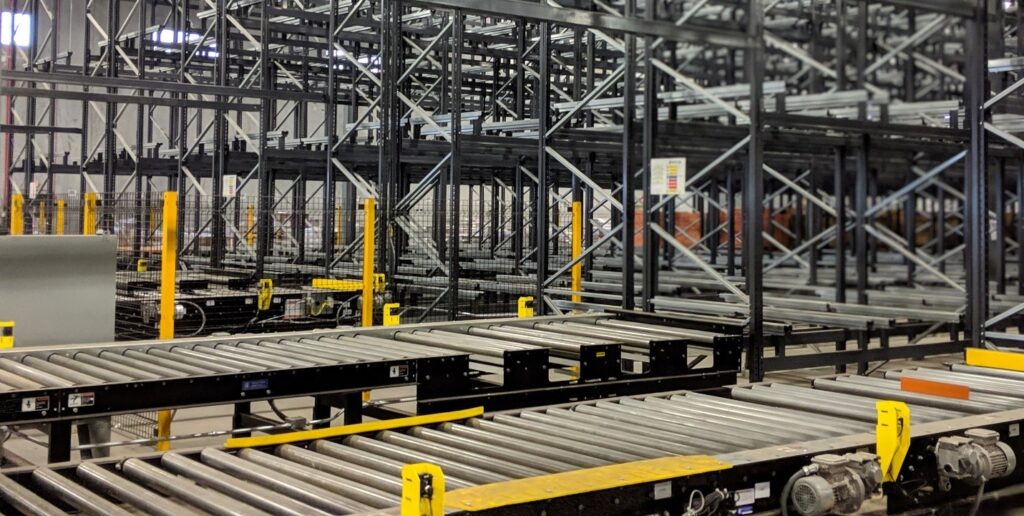
Backup Tube / Channel: A structural reinforcement running the length of the conveyor frame that provides added stiffness and durability. It’s especially important in wider conveyors, where it helps maintain frame alignment and can also serve as a mounting surface for center supports like T-bars.
Bearing: A mechanical component that reduces friction between moving parts, usually between a rotating shaft and a stationary mount. In conveyor systems, bearings allow rollers or shafts to spin smoothly, supporting continuous movement with less wear.
Bearing Mount: A bracket or housing that holds a bearing in place and connects to the conveyor frame. It helps define the overall conveyor width, maintains shaft alignment, and adds structural integrity to the frame. Often found at terminal ends or along intermediate shaft points.
Bed: The base or surface on which the conveyor belt or rollers sit. In a belt conveyor, the bed supports the belt to prevent sagging and helps guide materials smoothly. It may be flat or trough-shaped depending on the material being handled.
Belt: A continuous loop of material — rubber, PVC, or fabric-reinforced — that moves over pulleys or rollers to transport goods. Belts are ideal for moving small, loose, or delicate items and are used across industries from agriculture to logistics.
Brakes: Devices that slow or stop motion within the conveyor system. Brakes can be mechanical or pneumatic and are used to create gaps between items, control accumulation zones, or halt products at specific stations for inspection or processing.
Bushing Cover: A protective cover that sits over the bushing area of the conveyor, shielding internal components like roller shafts and transmission belts or chains from dust, debris, and physical contact. It’s essential for safety and system longevity.
Bushing Holder: A molded or fabricated component that holds bushings in place along the conveyor’s side rails. It ensures the bushings stay properly aligned, allowing roller shafts to rotate smoothly and reducing wear on the system.
Bushings: Also called plain bearings, bushings are sleeve-like components used to reduce friction between a stationary holder and a rotating shaft. They’re often made of plastic, bronze, or other low-friction materials and are commonly used to support roller shafts.
Drive: The mechanism that powers the conveyor, typically consisting of a motor, gearbox, and some form of transmission, like belts or chains. The drive converts electrical energy into mechanical motion, moving the conveyor belt or rollers.
Drive Roller: A powered roller that provides the driving force for a section of the conveyor. In motorized systems like MDR conveyors, the drive roller contains an internal motor and transfers motion to adjacent rollers via belts or O-rings.
Drive Shaft: A long shaft, typically running parallel to the conveyor frame, that transfers power from the drive motor to multiple rollers using belts or chains. Common in older or larger conveyor systems, it’s a key component for synchronized motion.
Drive Shaft Bearing: A specialized bearing that supports the drive shaft inside the conveyor frame, allowing it to spin smoothly while carrying torque. It reduces friction and helps prevent wear on both the shaft and the mounting surface.
E-Stop (Emergency Stop): A critical safety feature that shuts down the conveyor immediately when triggered. E-stops are placed in accessible locations along the conveyor line to allow operators to halt the system quickly in case of emergencies or hazards.
Frame: The structural backbone of the conveyor system. It holds all components in place — rollers, belts, motors, sensors — and defines the width and length of the conveyor. Frames are typically made from steel or aluminum and designed to support both static and dynamic loads.
Guide Rail: A component mounted along the sides of the conveyor to keep products aligned and prevent them from falling off or shifting. Guide rails are especially helpful in high-speed or curved sections and can often be adjusted for different product sizes.
Idler: A non-powered roller or pulley that supports the conveyor belt and helps guide it along its path. Idlers don’t drive movement — they simply provide support and help maintain belt tension and alignment, especially on longer conveyor runs.
Leg Assembly: The supporting structure that holds up the conveyor frame. It typically includes vertical legs, cross-braces, and adjustable feet. Leg assemblies can be customized for conveyor height, floor anchoring, or mobility (with casters) depending on the application.
Lift Gate: A hinged section of conveyor designed to swing upward, providing temporary access across a conveyor line. Lift gates are typically counterbalanced (without springs) for safer and easier operation in tight spaces.
Motor: The power source for the conveyor, converting electrical energy into mechanical motion. Motors come in various types (AC, DC, servo) and sizes depending on the system load. They’re typically connected to the drive unit and directly control belt or roller movement.
Poly-V Belt: A multi-ribbed belt used to transmit power from a motorized roller to adjacent rollers. Its grooved design provides a strong grip with low noise and high efficiency. Common in MDR systems, poly-V belts are durable and compact.
Positioner: A device used to stop and precisely locate a product on the conveyor. Positioners may use guide rails, pneumatic actuators, or mechanical pins to hold products in place for inspection, labeling, or transition to another system.
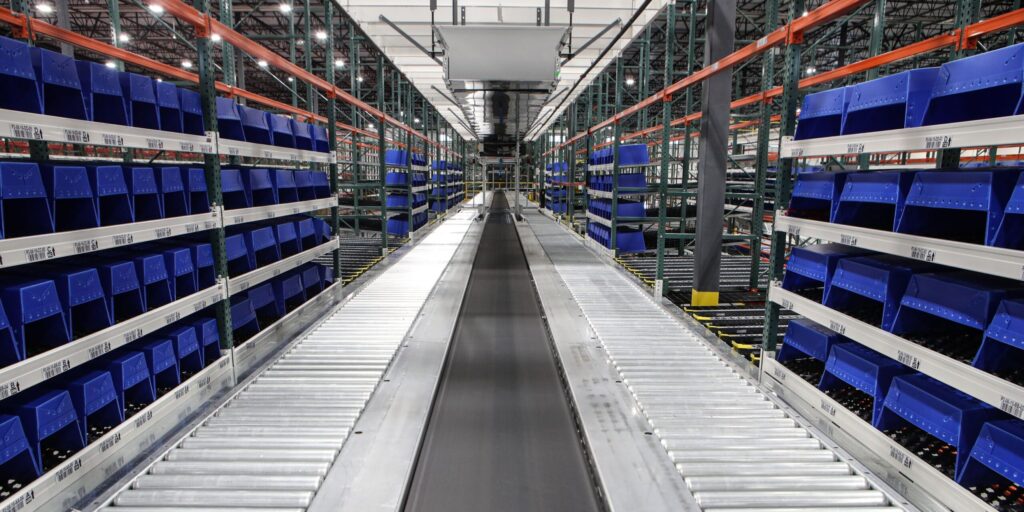
Pressure Roller: A roller that applies downward force to ensure proper contact between the belt or drive components and the load. Pressure rollers help maintain traction and smooth motion, especially in accumulation zones or incline sections.
Product Pusher: A mechanical arm or actuator that moves products off the main conveyor lane, either to sort them or transfer them onto another conveyor. Pushers can be powered pneumatically or electrically and are commonly used in sortation systems.
Product Stop: A device that halts product movement on the conveyor for temporary holding, inspection, or staging. Stops can be passive (fixed) or active (pneumatic or mechanical), depending on whether they need to release products on command.
Pulley: A round wheel used to support and redirect the conveyor belt. Drive pulleys are connected to motors and provide motion, while return or idler pulleys help guide the belt’s return path and maintain tension.
Roller: A cylindrical component available in various sizes and materials — such as plastic, steel, or rubber — that rotates to transport items along the conveyor. Rollers can be powered (live) or non-powered (gravity) and are used to carry everything from small parcels to heavy pallets, depending on their size and material.
Roller Shaft: The axle or rod, typically made from stainless steel (commonly 8mm diameter), upon which conveyor rollers are mounted. It transmits rotational force to the roller and is supported at each end by bushings or bearings. Roller shafts must be precisely aligned for smooth system performance.
Roller Shaft Bearings: Bearings mounted at either end of the roller shaft that reduce friction and allow smooth rotation. These are especially important in high-speed or heavy-duty conveyor applications where load wear must be minimized.
Safety Interlock: A safety feature that prevents a conveyor from operating unless certain conditions are met, such as guards being closed or sensors being clear. Interlocks help reduce the risk of accidental injury or system damage.
Sensors: Devices that detect the presence, position, or speed of products on the conveyor. Common types include photoelectric (photo eyes), proximity, and infrared sensors. Sensors enable automated control, sortation, and accumulation by feeding data to the system’s logic controller.
Set Collar: A mechanical clamp or ring that holds a component, like a roller or bearing, in place on a shaft. Set collars help maintain alignment and are often used to define spacing or keep parts from sliding along the shaft.
Side Rail: The side structure of the conveyor frame that holds rollers, belts, or other components in place. Side rails also serve as mounting points for guide rails, sensors, and safety equipment.
Skewed Roller Shafts: Roller shafts that are intentionally offset or angled to create lateral movement on the conveyor. This setup helps guide products toward one side, typically toward a guide rail or divert area, and is often used for alignment or sorting.
Spring Loading: A method where springs are used to apply tension or pressure between conveyor components, such as rollers or belts. Spring loading helps absorb shock, maintain traction, and improve the handling of irregular loads.
Take-up: A device that adjusts tension in the conveyor belt or chain. Take-ups compensate for slack caused by wear, stretch, or temperature changes, and help ensure consistent tracking and smooth operation over time.
Operational Terms & Features
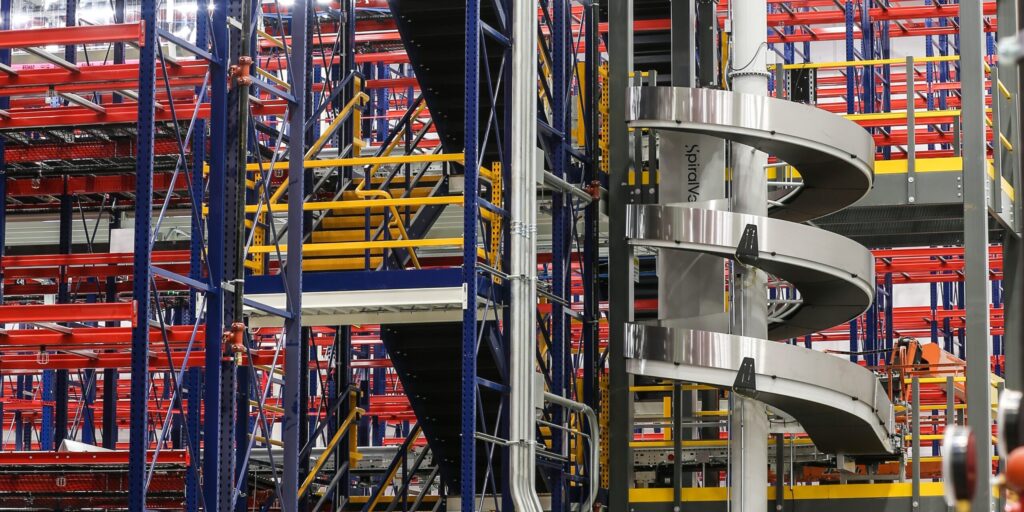
Belt Tracking: The process of keeping a conveyor belt properly aligned on its pulleys and rollers. Good tracking ensures the belt runs straight and doesn’t drift to one side, which prevents damage and keeps the system running smoothly over time.
Conveyor Line Control: The coordinated control of multiple conveyor zones or sections to manage product flow, timing, and spacing. This can include starting, stopping, and regulating speed across different zones to improve efficiency and reduce bottlenecks.
Curve Radius: The measurement of the bend or arc in a curved conveyor section. A tighter curve radius allows for more compact layouts, but may limit product size or speed. It’s a key design factor when space is limited and direction changes are needed.
Divert—Diverters (Swinger): Devices that reroute products from one conveyor line to another. Diverters can be mechanical arms, pneumatic pushers, or servo-controlled modules like Swinger arms. They are essential in sortation systems where items need to be sent to different destinations.
Incline/Decline: Refers to sections of the conveyor that angle upward (incline) or downward (decline) to move products between different elevations. These are often used to connect mezzanines, load docks, or overhead systems while conserving floor space.
Indexing: The controlled, step-by-step movement of products along the conveyor. Indexing is used when items need to stop at precise intervals for labeling, inspection, or machine operations, and helps ensure repeatable positioning.
Lift & Rotate: A conveyor feature that lifts a product off the main surface and rotates it to a new orientation, typically 90° or 180°. This is especially useful for packaging lines, labeling, or processes that require products to face a certain way.
Lift and Transfer: A mechanism that lifts a product off the main conveyor and transfers it to a different lane or level. It’s used for lane merging, sortation, or elevation changes and helps automate complex routing without stopping the main line.
Line Pressure: The amount of force the conveyor applies to a product while it’s moving. Low line pressure is ideal in accumulation systems where products must queue up without bumping into each other. High line pressure increases speed but can risk product damage.
Load Capacity: The maximum weight a conveyor section can safely and continuously support. This depends on the frame design, rollers or belts, and motor strength, and is a crucial factor in selecting the right conveyor for your application.
Low Profile: A conveyor designed with minimal vertical height to fit in tight spaces or integrate directly into workstations. Low-profile conveyors improve ergonomics and accessibility and are commonly used in packaging, assembly, and clean environments.
Merge: The process of combining multiple conveyor lines into a single stream. Merging can be done with angled belts or timing mechanisms that feed products one at a time into a shared line, helping to optimize throughput without product collisions.
Minimum Pressure Accumulation (MPA): An accumulation method where products gently press against each other while moving down the conveyor, maintaining minimal back pressure. Unlike Zero Pressure Accumulation, MPA allows limited contact between items using a clutch or slip-driven mechanism. This setup reduces drive wear and product damage compared to traditional contact accumulation, while still enabling high-throughput flow in packaging, shipping, or order fulfillment lines.
Product Brake: A component that slows or temporarily stops moving products by applying friction to the rollers beneath them. Brakes are used to create gaps between items or regulate flow into sortation or packaging zones.
Rotate: A function that turns a product while it’s moving on the conveyor. Rotation can be used to change orientation for barcoding, labeling, scanning, or packing without manual handling.
Slip-Torque Principle: A conveyor design where powered roller shafts turn beneath loosely mounted rollers. When product resistance occurs, rollers ‘slip’ against the rotating shaft, limiting line pressure and minimizing potential damage or friction to sensitive products.
Slug Mode / Singulation: Two opposite flow control methods. In slug mode, products are released in groups or “slugs.” In singulation mode, they’re released one by one with controlled spacing. Both are used in accumulation zones depending on the desired output pattern.
Sortation: The automated process of separating items based on specific criteria like size, weight, or destination. Sortation systems use sensors, diverters, and sorters to direct products efficiently, key in distribution, parcel, and e-commerce operations.
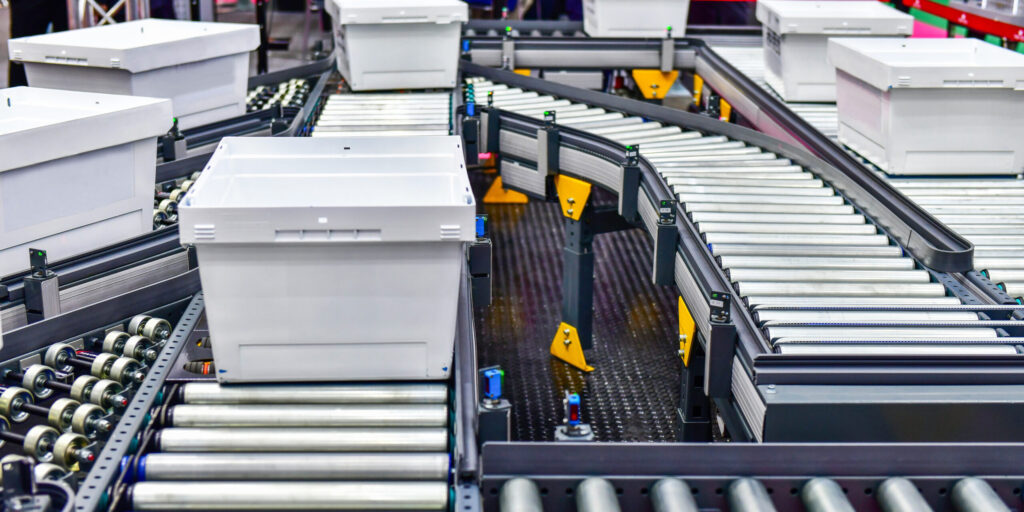
Splicing: The act of joining two ends of a conveyor belt together, typically using mechanical fasteners or heat welding. Proper splicing is essential for belt performance, longevity, and smooth operation.
Split Roller Surface: A conveyor configuration featuring two distinct roller zones within one conveyor frame. This allows for simultaneous bi-directional movement or handling multiple product lanes independently, optimizing space usage.
Speed (FPM – Feet Per Minute): The rate at which a conveyor moves products, measured in feet per minute. Speed affects throughput, product spacing, and coordination with other systems, and is often adjustable for flexible operations.
Staging: Temporarily holding products on the conveyor until downstream processes are ready. Staging zones help balance uneven workflow, especially in picking, packing, or palletizing areas.
Throughput: The total number of units a conveyor system can move in a given time, often measured in items per hour. Throughput is a key performance indicator for system efficiency and capacity planning.
Transfer: The act of moving a product from one conveyor to another. Transfers can be in-line, 90-degree, or vertical, and require precise alignment to avoid jams or product damage.
Troughing: A belt-shaping method where the edges of the belt are raised to form a “trough” that holds bulk materials in place. Troughing is common in conveyors handling loose goods like grains, gravel, or powders.
ZPA (Zero Pressure Accumulation): An accumulation method where products maintain precise spacing without physical contact. ZPA uses controlled zones and sensors to create gaps between products, reducing jams, minimizing damage, and maintaining smooth flow.
Automation & Controls Terminology

CAN Bus / Ethernet IP: Communication protocols used to link and control different devices within an automated conveyor system. CAN Bus is a compact, efficient protocol ideal for local device networks, while Ethernet IP is faster and better suited for complex, real-time data exchanges between industrial controllers and sensors.
Control Card (Zone Controller): A small circuit board that controls an individual conveyor zone, typically in an MDR system. It manages functions like start/stop, speed control, and accumulation logic for that zone, making it a key component of zero-pressure accumulation systems.
DC Motor: A motor powered by direct current (DC) electricity. Known for their compact size, efficiency, and ease of control, DC motors are commonly used in motorized conveyor rollers and are ideal for applications requiring variable speed and smooth starts/stops.
Encoder: A sensing device that converts motion into digital signals to track position, speed, or direction of a conveyor component like a motor shaft. Encoders are essential for precision tasks such as indexing, positioning, or speed synchronization.
HMI (Human Machine Interface): A touchscreen or panel that allows operators to interact with the conveyor control system. HMIs display system status, alerts, and diagnostics, and let users start, stop, or adjust conveyor settings directly from the interface.
Logic Controller: A programmable device used to automate the logic of conveyor operations. It determines what should happen when, such as when to start a zone, stop it, divert a product, or send alerts, based on sensor inputs and programmed rules.
Photoeye: A photoelectric sensor that detects the presence or absence of objects on the conveyor. It uses a beam of light (often infrared) and is commonly used to trigger actions like stopping a zone, counting items, or activating a diverter.
PLC (Programmable Logic Controller): A rugged industrial computer used to automate conveyor systems. It processes inputs from sensors and controls outputs like motors, brakes, and diverters. PLCs are highly customizable and essential for large or complex conveyor setups.
SCADA: Short for Supervisory Control and Data Acquisition, SCADA is a software system that monitors and controls entire facility operations. It provides real-time data from conveyor systems and other equipment to support decisions and optimize performance.
Sensors: Devices that detect various conditions on the conveyor, such as product presence, spacing, orientation, or motion. Sensors feed data to controllers and logic systems, allowing automation to respond intelligently to what’s happening on the line.
VFD (Variable Frequency Drive): An electronic device that adjusts the speed and torque of an AC motor by varying the input frequency. VFDs allow conveyor systems to change speeds smoothly, reduce energy usage, and improve control over motor-driven sections.
Application-Specific Terms
Accumulation Conveyor: A conveyor designed to hold or “accumulate” products temporarily without stopping the entire line. It allows items to queue up in specific zones — often using sensors and zone controllers — to prevent congestion and ensure smoother product flow into downstream processes like packing, sorting, or labeling.
Cleanroom Conveyor: A conveyor system built for ultra-clean environments such as pharmaceutical, semiconductor, or medical device manufacturing. These conveyors are made from materials like stainless steel or anodized aluminum and are designed to minimize particle generation, making them compliant with ISO cleanroom standards.
Gravity Conveyor: A non-powered conveyor that relies on gravity or manual force to move items. It typically uses rollers or skate wheels on a slight incline and is ideal for simple, low-cost applications like loading docks, order picking, or packaging areas.
Pallet Conveyor: A heavy-duty conveyor designed specifically to move palletized loads. It can use rollers, chains, or belts and is engineered to handle large weights and wide product dimensions. Common in manufacturing, warehousing, and distribution centers.
Reversing Conveyor: A conveyor capable of running in both forward and reverse directions. This flexibility allows products to be moved to and from different stations or operators on the same line, often in assembly or batch processing setups.
Side Transfer: A configuration that allows items to move onto or off of a conveyor from the side. This is useful when space is tight or when integrating multiple conveyor lines. Side transfers may involve guides, pushers, or rollers and must be precisely aligned to prevent jams.
Sortation Conveyor: A conveyor equipped with mechanisms to automatically sort products based on predefined criteria like destination, weight, or size. Sortation conveyors use sensors and diverters (like pop-up wheels or belts) and are essential in e-commerce, parcel delivery, and warehouse automation.
Transportation Conveyor: A general-purpose conveyor used to move products from one point to another. These conveyors don’t accumulate or sort. They simply carry items efficiently across distances and are the backbone of most material handling systems.
Turnkey Solution: A fully integrated conveyor system provided by a single vendor, like Apex, from design and manufacturing to installation and support. “Turnkey” means the customer gets a ready-to-use system that fits their requirements without managing multiple vendors or components.
Vertical Conveyor: A conveyor system that moves products between different elevations. Also known as vertical lifts or vertical reciprocating conveyors (VRCs), they save space and are often used between mezzanines, floors, or levels in warehouses and fulfillment centers.
Zone Conveyor: A conveyor divided into independently controlled segments or “zones.” Each zone can start, stop, or accumulate products without affecting the others. Zone conveyors are essential for zero-pressure accumulation systems and help manage flow without damaging items.
Acronyms & Abbreviations
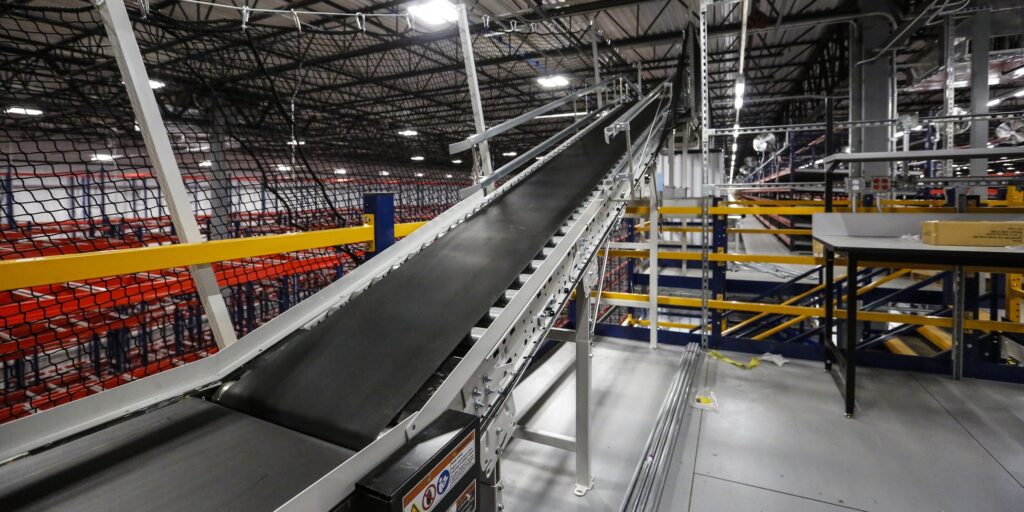
DC – Direct Current: A type of electrical current where the flow of electricity is in one consistent direction. DC motors, commonly used in motorized rollers, offer smooth acceleration and easy speed control, making them a smart choice for many conveyor systems.
FPM – Feet per Minute: A measurement of conveyor speed that tells you how many feet of belt or rollers move past a fixed point in one minute. It’s a key factor in calculating throughput and coordinating speed across different parts of a system.
PLC – Programmable Logic Controller: An industrial computer used to automate conveyor systems. PLCs take input from sensors and devices, then execute logic-based instructions to control motors, sorters, diverters, and other components. They’re reliable, flexible, and essential for modern automation.
RPM – Revolutions per Minute: A unit of rotational speed that indicates how many full turns a shaft or motor makes in one minute. RPM is often used to describe motor performance and is directly related to conveyor speed and torque.
VFD – Variable Frequency Drive: A device that controls the speed and torque of an AC motor by adjusting the frequency of the electrical power supplied. VFDs help reduce energy use, provide smoother starts and stops, and improve conveyor performance overall.
ZPA – Zero Pressure Accumulation: A conveyor control method that allows products to accumulate without touching one another. ZPA uses sensors and zone control to maintain gaps between items, helping prevent jams, scuffs, or damage during high-volume operations.
Safety & Maintenance Terms
Guarding: Physical barriers installed around moving parts of a conveyor system to protect workers from contact with rollers, belts, chains, and motors. Guarding helps prevent injuries and is a required safety feature under OSHA and other safety regulations.
Lockout/Tagout: A safety procedure used during maintenance or repairs to ensure that the conveyor system is completely de-energized. Workers place locks and warning tags on power sources so the system can’t be restarted until it’s safe, protecting personnel from accidental startups.
Lubrication: The process of applying grease or oil to moving parts like bearings, chains, or gears to reduce friction and wear. Regular lubrication extends the lifespan of components and keeps the conveyor running smoothly and quietly.
Preventive Maintenance: Scheduled inspection and servicing of conveyor components to catch wear, misalignment, or potential failures before they cause breakdowns. It includes tasks like cleaning, tightening, and replacing parts, and it helps reduce costly unplanned downtime.
Wear Parts: Components of the conveyor system that naturally degrade over time due to regular use, such as belts, bearings, rollers, and bushings. Identifying and replacing wear parts on schedule is essential for keeping the system reliable and efficient.
Need help designing the right conveyor system?
Let the Apex team turn these terms into real-world results—contact us today!
