
Scalable Warehouse Automation to Optimize Space & Productivity
Automated Storage & Retrieval Systems – ASRS Systems

Automated Pallet Shuttle
Battery-powered shuttle systems move pallets on rails within deep lanes, eliminating forklift entry. Options include semi- and fully-automated shuttles. They enable high-density storage and maximize space use. Common in cold storage and high-volume, low-SKU operations. Not ideal for high SKU selectivity.
Pallet and Unit Load ASRS
Pallet and unit load ASRS use rail-guided stacker cranes to handle loads up to 7,000 lbs in high-bay storage exceeding 100 feet. Configurations range from single to triple-deep to balance density and selectivity. Best for bulk storage and high-volume distribution. Not suited for low ceilings or frequent SKU changes.
Mini-Load ASRS
Mini-load ASRS use cranes, shuttles, or robotic arms to retrieve lightweight items and deliver them to operator workstations. This goods-to-person system improves accuracy and throughput without operator travel. Best for e-commerce, pharmaceuticals, and parts distribution. Not suited for palletized bulk storage.
ASRS carousels are closed-loop, goods-to-person systems designed to store individual items or cases in a high-density footprint. By bringing inventory directly to the operator, they reduce travel, increase picking speed, and improve accuracy. They are a strong fit for operations that need compact storage, fast access, and efficient order fulfillment.
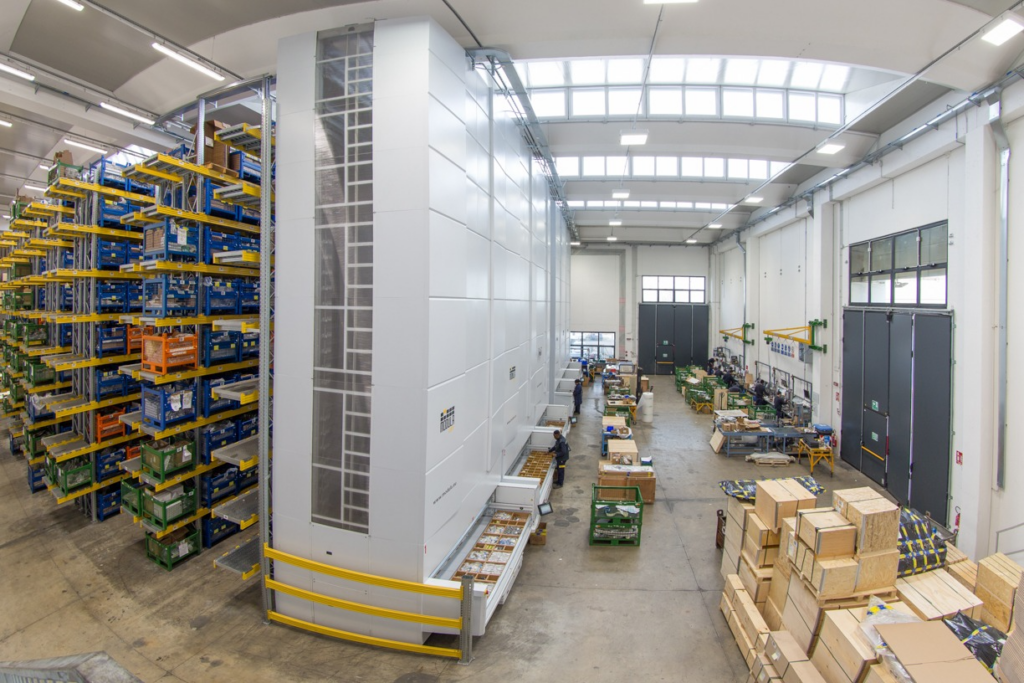
Vertical Lift Modules (VLMs)
VLMs are enclosed, tray-based goods-to-person systems that bring inventory to an ergonomic access point through a central inserter/extractor. Sensors measure item height and position trays accordingly, allowing the system to store variable-sized inventory more efficiently than fixed-spacing solutions. The tall, narrow design creates high-density storage in a compact footprint.
Robotic Cube and Pod Storage
Cube and pod systems are high-density, goods-to-person solutions where robots store and retrieve bins within a dense grid, eliminating fixed aisles. By bringing inventory directly to workstations, they reduce travel, increase flexibility, and scale throughput by adding robots—ideal for e-commerce and 3PL operations with variable demand.
What ASRS Systems Are and How They Work
Automated storage and retrieval systems use computer-controlled, electromechanical physical equipment to move inventory into and out of defined storage locations without requiring an operator to travel to every pick or put-away position. Throughput continues without proportional increases in manual labor, and defined storage locations keep inventory data accurate in real time.
Every automated storage system is built on three core components: the storage structure (storage racks, shelving, or bin framework), the retrieval machines (cranes, shuttles, carousels, or robots), and the software and controls that connect the entire system to your warehouse management system (WMS) or ERP. Together, these components handle everything from basic usage to complex multi-shift distribution operations without relying on manual processes.
Types of ASRS Systems for Every Warehouse Application
Where ASRS Fits Best (and Where It Doesn't)
Warehouse operations with high-volume repetitive transactions, multi-shift schedules, and meaningful accuracy requirements are where automated storage retrieval systems deliver the clearest returns. This includes distribution center and distribution operations environments, cold storage, e-commerce, pharmaceutical, food and beverage, automotive parts, 3PL, raw materials staging in manufacturing process buffers, and facilities managing high customer demand.
Space constraints, the need to improve efficiency across shifts, and rising labor costs all strengthen the business case. ASRS is not the right fit for low-throughput operations where capital and maintenance costs outpace savings, layouts that change frequently, or short-term lease facilities where the ROI timeline exceeds planned occupancy.
| Operation Type | Recommended ASRS Type | Why |
|---|---|---|
| Deep-lane pallet reserve, cold storage | Automated Pallet Shuttle (PEAK) | High density, fast cycle times, minimal labor in lane |
| High-bay bulk reserve, manufacturing buffer | Pallet and Unit Load ASRS | Vertical storage above 40 feet, crane-based throughput |
| High-SKU tote/carton picking, e-commerce | Mini-Load ASRS | Goods-to-person model, accurate tracking, high pick rates |
| Small parts, kitting, automotive | Carousels or VLMs | Compact footprint, goods-to-person, minimal travel time |
| E-commerce, 3PL, variable order profiles | Robotic Cube Storage | Grid scalability, space optimization, throughput on demand |
Key Benefits of Automated Storage and Retrieval Systems
Space savings and space efficiency – Optimizing space through vertical storage and eliminating travel aisles improves space usage across the facility. Properly configured ASRS can reduce the floor space required for an equivalent number of storage positions by up to 40% compared to standard racking, with cold storage seeing the strongest return on warehouse space.
Reduced labor costs – Goods-to-person configurations keep operators stationary while the system does the traveling, replacing manual processes with automated cycles and reducing manual labor requirements. In fully automated configurations, multi-shift throughput continues without proportional labor increases. Actual cost savings depend on your current travel time ratios and operator utilization.
Inventory control and accuracy – Defined storage locations, inventory management software, and automated inventory control eliminate reliance on manual counts. Quality control improves through accurate tracking and performance monitoring via integrated software, supporting tighter replenishment planning and faster, more accurate fulfillment.
Additional benefits include reduced product and rack damage, improved warehouse safety, and fire code compliance advantages for automated deep-lane configurations.
How Apex Designs the Right ASRS Solution for Your Operation
Apex takes a vendor-agnostic approach to designing automated storage retrieval systems. Every system is built around your operational needs, not a manufacturer’s catalog. The foundation of every project is the Design Evaluator: a structured analysis comparing low-capital traditional methods against semi- and fully-automated alternatives, including full capital, operating, and maintenance cost projections.
Key data inputs before recommending any ASRS solutions: SKU profiles and velocity data, facility constraints (ceiling height, slab condition, column spacing), storage capacity requirements, system throughput targets, current labor and shift schedules, and budget parameters. From there, the project moves through engineering, 3D CAD modeling, permitting, professional installation, and go-live training.
What to Consider Before Choosing an ASRS System
Facility requirements – Ceiling height, slab PSI, column spacing, and fire suppression compliance (NFPA codes apply for deep-lane configurations over 20 feet) are the first filters for any system type. Floor space availability and warehouse space constraints shape which architectures are feasible.
Inventory profile – High-SKU, high-velocity operations with consistent load types are the strongest candidates. Highly variable SKU mix or load types add engineering complexity and extend ROI timelines.
Integration readiness – Inventory management software and WMS compatibility need to be assessed early. A warehouse control system (WCS) bridges the ASRS to your existing WMS, and that integration requires planning before system selection is finalized.
Total cost of ownership – Most ASRS systems carry a 20 to 25 year useful life and payback periods ranging from 18 months to five years. Evaluate capital, installation, maintenance, software, and training costs against current labor, damage, and space costs.
Future scalability – Build growth projections into the design now to accommodate growth without costly reconfiguration later. Modular systems like the PEAK Pallet Shuttle allow incremental expansion by adding carts and lanes as customer demand increases.
Apex Full-Service ASRS Support: Design Through Operation
The right system depends on your inventory profile, throughput requirements, and facility constraints. Getting those inputs right before specifying a system is what separates a layout that works from one you’ll need to retrofit in two years.
| Deliverable | What You Get |
|---|---|
| Data analysis and design comparison | Full modeling of traditional versus semi- and fully-automated alternatives, including capital and operating cost projections. |
| Customized system design | Engineered to your facility, load profile, and throughput requirements. No catalog configurations. |
| Expert installation | National installation teams, hundreds of projects completed, minimal disruption to ongoing operations. |
| Project management and permitting | Scheduling, permitting, and compliance coordination managed start to finish. |
| Testing and training | Full system testing before go-live, hands-on operator training included. |
| ROI documentation | Performance benchmarks tracked from design phase through post-installation review. |
Frequently Asked Questions
What is an ASRS system and how does it work?
Computer-controlled equipment stores and retrieves inventory typically stored across defined storage locations, eliminating the need for operators to travel to every position. Storage racks and physical equipment form the structure; retrieval machines (cranes, shuttles, robots, or carousels) handle the movement; and software controls manage every transaction and track inventory data in real time. For basic usage, an operator submits a request and the system delivers the retrieval solution automatically.
What types of automated storage and retrieval systems are there?
The six primary types are automated pallet shuttles (PEAK), pallet and unit load systems, mini load systems, carousel systems, vertical lift modules, and robotic cube storage. Each is matched to specific load units, throughput requirements, and storage density goals.
How much does an ASRS system cost?
Costs vary significantly by system type, scale, and complexity. The most useful framing is total cost of ownership over the system’s 20 to 25 year life compared against the operational costs it replaces. Talk to an Apex specialist for a realistic range based on your operation.
What is the typical ROI timeline?
Payback periods typically range from 18 months to five years. Operations with high labor costs, product damage, and constrained floor space tend to see faster payback. The business case is strongest when ASRS addresses multiple cost drivers simultaneously.
Can ASRS work in an existing warehouse?
Most types can be retrofitted into existing facilities. Feasibility depends on ceiling height, floor load capacity, column spacing, and dock access. Apex starts every project with a facility assessment before any engineering investment is made.
What is the difference between semi-automated and fully automated ASRS?
Semi-automated systems involve an operator to initiate transactions. Fully automated systems execute storage and retrieval cycles without continuous operator input. The right choice depends on your throughput requirements, labor model, and operational readiness.
Is ASRS scalable as my operation grows?
Scalability varies by type. PEAK Pallet Shuttles are modular: add carts, extend lanes, or add levels as volume grows. Robotic cube systems scale by adding robots. Build growth projections into the design upfront to avoid costly reconfiguration later.
DISCOVER MORE SOLUTIONS FOR YOUR BUSINESS

Automation Solutions
The right tech applied for optimal efficiency
Warehouse Storage Equipment
Extensive variety - system design & install

Rack Audit & Repair
Free self-guided App or hand it off to the Pros

Quick Ship Inventory
Pallet rack & components
Contact Us To Get Started
Fill out the form below to speak with one of our experts.
