
AMR-Ready Pick Modules: Design Smarter, Safer Multi-Level Systems

Build for the Future: Pick Modules Designed for AMR Efficiency
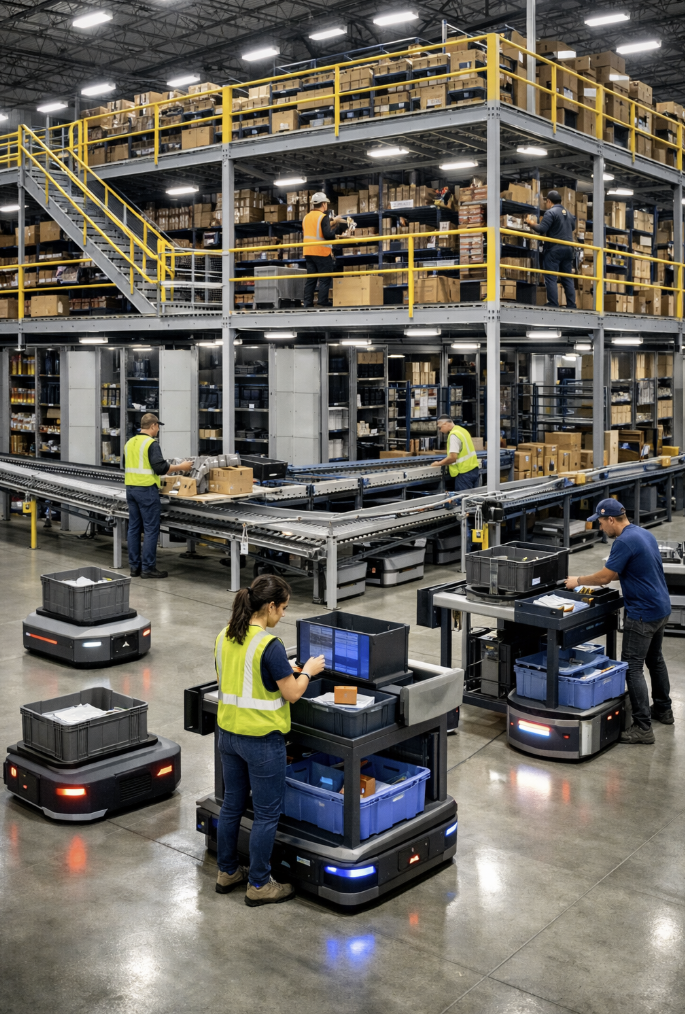 As more warehouses and distribution centers look to increase speed, accuracy, and safety, Autonomous Mobile Robots (AMRs) are becoming essential tools for automated order fulfillment. As a core engineered solution, pick modules consolidate storage and picking into a streamlined, high‑efficiency zone, making them an ideal foundation for integrating AMRs and other advanced automation technologies.
This blog explores key design considerations, such as carton/tote handoff points, traffic lanes, AMR elevators, and human–robot safety protocols, to help operations build smarter, safer multi-level systems that support today’s distribution demands and tomorrow’s growth.
Whether you’re planning a greenfield facility or retrofitting an existing pick module, designing for AMR integration offers scalable benefits with minimal disruption.
Why AMR-Ready Pick Modules Are a Game Changer
- Seamless tote transfer between AMRs and other systems
- 24/7 uptime potential with autonomous operation
- Reduced labor strain for repetitive, low-value tasks
- Superior space utilization with vertical, multi‑level layouts
- Enhanced throughput and reduced travel times for human pickers and robots alike
- Modularity and scalability, letting operations grow without rebuilding the system
- Lower infrastructure costs compared to conveyors due to flexible footprint and minimal fixed routing
AMR-ready pick modules are more than just a convenience—they’re a strategic infrastructure investment that prepares your operation for continued growth and automation expansion.
Flooring, Flow & Traffic: Critical Design Considerations
The floor of your pick module is foundational to AMR performance. Mezzanine flooring must be engineered with the right traction, smoothness, and finish—too slick, too shiny, or too uneven can disrupt AMR navigation and shorten equipment life. Since AMRs rely on sensors and navigation technologies to interpret floor features, every surface directly impacts accuracy, uptime, and throughput.
Design elements to consider:
- AMR-friendly flooring: level surfaces, non-slip materials, and clearly marked travel lanes
- Traffic flow planning: one-way loops, buffer zones, and predictable merge points
- Zone-based picking: structured layouts that reduce congestion and handoff delays
Key features include:
- Level, durable flooring for consistent AMR travel
- Integrated charging zones
- Clearly marked human walk paths to minimize mixed-traffic confusion
|
AMR-Tuned Pick Module Infrastructure
Designing your infrastructure with AMR requirements in mind eliminates costly retrofits later. That starts with ensuring mezzanine decking can handle the combined weight of robots and their payloads without sagging or long-term wear.
Optimize your structure for seamless AMR performance with:
- Carton/Tote handoff locations standardized to align with robot arm reach and height
- Conveyor to AMR merges engineered for smooth, sensor-regulated handoffs
- Guarded AMR lifts or elevators to allow safe robot transitions between levels
Safety First: Human and AMR Coexistence

AMRs enhance operational efficiency and reduce repetitive, labor-intensive tasks that contribute to workplace injuries. However, safe integration requires thoughtful system design and proper training. Designing AMR-ready pick modules with worker safety in mind ensures smooth collaboration between humans and machines.
While AMRs are equipped with sophisticated sensors and navigation systems, unexpected movements or navigation errors can still occur, especially in high-traffic or poorly marked zones. Understanding how AMRs move—and where human interaction is most likely to occur—helps prevent incidents and fosters a safer, more predictable workspace.

Key safety features include:
- Physical barriers and visual cues to clearly separate human and robot work zones
- Controlled access with safety gates or barriers to restrict pedestrian entry into AMR paths
- Sensor‑driven slowdown zones and AMR path control for mixed‑traffic safety
- Emergency stop buttons on each level to quickly halt AMR movement if needed
- Operator training on AMR movement patterns, interaction zones, and emergency override protocols
Future-Proofing Your System Design
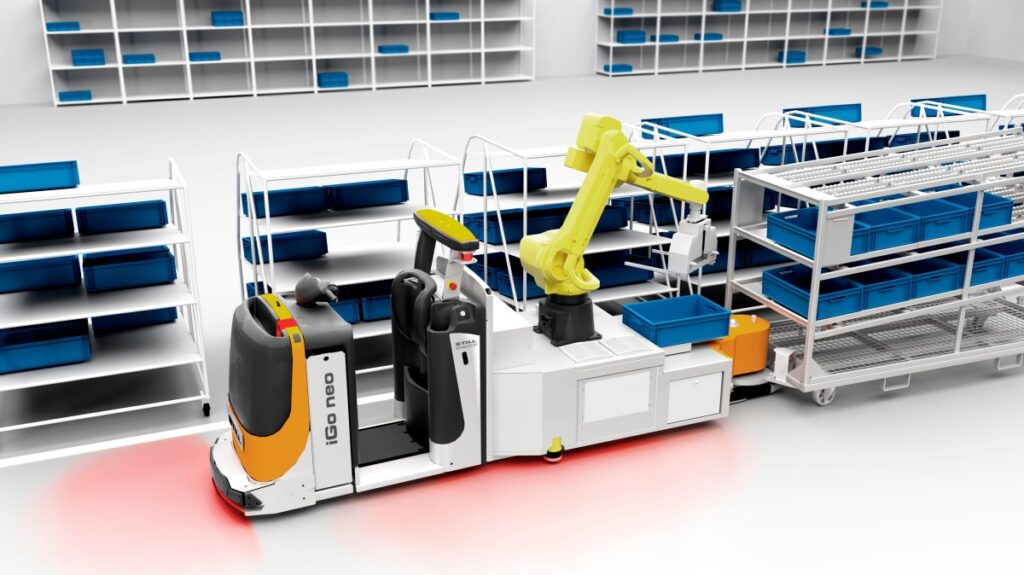
As customer expectations and fulfillment volume rise, designing pick modules to accommodate automation, including AMRs, becomes a strategic priority.
- Expandable lanes for future AMR models
- Flexible pick zone layout that adapts to changes in SKU velocity or order profiles
- Host-system control that supports AMR orchestration (WES/WMS compatibility)
Apex Automation Solutions: Design Expertise You Can Trust
With decades of experience in warehouse engineering and automation integration, Apex Companies delivers pick module systems that are built for today… and tomorrow.
- Custom pick module engineering
- Automation expertise to right-size the solution
- AMR integration planning from the ground up
- Safety-first solutions for your team and your tech
Contact us to design your AMR-ready pick module.
