
4 Options to Supercharge Your Layer Picking Operation


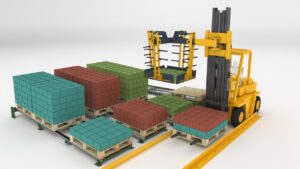
Caption – Layer Pick Attachment with Fork Pallet
Layer Picking Forklift Attachments for Mixed-SKU Pallet Building
Building mixed-SKU pallets in a high-volume mixing center or staging area is exponentially faster in a layer picking application. How much faster, you wonder? How about an increased pick rate of 400%? If you agree that is a productivity pick-up worth looking into, check this out…
A layer pick application can pick over 1200 cases per hour compared to 250 with hand picking. This time savings provides a lot of opportunities for your business, from eliminating shifts to increasing order fulfillment and improving turn rates — it’s up to you how you want to optimize your time savings, like, for example, maybe a little outdoor time in the beautiful Colorado mountains?
 Layer Picking Advantages:
- Implement JIT (just-in-time) order fulfillment
- Boost productivity
- Reduce labor costs
- Improve accuracy
- Select one or more layers in a pick
The primary mixing center/staging area design involves a layer picking attachment on a standard forklift or an overhead crane that captures one or more layers at a time from pallets on a pick aisle. The load is then placed onto an empty pallet creating a pallet of mixed SKUs.
Not every layer pick aisle is the same, so take a look at some popular configurations.
Layer Picking Applications:
- Clamp or suction attachment on a standard forklift – Simple yet highly efficient –Forklift secures one or more layers at a time using the attachment. The picked cartons are deposited on a waiting empty pallet to build the mixed SKU pallet. You can stage empty pallets at the end or in the middle of the pick aisle. When the pallet is complete, another operator picks it up and moves it to staging or storage. Emptied pallets are useable as the staging pallet. It’s all very well-contained to maximize productivity.
- Forklift with clamp & fork pallet – Similar to the design above with the clamp attachment, but instead of driving to the center or end of the aisle to deposit the load, the empty pallet is positioned right on the forklift forks. The driver then deposits the completed mixed pallet at the end of the lane for pick up.
- Overhead gantry with robot clamping or suction device – This configuration is higher on the automation scale than the previous designs, with layer picking administered via the warehouse management and warehouse control systems (WMS & WCS). The WMS instructs the WCS to create the custom pallet, and the WCS sends that request to the automated gantry to make it happen. There is limited labor involved saving time and money.
- Overhead gantry with automated storage and retrieval (ASRS) – this design takes it up just one more notch by adding automatic pallet replenishment to the layer-pick zone. The ASRS can also be programmed to extract the completed mixed pallet and position it for distribution or storage.
Adding automation into the application also provides automatic product tracking and material-flow data helpful for reviewing processes, tracking efficiency, and monitoring productivity.

5 Steps to a Mixed SKU Pallet
- Position high-volume SKUs in the mixing area. The forklift moves up and down the lane guided by the driver or an angled floor-mounted guide. In an overhead gantry, the clamp moves above the pallets.
- The order selection begins with one or more layers from one of the SKU pallets. The clamp secures the cases and closes in tightly on all four sides, holding them together for safe transport to the waiting pallet.
- The clamp places the cases on an empty pallet positioned in the center or at the end of the aisle to begin the mixed SKU pallet building.
- An order can be partially filled with a layer picker and completed manually if necessary. Adding to the flexibility of a layer pick application.
- A mixed SKU pallet may resemble this, for example – SKU A in layers 1 & 2, SKU B in layer 3, and SKU C in layers 4 & 5.

Restocking & Replenishment for Layer Picking
A good restocking and replenishment plan is as significant as the type of layer picking device. Bulk stacking of SKUs requires forklift operators to remove the shrink wrap as they restock, slowing things down a bit. However, you can automatically fill the pick aisle using pallet flow rack. Pallet flow is a gravity flow solution that uses pitched rails of wheels or rollers to flow pallets from an adjacent aisle to the pick face. With pallet flow, your pick aisle has a constant supply of inventory to keep your operation moving.
Additionally, you can use a multi-level approach to stock replenishment with push-back rack above the pallet flow lanes. It’s a great way to maximize warehouse space and keep your mixing center well-stocked at all times; however, this is only useful for full pallet applications vs. partial pallet picks. Take a look at how this design lays out.

Push-Back Above Pallet Flow for Ready Reserve & Automatic Replenishment
- The ground-level pallet flow lanes feed high-volume SKUs to the pick aisle. A pallet separator locks and holds the read pallets a few inches from the front pallet so that the layer picker can easily access all four sides of the pallet. Also, the operator can safely and efficiently extract the empty pallet, which will release the rear pallets to flow forward automatically. This design allows the operator to stay in the vehicle for maximum efficiency.
- Pallet flow lanes are quickly replenished from the adjacent aisle keeping the pick aisle clear for the layer picker. The push-back rack above the pallet flow lanes helps store ready reserve inventory.
Full-Service Layer Picking Equipment and Design with Apex Companies
The Apex team is ready to help you explore layer picking for your busy warehouse. We offer full-service support with our warehouse design experts, equipment specialists, and professional installation & training teams. Give us a call to learn more or to get started revolutionizing your order fulfillment operation.
