
Carry That Weight: Load Considerations in Pallet Rack Design

Pallet Rack Design Step 1 – Know Your Current & Future Load Specs
No one wants to see their rack system fail to do its job safely. That’s why it pays to plan for current and anticipated storage needs in your pallet rack design. To effectively do that, ask yourself two important questions:
- What will be the weight of the loads, and
- What is the nature of the loads stored on these racks—not only today, but over the projected lifespan of the system.
Today you might be loading pallets. Next week, who knows – boulders – elephants – beer kegs? Each load type has specific requirements for safe rack storage. Each will call for specific structural and operational parameters to ensure the structural integrity of the system. Here’s how to handle that heavy lift.
Load Distribution
While the bulk of material stored in warehouses and distribution centers is palletized, the need sometimes arises for storing bulk items, non-standard pallets, or odd-sized crates. Rack loads can generally be slotted into four categories:
- Uniformly Distributed Load (UDL) – The nirvana of rack storage. Goods stored on standard-size pallets usually fall into this category. The load’s weight is evenly distributed between the front and back beams. But not always – an HVAC system on a pallet might have its compressor—the weightiest part—on one side of the pallet. Make sure this type of load is securely placed on the beams. If you’re using wire decking, they must be rated for the load capacity independent of the rack support system, and the load must be evenly distributed on the deck and not extend over the rack beam.
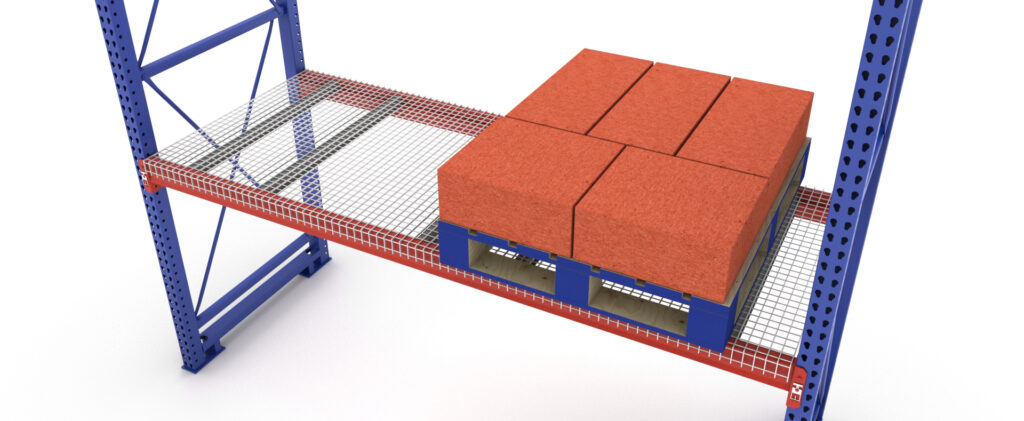
Example – Uniformly Distributed Load (UDL)
- Line load – A crated machine tool might be on a skid with a couple of stringers. This is another load you don’t want to place on an unsupported wire deck. In this case, the weight is concentrated in a few lines. Similarly, heavy rolls of converted paper or fabric products or sheet metal—or industrial-strength beer kegs have their weight concentrated in a single line. They will sit on one point on each beam. This could leave you with that sagging feeling. Drum cradles can help to support these types of loads. The goal is always to find a way to distribute the weight evenly.

Example – Line Load
- Point loads – Wire container bins, totes, footed pallets, boulders, or elephants have one or more point locations where their weight is concentrated. Here, you may want to avoid wire decking and opt for a solid surface decking or palletize the load. Read our Project Spotlight and see how we handled footed containers with a point load using a custom solid surface deck… Oh, and Don’t forget to feed the elephant.
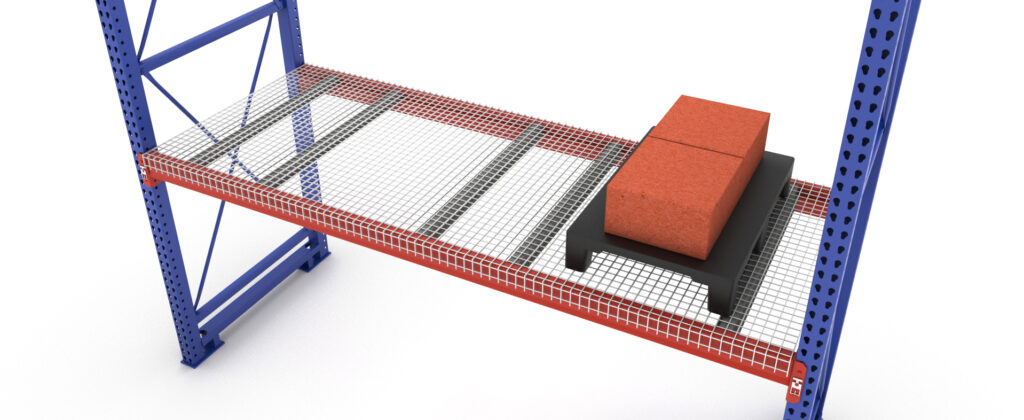
Example – Point Load
 Footed Containers with Shifting Contents |
 Custom Rack Solution – Solid Deck Surface |
- Concentrated load – This type of load occurs when a load’s dimensions aren’t large enough to reach the beams. This can happen with loads on smaller-than-standard pallets or crated equipment; often, import pallets fall into this category. Wire decking or grating can support these loads.
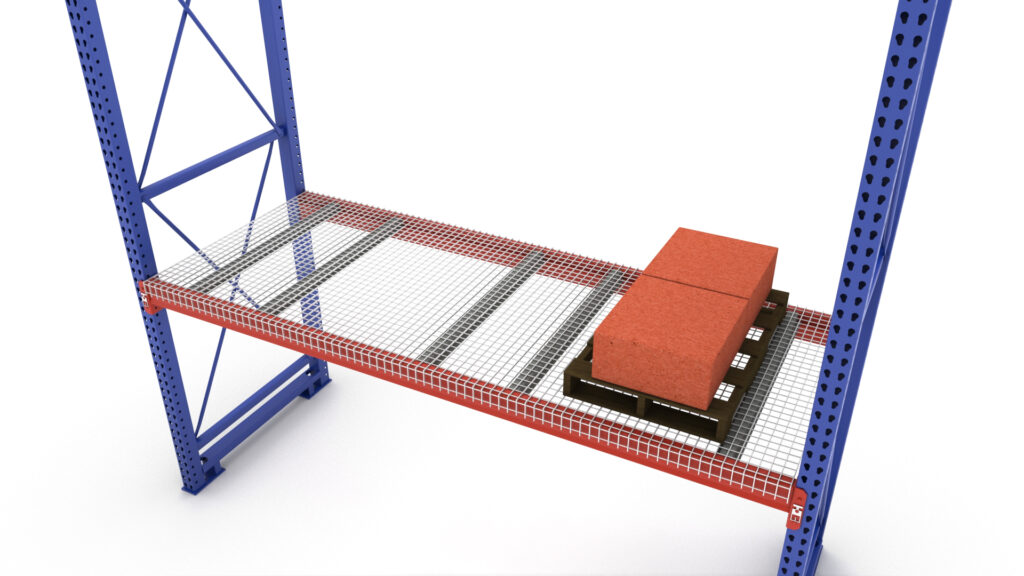
Concentrated Load
Load characteristics should also be taken into account when using different pallet rack types.

Push-Back Rack System
- Selective rack – Clearly, the simplest type of design for storing loads of varying weight and dimensions. Their one-deep configuration allows for carefully maneuvering a load for placement on a deck or the beams.
- Drive-in rack – This configuration can only be used with uniform, standard-size loads. Pallets are supported on the sides rather than front and back. Uniformly distributed loads are preferable with drive-in.
- Double-deep rack – If you need to go deep, a deep-reach forklift is required to place and extract pallets or other loads. Load weights may depend more on the ability of the forklift to handle the load on the extended forks. Forklift operators need to pay special attention to placing the deep load, where visibility might be an issue.
- Push-back rack – Here again, standard-size pallets placed on carts are the way to go, although carts are available with decking or solid surfaces to handle non-standard loads like that boulder. Forklift operators need to push gently on the carts to make sure the boulder doesn’t roll off. The capacity of the carts determines weight.
- Pallet-flow rack – In this setup, pallets ride on a set of wheels on tracks that line up with a standard-size pallet’s stringers. For applications where non-standard pallets or odd-shaped loads need to be stored, rollers are a better option. Both can handle reasonably heavy loads. Elephants don’t do well on rollers; however, and neither do boulders.
Structural Considerations for Pallet Rack Design

Previous blogs have covered the structural design of racking systems, but here’s a brief reminder of the basic principles of safe rack design with an eye on load characteristics.
- The most important parts of a rack system are the uprights and the beams, as these structural items will bear the burden of holding up everything stored in the system. It’s essential to specify the average weight of rack loads and the maximum load capacity for each rack system. Warehouse managers and workers need to take those limits seriously. For a deep dive into pallet rack design and configuration, check out our blog on the subject.
- Uprights and beams are constructed out of either structural steel or roll-formed steel. Heavy-duty structural steel is often considered where durability is a must and when heavy loads require extra capacity. Roll-formed steel members typically do the trick for most retail and distribution center applications. See our blog for detailed information on the pluses and minuses of each type of steel. Uprights can also be reinforced, especially on the lower levels. This not only provides additional strength but helps defend against forklift abuse. Learn more about pallet rack
 column design in our blog.
Typical Pallet Rack Bay – 2 Pallets Wide
- Bay width is an essential parameter in configuring a rack system, especially with non-uniform loads. For example – a typical bay configuration may consist of two standard pallets, side-by-side on a 96” – 108” beam. But what if you want to store heavy non-standard loads, three across the bay? Here’s where your rack configuration could get tricky – You’ll have to design your system for added capacity, use extra-long beams, and account for the non-uniform load distribution. But don’t worry, the Apex experts have you covered – We love a good custom application!
- Bay heights also play an important part in determining the maximum load that a tall, multi-tiered rack system can handle. As bay heights increase, the ability of higher racks to handle heavier loads decreases. Store that 12 ft. tall elephant on a low rack.
- A rack system is only as good as the floor it sits on, and the baseplate used to anchor it to the floor. We’ve covered those subjects in other blogs referenced here. Also, always plan your rack system to accommodate the seismic characteristics of your location.
Additional Steps Towards Pallet Load Safety

Several other factors impact the storage of non-standard loads; Among them are:
- Safe and careful forklift operation – Always carefully place the load on the beams or other support structures. This is especially important with non-standard loads and higher pallet bays. See our system-specific forklift operating videos for Drive-in, Push-Back, and Pallet Flow.
- Pallet quality – Inspect pallets for damage. A non-uniform load plus a damaged pallet equals trouble. Make sure non-standard pallets or custom skids are securely supported.
- Adhering to posted load capacity – Clearly post rack load capacities for each rack system. This is especially important with multi-level racks with high pallet bays.
Your Apex design team can help you design a pallet rack system for whatever you store in your warehouse, be it pallets or boulders. Submit a request or just give us a call at 331-263-6154 and we’d be happy to discuss your specific rack requirements.
