
Pallet Rack Design – Is Your Aisle Width Working FOR or Against You?

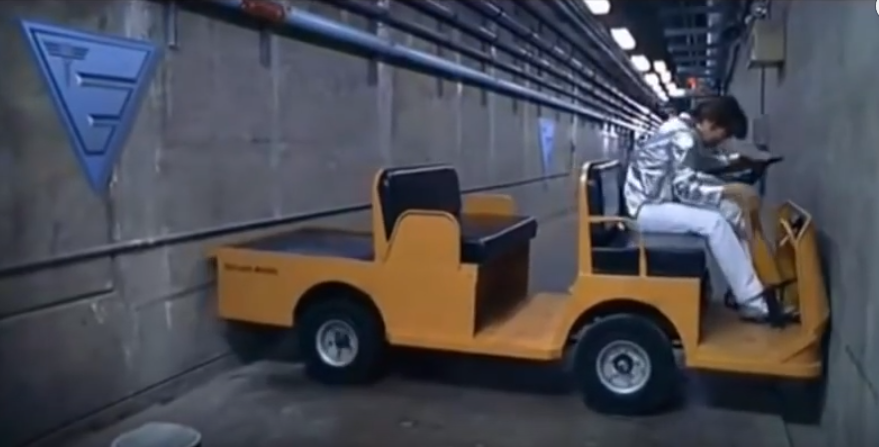
Ok, so we’re poking a little fun here, but in all seriousness, it’s critically important to define aisle width in your pallet rack design layout properly. Basically, it’s a financial boon if you do it right and a bust if you do it wrong because the types of forklifts you choose will directly affect your pallet storage capacity and access speed. A miscalculation here is expensive and unnecessary, but Apex is here to help.
Your forklift, rack depth, and pallet length are critical for defining aisle width. Let’s look closer at the most variable component – the forklift.
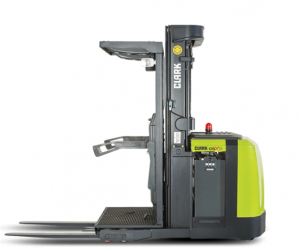
Clark VNA Order Selector
Several features identify forklift equipment, but for our purposes, they mostly fall into these categories:
- Counterbalanced (electric and internal combustion):
- Sit down
- Stand up
- Reach trucks:
- Narrow aisle
- Deep reach
- VNA (Very Narrow Aisle) trucks:
- Swing-mast/turret
- Order picker
The following table shows you the aisle width differential required in your pallet rack design for each forklift type. It’s a broad range, as you can see:
Typical Forklift Aisle Requirements: (Calculated on 40” w x 48” d pallet, 8” clearance)
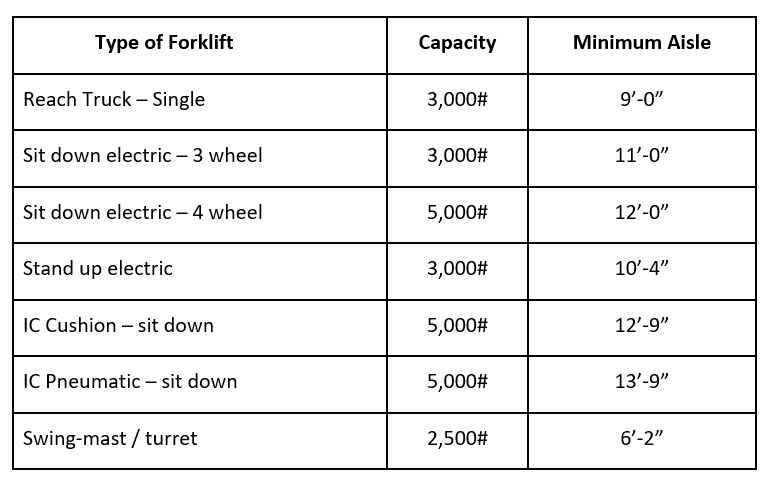
Now, if we narrow this down just a bit, we are looking at three major aisle width categories:
- Wide aisles > 10′
- Narrow aisles = 9’
- VNA < 9’
If we were constructing your pallet rack design, we would consider all of this information to determine if you require wide, narrow, or VNA aisles… or perhaps a combination of widths to most effectively and safely access your pallet rack.
Determining aisle configuration in pallet rack design:
- Start with forklift “head” length (from back of truck to front of load backrest)
- Add Load length – length of pallet
- Add at least 6” for pallet overhang (could be more with oversized pallets)
- Add 12” for maneuverability
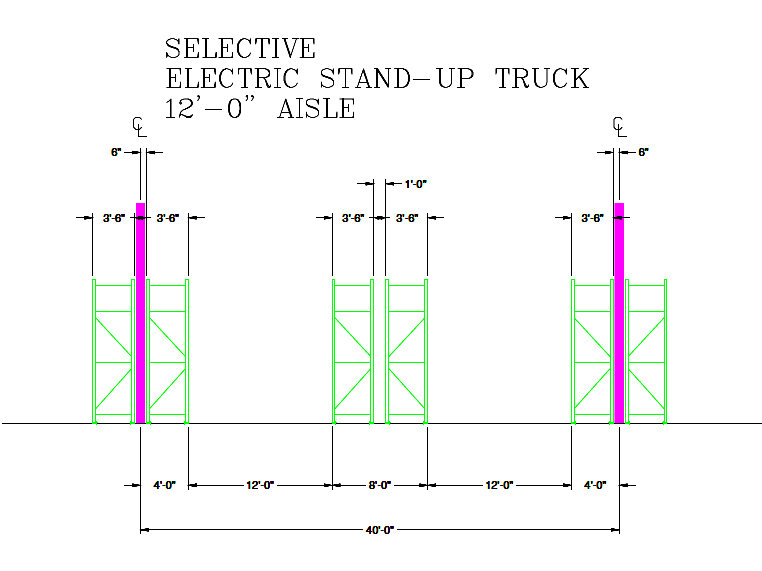
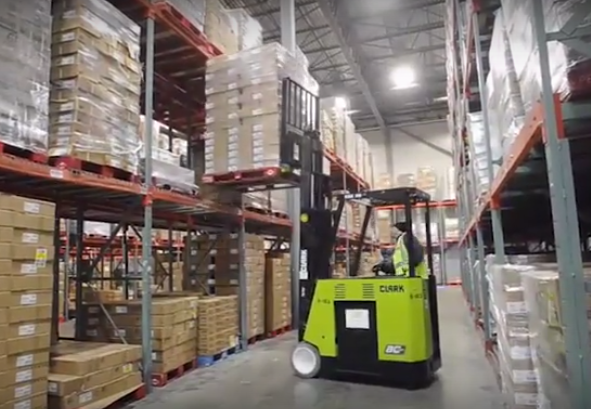 A 12’ measurement is commonly the default for warehouse managers when installing standard selective rack. However, if your forklift equipment is single reach or stand-up, you would be wasting a significant amount of costly real estate with those overly wide aisles, and in some cases, 3’ to 6’ of wasted space! Moreover, if you have IC (internal combustion) machines, let’s just say you’d likely end up like our friend Austin above. IC lifts are wider than standard lifts and require a more significant turning and operation radius.
And don’t forget to account for extra depth required in deep-reach pallet rack if that’s your rack of choice. Deep-reach can require 12” to 18” of additional aisle space.
As you can see from the diagrams below, there is a significant space differential when comparing a standard aisle vs. a narrow aisle configuration. The narrow aisle configuration allows an additional single rack row in the same square footage. If you are looking at growing inventory demands, you could meet your needs with a rack configuration and equipment replacement vs. a whole warehouse move –food for thought.
 |
 |
Good planning can take advantage of what your space, inventory, and equipment have to offer to make the most of your budget and your inventory goals. Each forklift company provides specs and calculations specific to their vehicles, so it’s always recommended that you consult the documentation that accompanies your forklift.
Thanks for checking out our blog, and let us know if we can help you design or reconfigure your storage operations or if you need help finding the right equipment to handle your inventory. The Apex team offers full-service warehouse design through installation services, and we only recommend products and materials from trusted material handling manufacturers and suppliers. Our team is here to work closely with you through the process to ensure the finished product meets your goals.
 Lastly, those of you who were hoping the Austin Powers picture at the top of the page was a video link; here you go, enjoy!
We look forward to working with you on your next project. Call today to get started.
