
Your Selective Rack May Look Great but Is It Safe? How to Check…

Crucial 6:1 Height to Depth Ratio Holds the Key to Safe Selective Rack
Selective pallet rack is a simple go-to warehouse storage option… except if it ends up twisted in a heap on the ground and you’ve compromised your business and the safety of your employees. The good news is that it’s easy to get it right and to design selective rack to work successfully for your business for many years.

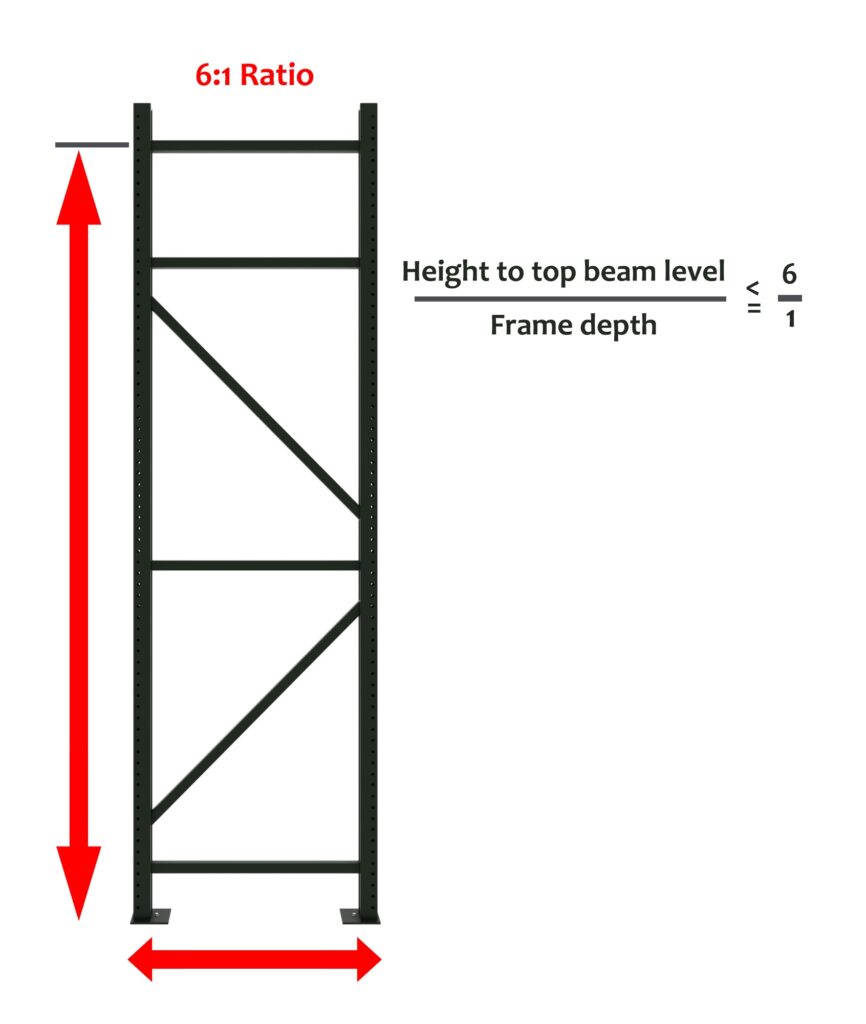 Selective pallet rack is the most common pallet racking system for a lot of reasons. Essentially, it is a simple, cost-effective, single pallet depth system that allows for 100% accessibility to every pallet stored. However, because it is a tall, shallow system, certain design features must be engineered to maximize storage capacity and ensure rack safety. RMI (Rack Manufacturers Institute) guidelines for the critical height-to-depth ratio of this type of system is also called the 6:1 Ratio.
The 6:1 Ratio
This ratio is measured by dividing the height (distance from the floor to the top beam level) by the depth of the frame. The final design must not exceed 6-to-1.
So, if a standard selective rack is 20′ tall (240″ from floor to top beam) and is designed at a 42″ depth, the ratio would be 5.714 and well within the 6:1 ratio. However, if that same rack is spec’d for even as much as an additional pallet level, say 24′ (288″), the ratio would exceed the 6:1 ratio at 6.857 and put the rack at risk for failure.
I.e. 20’ tall — 240 / 42 = 5.714 24’ tall – 288 / 42 = 6.857
Engineering Options

Deep-Reach Pallet Rack Above Pallet Flow
But wait! Not all is lost if you want to take advantage of unused vertical space for your selective rack –special anchors, footplates, and overhead rack ties, usually specified by the manufacturer, can provide necessary safeguards.
Building your rack as a two-pallet deep or a deep-reach system is another way to secure the frame and accommodate more inventory, if applicable.
Also, back-to-back selective rack is another way to ensure system strength and stability. Back-to-back is just like it sounds… two selective rows are tied together by row spacers rear to front every 10 feet up the system’s height. You can also use overhead ties for added stability. This configuration maintains the 100% SKU selectivity of single pallet depth but requires an additional aisle to load and pick the adjacent rack.
The Apex team throws our experience, know-how, and problem-solving skills into every project to benefit our customers. If you’d like to speak with an Apex Team member about your storage needs, just give us a call. Knowing your inventory specs –load weights, pallet sizes, SKU count, receiving and order processing forecasts, and equipment functionalities– will allow us to design a pallet rack system or order processing solution to address your needs specifically.
If you’d like to see some of the Apex projects of the past, check out our gallery pages, and we also have a Project Spotlight page with pictures and videos with the specs of some of our most recent projects.
