
Spiral Conveyor vs Incline Conveyor: How to Choose Your Vertical Solution

Tips For Choosing Your Vertical Conveyor to Fit Your Building, Product Flow, And Operation
When your operation starts building up—mezzanines, pick modules, and higher-volume pick/pack operations—the real challenge is keeping product moving between levels without sacrificing floor space, throughput, or safety. When you’re comparing powered conveyor options for vertical movement, the choice usually comes down to spiral conveyors vs incline conveyors. The real question is how to connect elevations in a working facility without creating congestion, service headaches, or safety risks.
This article compares spiral and incline conveyors and helps you choose the right solution for your building, product flow, and operation.
You’ll typically face this decision when:
- You’re adding a mezzanine or multi-level pick area
- You need to move product between receiving, picking, packing, and/or shipping zones
- You’re trying to reduce traffic and congestion in active work zones
Vertical Conveyor Options at a Glance
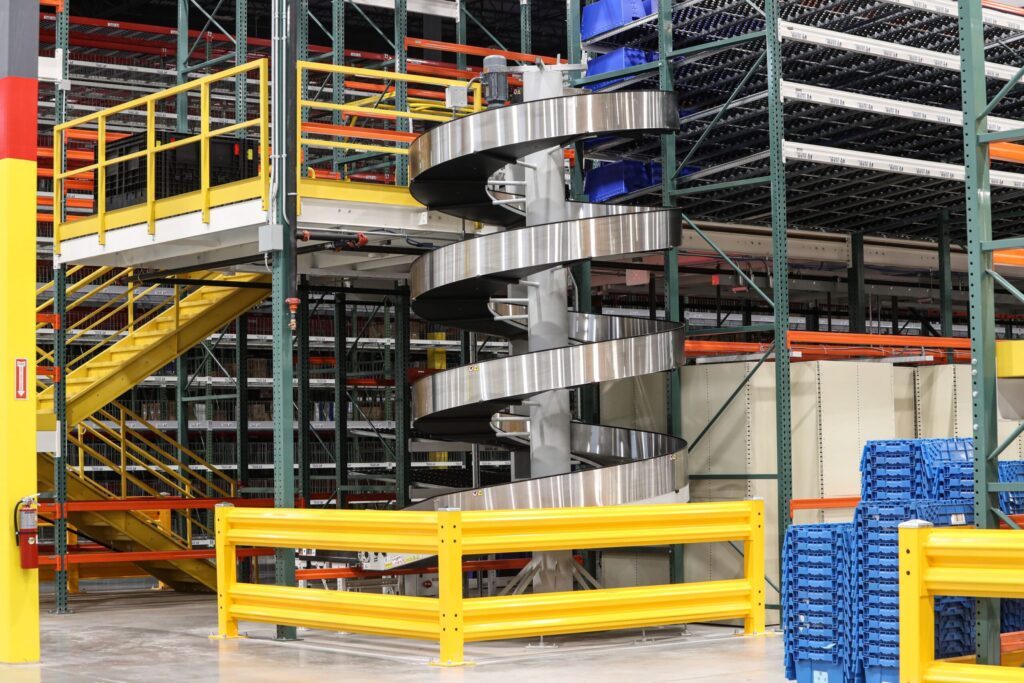 |
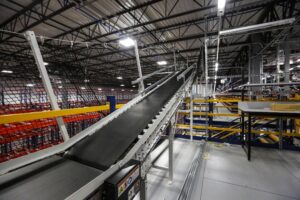 |
| Spiral Conveyor | Incline Conveyor |
Before comparing design factors, it helps to understand the two vertical conveyor approaches most operations evaluate.
What Is a Spiral Conveyor?
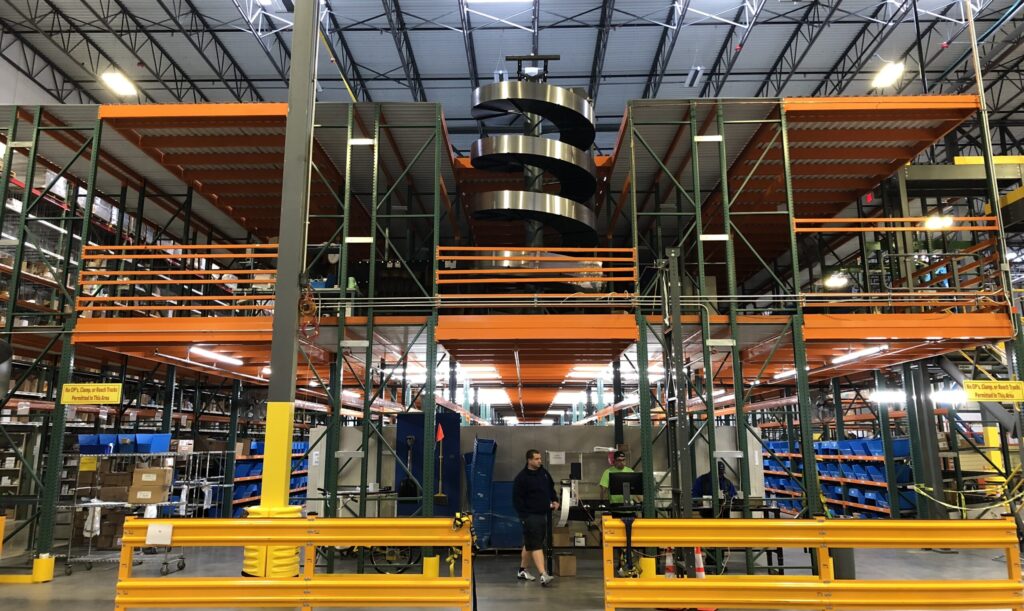
A spiral conveyor is a powered vertical conveyor that moves cartons, totes, or other unit loads between elevations in a compact footprint. Spiral conveyors are often used as a small-footprint alternative to long incline/decline runs, especially when conveying product to different floors or mezzanine levels within a pick module. Many spiral systems can also be programmed for accumulation, helping manage flow when downstream processes slow down.
What Is an Incline Conveyor?
An incline conveyor moves product up or down a grade using a longer run. It is often the straightforward choice when you have enough linear space and can create a relatively direct path between elevations.
Incline and decline conveyors are commonly used when the layout allows length and when larger or less stable items make a spiral less practical.
Spiral vs Incline Conveyor: What Changes in the Real World
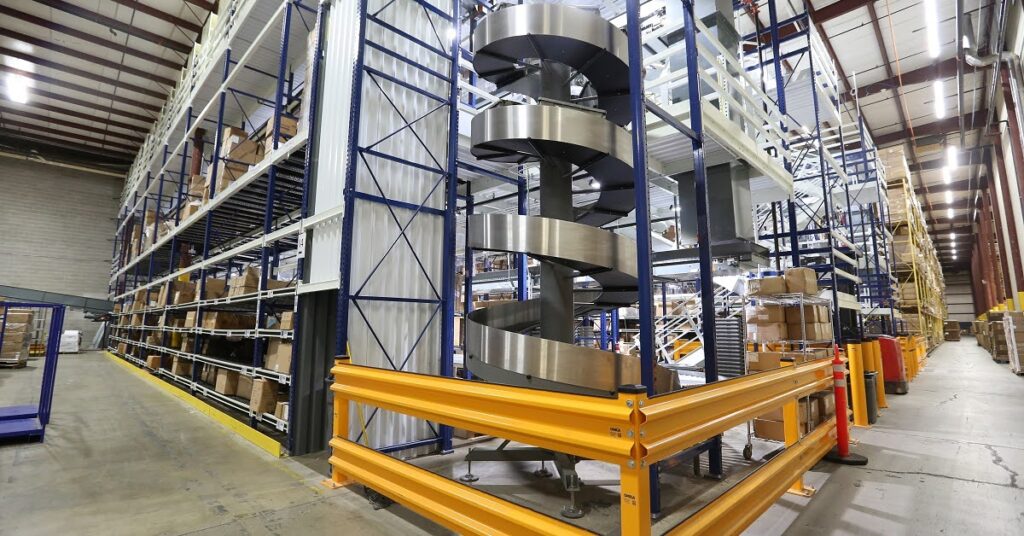
Your conveyor layout has to work inside a real facility, not a blank floor plan. Columns, sprinkler lines, mezzanine elevations, work zones, travel lanes, and existing equipment all shape what’s possible.
Start with the building constraints: footprint and vertical clearance.
1. Footprint and Vertical Clearance
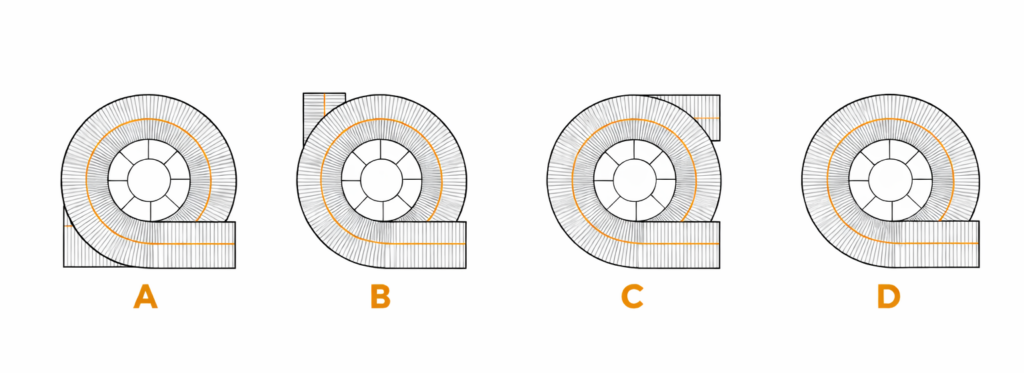
Spirals tend to win when space is tight. Because spiral conveyors use more vertical space and less floor space, they often make more sense around aisles, workstations, and fixed building features, especially when moving product between mezzanine levels. They can also offer more flexibility in how the system is configured, including different inbound and outbound conveyor arrangements. In some layouts, those connection options can be a major reason to choose a spiral design.
Inclines tend to win when you have open floor space and a clean, direct route between elevations. In that situation, an incline or decline run can be one of the simplest and most cost-effective options.
Before choosing either one, map the vertical boundaries that can ruin a design late in the process: ceiling height, beams, sprinkler lines, HVAC, lighting, and the clearances needed above people zones and work areas. This crucial step sets you up for a smooth install.
2. Product Size and How Stable It Is During the Move
This is one of the biggest factors in the decision. Spiral conveyors have practical size limits because of the spiral radius and available width. Many common spiral designs top out at around 30 inches of clear width between frames, so oversized cartons or awkward loads often point you toward an incline instead.
With incline conveyors, the real design question isn’t just “belt or roller.” It’s whether the product stays planted and controlled on the grade. Incline and decline belts can be configured with different surface materials to improve positive product control during conveyance, especially when cartons or totes may slip, tip, rotate, or deform.
In other words, you’re not only choosing between incline and spiral. You’re also choosing the conveying surface, side guidance, and product-control strategy that keeps loads stable and predictable from start to finish.
3. Throughput and What Happens When Downstream Slows Down
Throughput is a system problem—not a vertical conveyor spec. Some spiral conveyor designs can support high throughput because they’re engineered to run continuously and, in certain configurations, start and stop while fully loaded. That’s why spirals show up so often in tight, multi-level layouts.
But in the real world, vertical moves usually don’t fail at the “up” or “down.” They fail at the interfaces. Merges, queues, scan points, labeling steps, and downstream slowdowns are where performance often breaks down. That’s why buffering and accumulation strategy matter: they absorb variation and protect flow when one part of the line slows or stops.
To size it correctly, you need to consider how items enter and exit, and how they behave when the rest of the system isn’t running perfectly.
4. Routing the Vertical Move Through Your System
Spiral conveyors handle elevation changes in a single compact location, serving as a vertical node within the conveyor layout. Product enters the spiral, changes elevation, and exits at a new level without requiring a long run across the floor. This can simplify routing in facilities with tight floor space or where multiple levels need to connect at a single point in the system.
Incline conveyors, on the other hand, distribute the elevation change along the conveyor path. Instead of concentrating the vertical movement at a single location, the product gradually rises or descends as it travels along the route. When layouts allow a clean, direct run between elevations, an incline can integrate naturally into the overall conveyor path.
In many systems, these approaches are not mutually exclusive. A spiral may handle the main vertical transition, while incline or horizontal conveyor sections route product to and from that point.
5. Cost and Electrical/Energy Considerations
At the equipment level, incline and decline conveyors are usually more affordable than spirals. If you have the room and the layout is simple, that can make the decision easy.
Installed cost is often a different story. Total cost includes route complexity, controls, wiring, and the frequency with which the system must start and stop under load. Conveyor duty cycle affects motor and drive requirements, and more complex routing usually means more components to coordinate and maintain.
On the energy side, a typical single-elevation change may use fewer motors on a spiral than on an incline-based approach, reducing energy consumption in some configurations.
6. Maintenance, Uptime, and “Can We Safely Service This?”

Whichever option you choose, maintainability has to be part of the decision. Safe access matters. Guarding matters. Lockout/tagout matters. OSHA and other safety guidance are clear that conveyors need proper isolation during service, along with guarding around moving parts, pinch points, and floor or ceiling penetrations.
From a practical standpoint, good vertical conveyor design avoids creating service headaches around people zones, obstructions, and hard-to-reach components. It also avoids unnecessary detours and extra transfers, because added complexity usually increases maintenance risk. In general, spiral conveyors tend to require more maintenance than inclines and can introduce more downtime risk if they are not properly positioned, installed, and serviced. That’s why maintenance access, serviceability, and long-term uptime should be weighed just as carefully as footprint and routing.
In most projects, the right choice comes down to how space, product characteristics, routing, and overall system flow interact inside your building.
Four Questions That Help You Choose the Right Vertical Conveyor
If you’re deciding between spiral and incline conveyors, these four questions usually make the answer clear.
1. How much space do you really have?
If the footprint is tight, a spiral conveyor often makes more sense. If you have plenty of run length and a direct path, incline could be the simpler option.
2. What is the product profile?
If you are moving stable cartons or totes that fit within a spiral’s size limits, a spiral often works well. If the product is oversized, awkward, or less stable, incline is often the safer choice.
3. What does peak flow look like?
If you need compact buffering and steady vertical flow, a spiral may have the edge. If your flow is simpler and you have room to spread it out, incline may be enough.
4. How “messy” is the route?
If the layout includes obstacles, people zones, or tight travel paths, a spiral can simplify the route. If there is a straight shot between elevations, an incline may be the more practical answer.
How Apex Helps You Pick the Right Fit
Vertical conveyor systems do not succeed or fail on equipment alone. They succeed or fail on integration. That includes how product merges into the line, where it accumulates or buffers, how controls respond when downstream slows, and whether the system still works smoothly inside the facility.
The right design also has to account for a people-first workflow. That means proper clearances, safer work zones, less congestion, and a layout that does not create unnecessary friction for operators or maintenance teams.
And finally, good design plans for uptime from the start. Service access and maintainability should be part of the decision from the start, not an afterthought.
Talk with the Apex automation services experts to confirm the best-fit vertical solution for your building, product mix, and throughput goals.
