
Dynamic Pallet Rack for LIFO Inventory Storage
Push-Back Racking

Push-Back Racking - High-Density Storage Meets SKU Selectivity
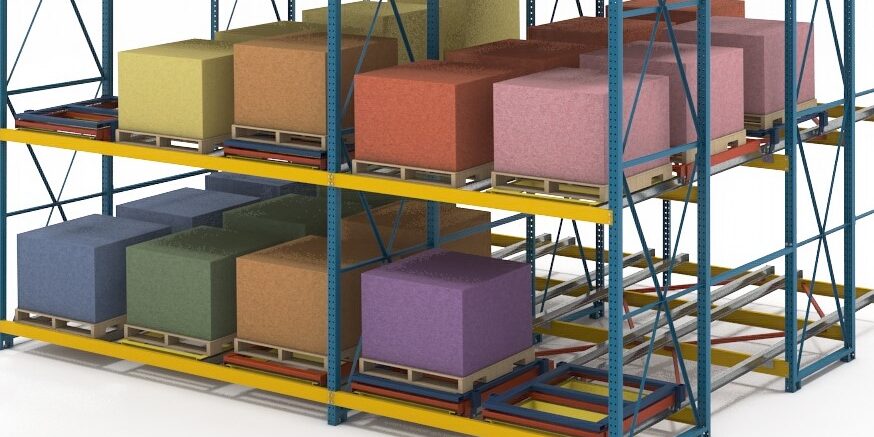
Push-back racking is a high-density storage system that stores pallets 2 to 7 deep on inclined rails using a nested wheeled cart system. Unlike drive-in racking, where forklifts drive directly into deep lanes and place pallets on side rails, push-back pallet racking is loaded and unloaded from a single aisle, with each lane assigned to a single SKU. Each new pallet pushes the pallet behind it back on the carts, and when the front pallet is removed, the remaining pallets roll forward into position for the next pick.
Push-Back Racking Advantages
- 100% SKU selectivity by lane
- High density - typically 3-4 deep (up to 7-deep)
- Ideal for high-volume, low-SKU inventory
- Forklifts don’t enter the rack - less damage
- Compact footprint lowers cost per pallet position
- Durable structure with minimal upkeep required
System Highlights
- Independent SKU Lanes – Each lane is dedicated to a specific product, streamlining inventory organization. System depth is commonly 3-4 pallets and up to 7 deep per lane.
- Single-Aisle Loading & Unloading – Pallets are loaded and extracted from a single aisle, minimizing the system footprint.
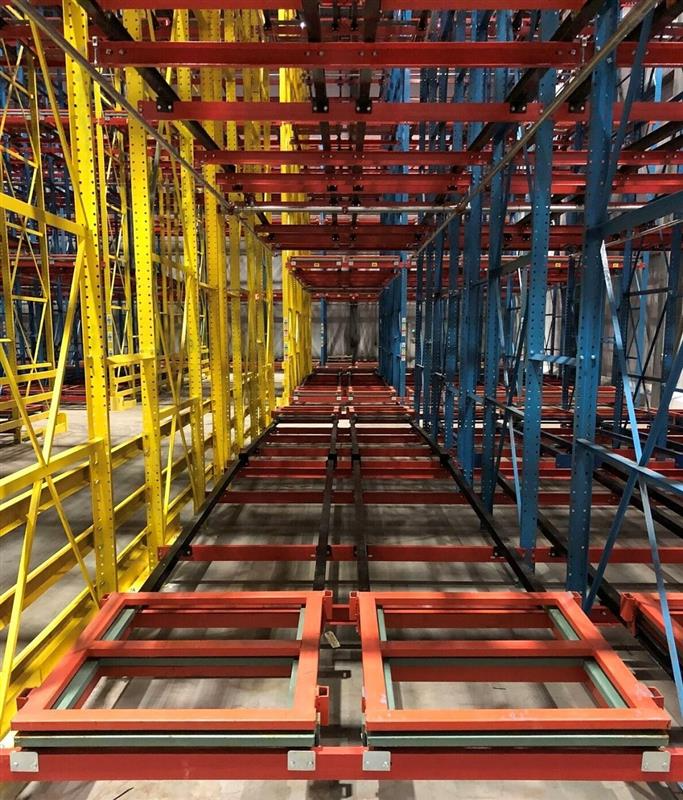
- Efficient Cart System – Nested wheeled carts sit on inclined rails at the aisle face of each lane. The carts flow along the rails for the depth of the lane.
- Smooth Loading – A pallet placed on the top cart sits at the aisle face. The forklift gently pushes the first pallet back to load the next pallet, exposing a cart underneath. This continues until all carts are filled, with the final pallet resting on the rails.
- Gravity-Fed Retrieval – As pallets are extracted, the rear pallets automatically advance to refill the aisle position.
Photo Gallery

3D Illustrations
System Videos

How the Push-Back System Works
The push-back system works by nesting carts inside each lane. As pallets are loaded, they move previous pallets farther back into the lane. When the front pallet is removed, the remaining pallets automatically roll forward into the next pick position. The result is fast loading and unloading from a single aisle with no manual pallet repositioning.
Here’s the sequence in detail:
First pallet: The forklift places the first pallet centered on the top cart at the aisle face.
Second pallet: The forklift pushes the first pallet back, exposing the next cart. The second pallet is placed on that cart.
Subsequent pallets: Each new pallet placed in the lane pushes the remaining pallets deeper, with each pallet resting on its own cart at a slight slope.
Last pallet: The final pallet rests directly on the load beams at the front of the lane.
Unloading: Remove the front pallet. Gravity advances the remaining pallets forward. Repeat until the lane is empty.
The slope, typically 1/4 to 5/16 inch per foot, helps control movement inside the lane. Using a 5/16-inch slope as an example, push force is about 4% of the combined rear pallet load weight, though actual force varies by lane depth, pallet weight, and system design and should be confirmed against forklift capability.
Push-Back Racking Advantages
Push-back racking delivers strong results when your inventory profile matches the system design. Here’s what makes it an effective high-density storage solution, and why each benefit matters operationally.
Excellent space optimization
A push-back racking system stores 2 to 7 pallets deep per lane, reducing the number of aisles required and putting more of your warehouse space to work. Facilities switching from selective rack often see storage capacity increase significantly without expanding their footprint.
100% lane selectivity
Each lane is dedicated to one SKU, but you can run a different SKU on every level. That means higher storage density without sacrificing the ability to access specific unit loads. Drive-in racking requires the same SKU across all vertical levels in a bay. Push-back doesn’t.
Less rack damage
Because the forklift never enters the rack structure, impact damage to uprights, rails, and base plates is reduced, helping protect anchoring points and maintain system integrity over time.
Cold storage compatibility
Push-back racking performs well in freezer and cold storage environments. It provides high-density pallet storage with single-aisle access and lane-based SKU selectivity, making it a practical choice for cold applications that operate on LIFO inventory flow.
Forklift flexibility
No specialty equipment required. Standard counterbalance forklifts and reach trucks handle loading and unloading. That’s a meaningful advantage over double-deep rack, which requires a deep-reach truck.
Lower cost per pallet position than automation
Push-back offers higher storage density than selective rack at a fraction of the cost of a full automated system. It’s a practical middle ground for operations that need density without the capital investment of a shuttle system or full ASRS.
Push-Back Rack Components
Rail Types: I-Beam, C-Channel, and Structural Tube
Rail selection affects performance, durability, and debris protection. I-beam rails offer heavy-duty capacity with natural debris deflection, though slightly more rolling friction. C-channel rails are abuse-resistant and a common choice for high-cycle operations. Structural tube rails provide the lowest friction and the lowest profile, suited for systems handling heavier unit loads over longer lanes.
Rail type depends on load weight, lane depth, and your operational environment. Apex engineers specify the right rail as part of the system design, not as an afterthought.
Cart Construction and Safety Features
Cart construction affects long-term performance and pallet guidance accuracy. Four-sided cart frames offer greater durability and better pallet containment. Three-sided frames reduce cost where load conditions allow.
Key safety accessories built into a properly specified push-back system include backstops, rubber bumpers, lift-out protectors, and pallet catches. These components protect the base metal structure and keep pallets properly tracked under load. Non-standard pallet sizes and debris protection requirements influence cart selection and should be reviewed during the design phase.
| Component | Function |
|---|---|
| Wheeled Carts | Nested wheeled carts travel on inclined rails within each lane |
| Steel Tracks (Rails) | Heavy-duty, inclined rails create the slight slope that drives gravity-fed cart movement |
| Roll-Formed or Structural Frames | Roll-formed frames are cost-effective; structural frames support heavier loads and offer greater impact resistance |
| Pallet Stops | Positioned at the rear of each lane, secure the last pallet and absorb impact forces during loading |
| Load Beams | Horizontal beams provide primary structural support for the rack structure |
| Bumper Plates | Installed at the aisle face to reduce cart impact during retrieval |
How to Properly Load and Unload
Consistent technique protects your system, your product, and your team.
Loading:
- Square the forklift with the aisle opening before approaching the lane.
- Place the first pallet centered on the top cart, then lower and align before releasing.
- For each new pallet, push the existing pallet back in a controlled movement to expose the next cart.
- Continue until the lane is full. The last pallet rests directly on the load beams.
Unloading:
- Square the forklift at the pick face. Lift the front pallet clear of the front beam and pallet stops.
- Back out smoothly, controlling the rate of rearward pallet advance by your backing speed.
- If stored pallets don’t advance, gently push the front pallet back a few inches to restart movement before removing it.
- Repeat until the lane is empty.
Troubleshooting hang-ups:
Most hang-ups can be resolved with a simple purge. If a pallet does not roll forward as expected, gently push the front pallet back a few inches to help restart forward movement. If the lane still does not operate properly, the issue may be caused by debris, pallet damage, or another obstruction in the lane. At that point, stop using the lane and have it inspected by qualified rack professionals.
Where Push-Back Racking Fits Best (and Where It Doesn't)
Ideal Applications
Push-back racking is the ideal system when your operation checks these boxes:
-
High-volume, low-to-moderate SKU count with multiple pallets per SKU
-
LIFO inventory rotation is compatible with your products (non-perishable goods, long shelf life items)
-
Distribution center operations where storage density matters more than individual pallet access
-
Cold storage and freezer environments where standard forklifts and a cart-based live system are preferred
-
Facilities needing to increase pallet positions without additional floor space
-
Hybrid warehouse layouts combining push-back with selective rack or pallet flow in different zones
Not a Fit When
-
Your inventory requires FIFO rotation (perishable goods, expiration-dated products, anything date-sensitive)
-
SKU count is very high and most SKUs carry only one or two pallets (selective rack is more efficient)
-
Lane utilization will consistently be partial (unfilled lanes eliminate the storage density advantage)
-
Every individual pallet needs to be directly accessible at all times
-
Pallet condition is inconsistent (damaged or non-standard pallets disrupt cart movement)
If you’re unsure, a facility review with an Apex engineer will clarify it quickly.
Push-Back Racking vs. Other High-Density Storage Systems
The right system depends on your inventory profile, throughput requirements, and facility constraints. Getting those inputs right before specifying a system is what separates a layout that works from one you’ll need to retrofit in two years.
| System | Rotation | Selectivity | Forklift Needed | Relative Cost |
|---|---|---|---|---|
| Push-Back Racking | LIFO | By lane and level | Standard counterbalance | Mid-range |
| Drive-In Racking | LIFO | One SKU per bay, all levels | Counterbalance (specialty for deep lanes) | Lower upfront |
| Pallet Flow Rack | FIFO | By lane | Standard forklift | Higher per position |
| Double-Deep Rack | LIFO | Limited (every other pallet blocked) | Deep-reach truck required | Lower upfront |
Push-back vs. drive-in racking: Both are LIFO, one SKU per lane. The key difference is vertical flexibility. Drive-in racking requires the same SKU across all vertical levels in a bay. Push-back allows a different SKU on each level, which makes it more practical for operations with moderate SKU variety. Push-back also produces significantly less rack damage because the forklift never enters the storage lane.
Push-back vs. pallet flow: Push-back is LIFO; pallet flow is FIFO. For date-sensitive inventory, pallet flow is the right system. For LIFO-compatible products with long shelf life, push-back costs less per pallet position.
Push-back vs. double-deep rack: Push-back delivers faster cycle times with standard forklifts. Double-deep has a lower upfront cost but requires a deep-reach truck and restricts access to every other pallet without repositioning.
What to Consider Before Choosing Push-Back Racking
Getting the most out of a push-back racking system starts with an accurate picture of your warehouse and inventory. Cover these before committing to a configuration:

Inventory profile – How many SKUs, and how many pallets per SKU? Inconsistent pallet counts per SKU reduce the high-density storage advantage.
Pallet specifications – Size, type, weight, and condition affect cart and rail selection. GMA wood pallets in good condition work best. Non-standard or damaged pallets may require specialized pallet guidance accessories.
Facility constraints –Ceiling height, floor slab PSI, column spacing, and dock access all affect rack structure design and anchoring requirements. These inputs drive lane depth and aisle orientation decisions.
Forklift and pushing force – Standard counterbalance forklifts work for most configurations. Deeper lanes require confirming push-force capacity for the combined pallet load.
Available space and aisle planning – Push-back operates from a single aisle per row. Plan forklift traffic flow before finalizing the layout, especially in hybrid warehouse zones.
Budget and total cost – Push-back costs more upfront than selective rack. Factor in labor savings, reduced equipment needs, and increased pallet positions per square foot of available space when evaluating total cost.
Frequently Asked Questions
How many pallets deep can push-back racking store?
Push-back racking stores 2 to 7 pallets deep per lane. Lanes of 3 to 4 pallets deep are most common. Deeper lanes make sense when pallet counts per SKU consistently fill those positions.
Does push-back racking work in cold storage or freezer environments?
Yes. The cart system performs well at low temperatures with standard forklifts, which avoids the need for specialty equipment in refrigerated spaces. It’s a practical alternative to shuttle systems in cold storage applications.
What type of forklift is required for push-back racking?
Standard counterbalance forklifts handle most configurations. No specialty forklift is required. Confirm push-force capacity for lanes deeper than 4 pallets.
How does push-back compare to drive-in racking?
Both are LIFO. Push-back allows a different SKU on each level of the rack; drive-in racking requires the same SKU across all levels in a bay. Push-back is faster to load and unload, produces less rack damage, and provides better selectivity. Drive-in offers deeper lanes at lower initial cost.
What pallet types work best with push-back racking?
GMA wood pallets in good condition are the standard. Consistent pallet size, weight, and condition across a lane reduces hang-ups. Block and plastic pallets can work with proper cart and rail configuration. Confirm pallet specs with Apex before finalizing the design.
Can push-back racking be combined with other storage systems?
Yes. Push-back works well in hybrid layouts alongside selective rack, pallet flow, and drive-in racking. A common approach pairs push-back for high-volume stable SKUs with selective rack for fast-moving or low-count products that need direct access.
What kind of maintenance does push-back racking require?
The system is mechanically simple. Inspect carts, rails, and safety accessories quarterly. Clean rails if exposed to moisture or dust. Check floor fixing elements, beam connections, and pallet stops for wear. Report any rack structure damage through the Apex Rack Repair App.
Ready to Discuss Your Storage Challenge?
Apex designs, supplies, and installs push-back racking systems nationwide, backed by full-service engineering, integration, and rack inspection and repair support.
The Solutions You Need to boost warehouse productivity
automation solutions
The right tech applied for optimal efficiency
Warehouse Storage Equipment
Extensive variety – system design & install

Rack Audit & Repair
Quick Ship Inventory

industrial fans
Warehouse Airflow Solutions
Contact Us To Get Started
Fill out the form below to speak with one of our experts.
