
ASRS Storage Solutions 101: Your Complete Guide to Automated Warehouse Systems

From Pallets to Parts: A Practical Look at ASRS Storage Solutions
Automated Storage and Retrieval Systems (ASRS) are transforming how warehouses operate –streamlining inventory management, optimizing space, and boosting overall productivity. From high-density pallet storage to precise small-part retrieval, there’s an ASRS storage solution for nearly every warehousing challenge.
Given the variety of systems and features, identifying the right solution can be a complex task.
That’s why we created this guide—a clear, practical overview that walks you through the core ASRS products and technologies, how they function, and where they’re most effective. Whether you’re evaluating automation for the first time or refining your existing setup, this is a great place to start.
What Is ASRS?
Automated Storage and Retrieval Systems (ASRS) are advanced material handling systems that automatically place and retrieve inventory within a warehouse or distribution center. These solutions combine mechanical equipment, software, and controls to streamline the movement of goods, reduce manual labor, and improve operational accuracy. They also help reduce the risk of damage to both products and equipment by minimizing manual handling.
ASRS solutions are especially valuable in high-density storage environments or operations facing labor shortages, space constraints, or accuracy challenges. By automating repetitive storage and picking tasks, ASRS enables facilities to run more efficiently and with greater control over inventory.
Core Components of an ASRS Solution
While each ASRS type is unique, most systems include these foundational elements:
- Storage Structure – Racking or shelving optimized for the type of product being stored, whether it’s pallets, totes, cartons, or bins.
- Storage/Retrieval Mechanisms – The technology used to move goods in and out of storage. This can include robotic shuttles, lifts, cranes, vertical or horizontal carousels, and more.
- Software & Controls – Integrated warehouse control systems (WCS) or warehouse execution systems (WES) that manage inventory locations, system commands, and operator instructions.
Together, these components create a seamless, automated workflow that reduces handling errors, speeds up fulfillment, and maximizes usable warehouse space.
Primary Benefits of ASRS Implementation:
- Space optimization
- Labor efficiency
- Accuracy and traceability
- Enhanced safety
Types of ASRS and Their Ideal Applications
Each system overview is broken into four easy-to-follow sections—What it is, How it works, Ideal environments/applications, and Key benefits—so you can quickly compare options and find the right fit.
Pallet Shuttle Systems

4-Way Shuttle ASRS
What It Is:
Pallet shuttle systems are high-performance ASRS solutions designed to automate the storage and retrieval of palletized goods within racking structures. These systems use battery-powered shuttle carts that travel on rails inside storage lanes to move pallets in and out without the need for forklifts to enter the aisle. Shuttles can typically handle pallet loads up to 3,300 lbs and are well-suited for deep-lane storage, often 10 to 40 pallets deep per lane. Depending on the design, racking structures may reach heights of up to 50 feet, and throughput can be scaled by adding more shuttle carts to the system.
How It Works:
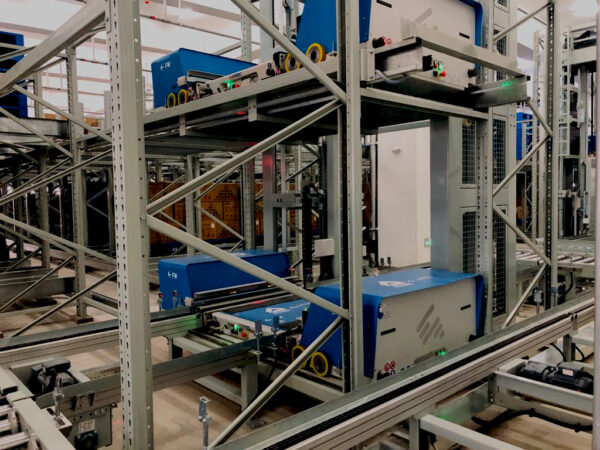
Mother-Child ASRS
The shuttle cart is positioned at the appropriate storage level using a forklift or vertical lift. Once aligned, the shuttle independently carries the pallet to its designated position within the lane –except for the mother-child systems. In those cases, a mother vehicle is stationed on each level to receive the shuttle from the lift. Shuttle movement follows this pattern for the different system types:
- 2-Way Shuttle – Moves forward and backward within a lane —watch video
- 4-Way Shuttle – Adds lateral movement between aisles for increased flexibility —watch video
- Mother-Child Systems – The “mother” shuttle travels along the main aisle, deploying a “child” shuttle to access the storage lanes
Systems integrate with the warehouse management system (WMS) for fully automated operation.
Ideal Applications:
- High-throughput distribution centers
- Warehouses with dense SKU profiles or deep-lane pallet storage requirements
- Harsh warehouse climates, such as freezer and cold storage facilities
- Food and beverage warehouses
Key Benefits:
- Speed & Efficiency: Rapid pallet movement with minimal aisle interference
- Scalability: Add more shuttles to increase throughput as needed
- Flexibility: Supports FIFO/LIFO configurations and a range of pallet sizes
- Space Optimization: Enables deeper lane storage and reduces dedicated aisle space
For a deep dive into the different types of pallet shuttle systems, check out our Shuttle Guide Blog.
Unit-Load ASRS Storage Solutions

What It Is:
Unit-load ASRS handles large, pallet-sized loads using automated stacker cranes that transport pallets or large containers to and from storage locations with high precision and minimal operator involvement. These systems are designed to buffer inventory between supply and consuming operations, helping maintain consistent material flow in high-volume environments. Ideal for managing heavy or bulky loads—up to 7,000 lbs—unit-load ASRS is typically configured for single-, double-, or even triple-deep storage across multiple vertical levels. Their ability to operate in high-bay environments, often exceeding 120 feet, makes them exceptionally efficient at maximizing warehouse cube utilization.
How It Works:
A Unit-Load ASRS uses a rail-guided crane that travels both vertically and horizontally along a dedicated aisle to access heavy pallet loads, Gaylords, and bulk containers stored in high-density racking. The system handles single-deep or double-deep configurations and is optimized for high-bay environments.
Guided by WMS or WES, the crane automatically retrieves or stores unit loads based on real-time inventory demands. Advanced system features may include load profiling, onboard weight verification, and environmental controls, making it ideal for sensitive or regulated materials. This precise, automated process enhances storage density, reduces manual labor, and improves inventory accuracy across the operation.
Ideal Applications:
- Heavy industrial manufacturing
- Bulk storage facilities
- High-bay distribution centers
- 3PL distribution centers
- Automotive and appliance supply chains
Key Benefits:
- High Load Capacity: Engineered for durable performance under heavy weight conditions
- Vertical Space Utilization: Ideal for tall facilities looking to maximize cubic storage
- Reduced Aisle Footprint: Automation enables narrower aisles and deeper storage lanes
- Inventory Control: Seamless integration with WMS systems for real-time accuracy
While both pallet shuttle systems and unit-load ASRS are designed for automated pallet storage, they serve different operational needs. The table below provides a quick side-by-side comparison to help clarify their key differences and ideal applications.
Comparing Pallet Shuttle Systems to Unit Load ASRS

Mini-Load ASRS
What It Is:
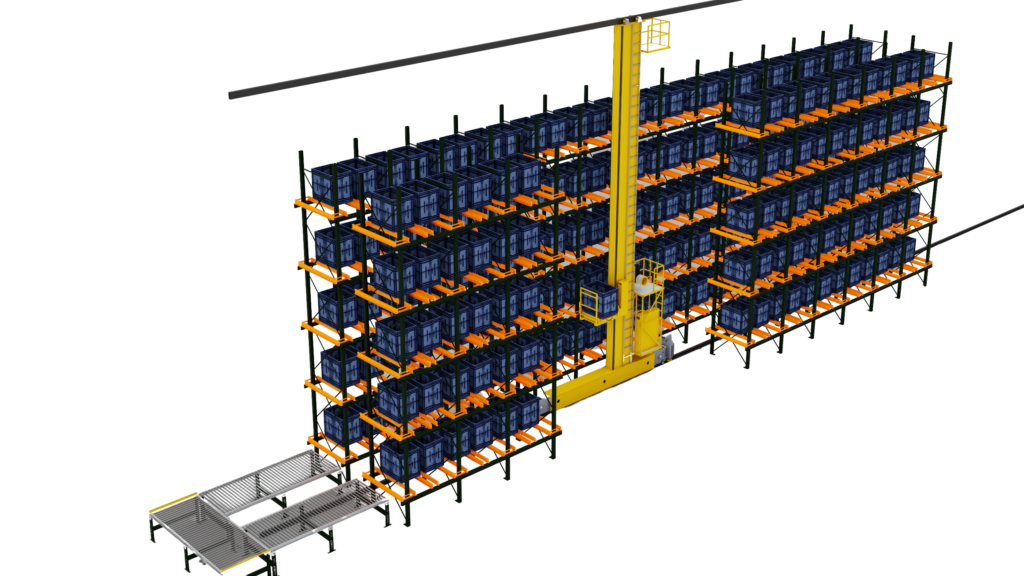
Not all inventory is palletized. Whether you’re handling cases or single units, Mini-Load ASRS offers a smart automation solution for managing small-unit inventory. These compact, high-speed systems are designed to handle totes, cartons, or trays—with load capacities of over 600 lbs per unit. Engineered for environments where speed, accuracy, and SKU variety are essential, Mini-Load systems automate storage and retrieval using a robotic extractor or crane that operates within narrow aisles and high-density racking. These systems can reach heights of up to 88 feet, making them highly efficient for vertical storage and throughput-intensive operations.

plastic boxes in the cells of the automated warehouse. Metal construction warehouse shelving
How It Works:
Inventory is stored in containers on shelving units or racking that span several levels. A robotic extractor or shuttle travels along the aisle, vertically and horizontally, to retrieve the target tote and deliver it to a picking station. Once the item is picked, the tote is returned to storage or redirected to another zone.
The system is often integrated with a WES or WMS, ensuring accurate inventory control and optimized picking sequences.
Ideal Applications:
- E-commerce order fulfillment
- Retail replenishment operations
- Electronics and small parts handling
- Spare parts and MRO (maintenance, repair & operations) inventory environments
Key Benefits:
- High Throughput: Fast and efficient retrieval of high volumes of small items
- Space Efficiency: Narrow aisles and high stacking reduce footprint
- Improved Accuracy: Automated tracking and sequencing reduce picking errors
- Labor Optimization: Reduces manual handling and walking time for operators
Rack-Supported Building ASRS
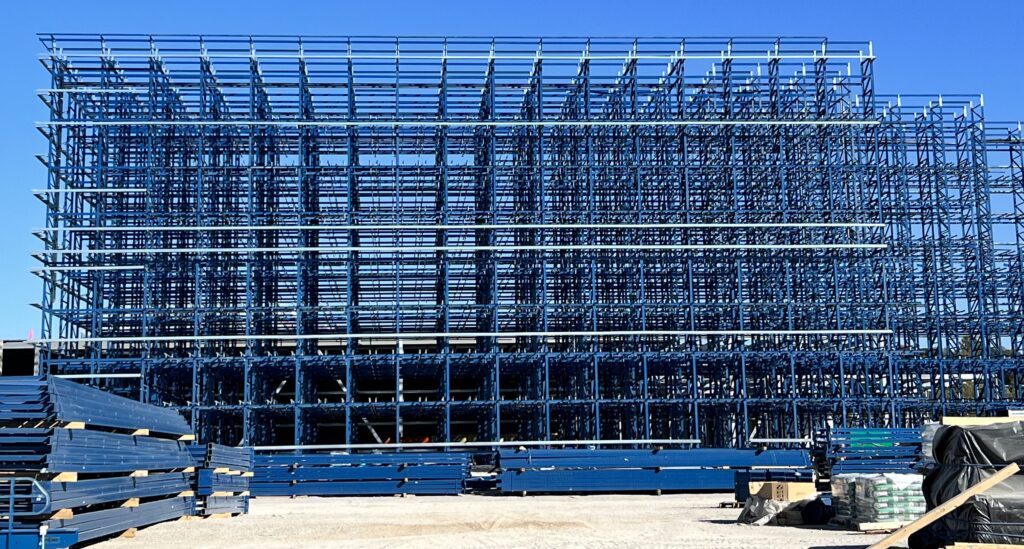
Rack Supported Warehouse Under Construction
What It Is:
 Rack-supported building structures are unique, crane-based ASRS solutions. In these systems, the storage racking serves as the facility’s structural framework, eliminating the need for a separate building shell. The ASRS infrastructure supports the roof and exterior walls, creating a fully integrated storage and building solution. Inside, automated stacker cranes perform storage and retrieval tasks, accessing pallets, totes, or containers within high-density, high-bay racking systems.
How It Works:
Each stacker crane operates within a dedicated aisle, equipped with a telescopic fork or shuttle mechanism that retrieves or deposits loads on either side of the racking. Cranes are guided by a central control system, which receives instructions from a WMS or WCS. This integration ensures precise inventory tracking and efficient movement.
Depending on the load type and system configuration, crane-based ASRS can accommodate pallets, totes, or custom containers. The system’s ability to function in low-light, high-bay, and temperature-controlled environments adds to its versatility.
Ideal Applications:
- Large-scale distribution centers
- Cold storage or freezer warehouses
- Industrial manufacturing and production support
- Deep-lane, high-density storage facilities
Key Benefits:
- Maximum Vertical Utilization: Perfect for high-bay storage with minimal floor footprint
- Space Efficiency: Narrow aisle configurations reduce wasted space
- High Load Capacity: Engineered for heavy-duty handling and deep-lane access
- Reduced Labor Dependency: Fully automated storage with minimal operator intervention
- Potential Tax Advantages: In some cases, rack-supported structures may qualify as equipment,allowing for accelerated depreciation and tax benefits under U.S. tax codes — always consult your tax advisor for details related to your specific application and jurisdiction.
Vertical Lift Modules
What It Is:
Vertical Lift Modules (VLMs) are enclosed, automated storage systems designed to deliver inventory trays directly to an operator at an ergonomic picking height. Inside the unit, trays are dynamically organized in two vertical columns, with a central extractor that retrieves and presents the correct tray on demand.
VLMs can reach heights of up to 52 feet, handle tray loads of up to 2,200 lbs, and achieve throughput speeds of up to 120 trays per hour—making them ideal for operations with ample vertical space. This compact system dramatically reduces floor space requirements while improving inventory security, traceability, and ergonomic access.

How It Works:
Items are stored on trays that are scanned and indexed as they enter the VLM. When a pick or putaway command is initiated—either manually or via integration with a WMS—the internal lift locates the correct tray, retrieves it from storage, and presents it at an access opening for the operator. Once the task is complete, the tray is automatically returned to its optimal location within the module.
Advanced models offer environmental controls, badge-based access, and integrated inventory tracking, making VLMs an excellent fit for regulated industries with strict storage and access requirements.
Ideal Applications:
- Pharmaceutical and healthcare warehouses
- Medical device and lab supply storage
- Tool cribs and secure parts inventory
- Facilities requiring temperature control or restricted access zones
Key Benefits:
- Security & Compliance: Supports controlled access and traceability for sensitive items
- Space Optimization: Maximizes vertical space, often replacing large shelving areas
- Operator Ergonomics: Delivers items at a consistent, waist-high level to reduce strain
- Inventory Accuracy: Reduces human error through automated tray management
Vertical Carousels

What It Is:
Vertical carousels are enclosed automated storage systems that store and retrieve items using a series of vertically rotating shelves. Similar to a Ferris wheel in motion, the shelves move up or down to deliver the required item to an ergonomic pick window at waist height. These systems follow the “goods-to-person” principle, reducing the need for operators to walk or search through shelving.
With systems reaching up to 40 feet high and requiring as little as 5 feet in depth, vertical carousels offer a compact, space-saving design ideal for maximizing vertical storage in tight footprints.
How It Works:
Items are stored on carriers or trays mounted to a closed-loop vertical track. When a retrieval command is issued—either manually or via an integrated WMS—the carousel rotates to bring the selected tray directly to the access point. Operators can pick from illuminated zones or scan items for confirmation, minimizing errors and handling time.
Vertical carousels are particularly effective in environments where space is at a premium and fast, secure access to small items is essential. Optional features like locking access doors or barcode verification further enhance inventory tracking and control.
Ideal Applications:
- Healthcare and pharmaceutical storage (medications, kits, instruments)
- Electronics and component inventory
- MRO parts, tools, and service parts
- Secure or access-controlled small item storage
Key Benefits:
- Space Efficiency: Maximizes vertical space while minimizing floor footprint
- Faster Access: Brings items directly to the operator to reduce walk time
- Ergonomic Design: Presents all items at waist level to minimize strain
- Inventory Control: Optional locking, tracking, and verification features for accuracy and security
Horizontal Carousels

What It Is:
When you don’t have the vertical space for a tall system, horizontal carousels are your go-to choice! These high-speed, automated storage systems rotate shelving units along a horizontal track to deliver items directly to a fixed pick station. The “goods-to-person” design is engineered for fast, high-volume order fulfillment and is especially effective in operations with consistent throughput demands and limited ceiling height. Pick-to-light systems and batch picking software can be integrated to increase speed and accuracy to reach volumes of 250-600 lines picked per hour and achieve up to 99.99% picking rate accuracy.
How It Works:
Inventory is stored in bins or trays mounted to carriers on a closed-loop horizontal track. When an item is requested manually or through a connected WMS, the carousel quickly rotates to bring the correct bin to the operator. Multiple carousels can be grouped into a pod to allow for simultaneous picking across zones, further improving throughput and labor efficiency.
Ideal Applications:
- Manufacturing kitting and assembly lines
- Distribution centers requiring high-speed, small-item access
- Parts departments or tool cribs with fast-moving inventory
- Facilities with low ceilings or limited vertical space
Key Benefits:
- Fast Order Fulfillment: Ideal for high-volume, repetitive picking environments
- Low-Profile Design: Horizontal layout works well in low-clearance spaces
- Accuracy & Control: Integrated pick-to-light and software systems minimize errors
- Labor Efficiency: Reduces operator walk time and supports multi-order picking
Robotic Cube Storage Systems
Modern robotic ASRS solutions deliver flexible, scalable automation by transporting goods directly to an operator. These systems fall into two primary categories: Robotic Cube Storage and Mobile Robotic Goods-to-Operator Systems. While both eliminate walking and increase throughput, they differ significantly in design, storage density, and adaptability.
1. Robotic Cube Storage Systems


What It Is:
This system uses battery-powered robots that travel across the top of a densely packed cube structure filled with stacked inventory bins. The robots retrieve bins by lifting them vertically through the stack, then deliver them to pick ports at operator workstations. There is no racking in a traditional sense—bins are stacked on top of one another within a fixed grid.
How It Works:
Each bin is digitally assigned and tracked. When an order is triggered, a robot locates the bin, clears any bins above it, retrieves it, and delivers it to a designated port. After picking, bins are returned to their optimal position in the cube.
Ideal Applications:
- Micro-fulfillment centers
- High-SKU e-commerce or retail operations
- Urban warehouses where space is at a premium
Key Benefits:
- Maximum storage density with a small footprint
- High-speed order picking via multiple robots
- Modular design—easily add robots or ports to scale
- No fixed aisles—more inventory per square foot
2. Mobile Robotic Goods-to-Operator Systems
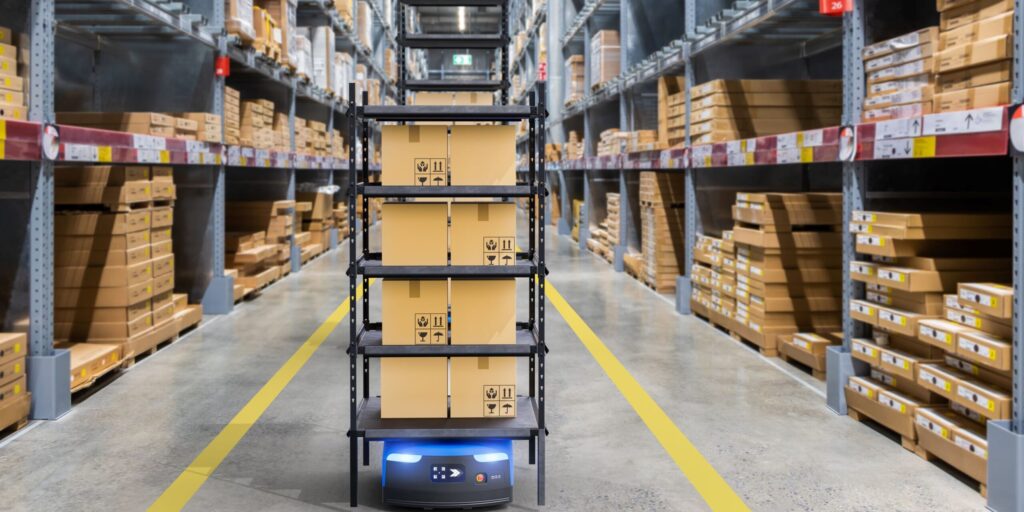
What It Is:
Autonomous Mobile Robots (AMRs) are self-navigating robotic systems designed to transport materials throughout a facility without fixed paths or human intervention. Guided by onboard sensors, cameras, and advanced mapping software, AMRs dynamically avoid obstacles and adapt to their environment in real time –making them ideal for flexible and dynamic warehouse environments.
How It Works:
Unlike traditional AGVs (Automated Guided Vehicles), which rely on predefined tracks or floor markers, AMRs use SLAM (Simultaneous Localization and Mapping) or similar technologies to chart optimal travel paths autonomously.
While many AMRs are designed to transport mobile shelving units (as seen in mobile goods-to-operator systems), today’s AMRs serve a broad range of functions across the fulfillment process.
Common AMR Functions Include:
- Rack Transporters: Carry full shelving units to operator stations for item picking
- Tote or Bin Delivery: Retrieve and transport individual totes or cartons across zones
- Sortation Tasks: Group or route items for packing, shipping, or staging
- Zone-to-Zone Transfers: Move materials between storage, picking, or replenishment areas
- Production Support: Deliver components or tools to workstations as needed
Ideal Applications:
- Distribution centers with dynamic inventory profiles or high SKU variability
- Manufacturing operations requiring on-demand delivery of parts or kits
- Facilities that prioritize layout flexibility, modular workflows, or phased automation
- E-commerce and omnichannel fulfillment where zone-to-zone movement is critical
Key Benefits:
- Highly Flexible Layouts: Operate without fixed infrastructure or aisle constraints
- Scalable by Design: Add AMRs, tasks, or zones as volume grows
- Labor Optimization: Reduces walking and improves order picking productivity
- Versatile Deployment: Easily reconfigured for new workflows, zones, or SKUs
How to Choose ASRS Storage Solutions for Your Operation
Selecting the right Automated Storage and Retrieval System (ASRS) depends on a range of operational factors, from your inventory profile to the level of automation already in place. Whether you’re optimizing an existing facility or designing a new one, understanding your workflow requirements is critical to making a smart, future-ready investment.
Key Considerations
When evaluating ASRS options, consider these core factors:
- Load Size and Weight:
Are you handling full pallets, totes, trays, or a mix? Systems like unit-load ASRS support heavy palletized loads, while mini-load and carousel systems are better suited for lightweight, high-SKU count operations. - Inventory Mix:
A diverse or fast-moving SKU profile often calls for flexible, high-access solutions like shuttle systems, mini-load ASRS, or horizontal carousels. - Throughput Requirements:
Throughput capacity is a key driver for operations requiring rapid pick rates and 24/7 reliability. Modular shuttle systems and carousel pods with pick-to-light tech offer high-performance output. - Space Constraints:
Maximize available vertical or horizontal space with systems designed to fit your building’s dimensions—vertical lift modules and rack-supported crane-based ASRS are ideal for high-bay applications, while horizontal carousels work well in low-clearance areas. - Integration with Existing Systems:
Seamless communication with your WMS or WES ensures accurate inventory tracking, optimized slotting, and real-time order fulfillment.
Customization Options
ASRS systems are highly configurable to align with your unique operational needs. Consider:
- Modular Scalability: Start with a single system and expand as your volume grows—ideal for 3PLs and fast-scaling operations.
- Environmental Controls: Temperature and humidity options for pharma, electronics, or food-grade storage.
- Software Compatibility: Ensure your ASRS integrates with your existing tech stack or select a system with advanced WES/WMS integration options.
Let Apex Help You Automate Smarter
Choosing the right ASRS system is only part of the equation—designing it to work seamlessly within your operation is where Apex Companies delivers real value. With decades of experience in warehouse design, material handling, and integrated automation, we partner with you to build smart, scalable solutions that evolve with your business.
Expert Design & Consulting
Every facility is different—and so is every ASRS solution we design. At Apex, we combine hands-on industry expertise with data-driven analysis and proprietary design tools to develop systems that align with your space, workflow, and long-term operational goals. By leveraging real-time data and performance modeling, we help you select and configure the ASRS technology that delivers measurable results.
Full-Service Integration
Apex provides turnkey automation solutions—from concept and engineering to installation and commissioning. Our integrated approach ensures that your ASRS system functions flawlessly alongside your WMS, conveyor systems, and facility layout.
Support & Maintenance
We stand behind every system we deploy. Our service team offers preventative maintenance programs, emergency support, and performance optimization to keep your ASRS running at peak efficiency.
Storage—Together
Whether you’re just exploring ASRS options or ready to automate your next facility, Apex is here to help. Contact us to schedule a consultation, or visit our Automation Solutions page to learn more about how we help companies like yours work faster, safer, and more efficiently.
