
Drive-In Pallet Racking vs. Push-Back and Pallet Flow: Key Considerations

Is Drive-In Pallet Racking Right for You? Compare with Other Systems
Maximizing warehouse space without compromising efficiency is a common challenge in storage operations. Whether expanding inventory, consolidating SKUs, or designing a new facility, selecting the right pallet racking system can have a major impact on throughput, accessibility, and your bottom line. Among the most popular solutions are Drive-In Pallet Racking, Push-Back Racking, and Pallet Flow Racking—each engineered to support high-volume storage, but with essential differences in design, operation, and application.
The Apex team is here to break down each system’s core functionality, highlighting how they work, where they shine, and where they may fall short. We’ll also provide a direct comparison in terms of storage capacity, layout efficiency, and inventory rotation to help you make an informed decision for your facility. Whatever your inventory mix, throughput goals, or capacity needs… We’ll help you land on the best solution for your operation.
Drive-In Pallet Racking: Maximum Storage, Minimum Aisles

Drive-in pallet rack systems are engineered for high-density storage by forming deep, multi-level storage lanes. Forklifts drive directly into these lanes—sometimes upwards of 10 pallets deep—to place or retrieve inventory. Each lane functions like a tunnel, with horizontal rails on either side that support pallets stored several levels high and deep, eliminating the need for multiple aisles.
These systems can be configured with single-entry or double-entry access:
- Single-entry systems allow forklift access from one end only, which is ideal for LIFO (Last-In, First-Out) inventory.
- Double-entry systems — called Drive-Thru — are accessible from both ends of the racking, with a shared center support, and can help improve throughput and support FIFO (First-In, Last-Out) stock rotation.
Drive-in racks often consist of:
- Vertical upright frames
- Horizontal support rails at each pallet level
- Bracing systems for lateral stability
- Guidance rails or flared entries for safer and easier forklift entry
- Column guards to protect uprights from forklift damage
The forklift drives into each lane to place pallets on the rails, which are positioned at each storage level. Because of the need to physically drive into the rack, storage lanes must be kept clear and aligned, and forklift operators must be well-trained to reduce the risk of impact and damage to the structure.
Key Use Cases
- Best suited for operations with low SKU diversity and high pallet counts per SKU
- Commonly used in cold storage, bulk goods, or seasonal inventory, where access frequency is lower, but maximizing cubic storage is critical.
- This system prioritizes storage density over selectivity.
- Lower cost per pallet position than other high-density systems, such as push-back or pallet flow.
Push-Back Racking: Efficient Loading with Better Selectivity

Push-back pallet racking systems are dynamic, high-density storage solutions designed to increase selectivity and speed of access without sacrificing valuable space. The concentrated, multi-level design efficiently uses cube space without requiring specialized forklift equipment. Typically configured up to 6 pallets deep, each storage lane includes nested, wheeled carts that rest on slightly inclined rails. Pallets are loaded from the front, and each new pallet pushes the previous one back—hence the name “push-back.”
When unloading, gravity takes over: as the front pallet is removed, the pallet behind it gently rolls forward into position. The system operates on a LIFO (Last-In, First-Out) basis, making it ideal for inventory that doesn’t require strict rotation but benefits from organized, efficient access.
Push-Back Racks Often Consist of:
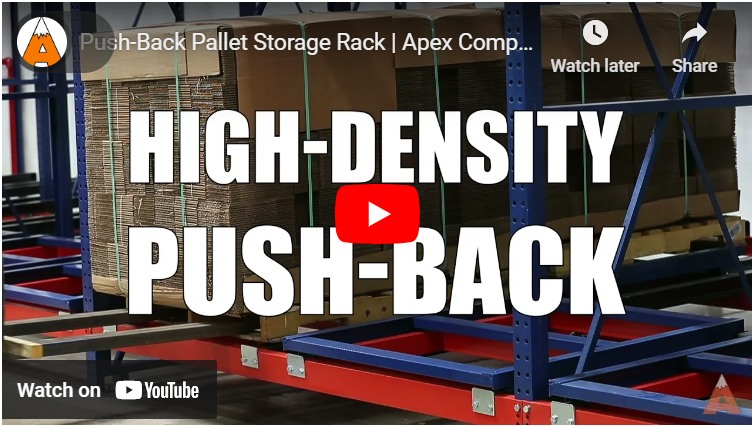
- Upright frames for vertical support
- Sloped rails mounted within the bay structure
- Wheeled carts that nest atop each other and move along the rails
- Backstops and safety mechanisms to secure pallet positioning during flow
Push-back systems are typically configured to store 2–6 pallets deep, allowing for substantial storage density while maintaining higher SKU access than drive-in systems. Forklifts never enter the racking lanes, significantly reducing rack damage and increasing safety.
Key Use Cases
- Ideal for multi-SKU environments where selectivity and speed are important.
- Frequently used in retail, manufacturing, and general warehousing, where product turnover is moderate to high.
- This system provides fast, forklift-friendly access to multiple SKUs without sacrificing valuable floor space.
- Cost per pallet position is slightly higher than drive-in and lower than pallet flow.
Pallet Flow Racking: High-Throughput FIFO Storage at Its Best

Pallet flow racking systems— known as gravity flow racks—are designed for high-efficiency, FIFO inventory management. The system is loaded and picked from opposite aisles, enabling concurrent stocking and picking activities. Each rack lane has slightly inclined wheeled or roller tracks, allowing pallets to glide from the loading to the picking side. Once a pallet is removed from the lane, the rear pallets automatically flow forward to fill the pick face, maintaining a constant product flow and eliminating waiting for restocking.
These systems are compatible with advanced and automated lift equipment and can be configured to hold up to 20+ pallets deep while maintaining selectivity and maximizing space usage.
Pallet Flow Racks Often Consist of:
- Upright frames for vertical structure

- Wheeled or roller tracks on a sloped pitch to flow inventory
- Entry guides and speed controller systems to maintain a safe flow speed
- Pallet separators to isolate front pallets and reduce rear pallet back pressure
- Ramp stops at the discharge end for added safety
Key Use Cases
- Ideal for high-throughput, FIFO-driven inventory like food, beverage, pharmaceuticals, and fast-moving consumer goods.
- Commonly used in distribution centers, cold storage, and manufacturing environments where inventory rotation and time sensitivity are critical.
- Perfect for operations seeking to reduce forklift traffic, improve pick rates, and maximize automation readiness.
- Pallet flow has a higher cost per pallet position than drive-in and push-back systems; however, it delivers superior storage density and productivity—on par with automated solutions, but without the complexity or cost of automation.
How Drive-In, Push-Back, and Pallet Flow Racking Stack Up in the Same Space
.
Drive-In, Push-Back & Pallet Flow Rack Options Explored
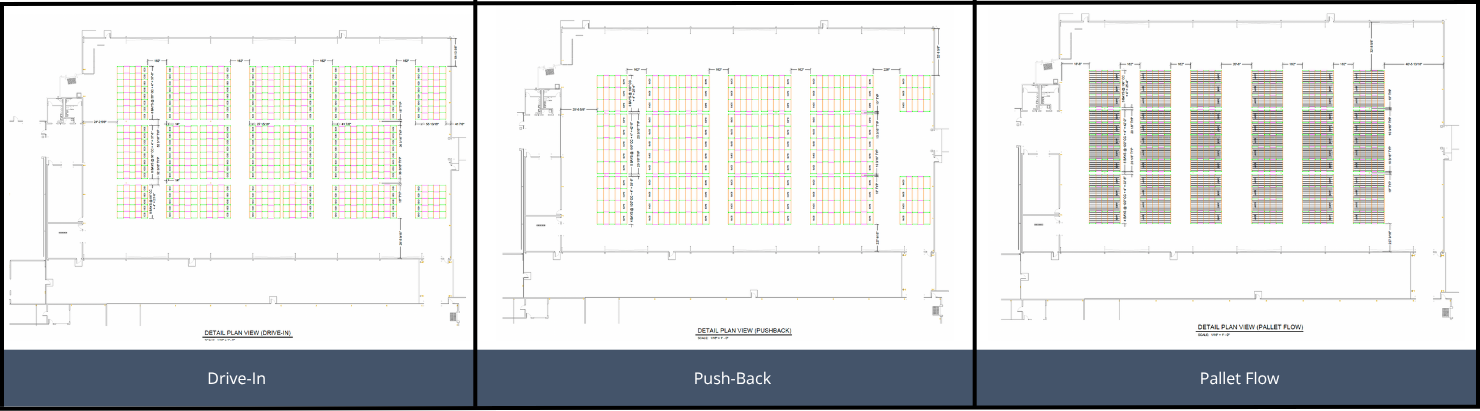
To help visualize how each racking system performs in a fixed space, we created a side-by-side comparison of pallet storage capacity within a 40,000 sf footprint. This practical example highlights how pallet rack type and rack design impact total pallet positions.
.
Pallet Storage Capacity in a 40,000 sq. ft. Footprint
System Type |
# of Bays |
Depth |
Width |
Pallets Per Bay |
Total Pallet Positions |
| Drive-In Rack | 160 bays | 5 deep | 1 wide | 25 | 4,000 |
| Push-Back Rack | 91 bays | 5 deep | 2 wide | 50 | 4,550 |
| Pallet Flow Rack | 72 bays | 5 deep | 2 wide | 50 | 3,600 |
Which System Is Best for Your Warehouse?
These high-density racking systems have unique strengths, making the best choice highly dependent on your inventory profile, space utilization goals, and picking strategies.
- Choose Drive-In Racking for bulk storage of limited SKUs with low product turnover. It delivers maximum storage density at a lower cost but sacrifices selectivity and speed.
- Push-Back Racking is ideal for medium-turnover inventory that requires moderate selectivity and faster access. It’s a versatile solution for operations with multiple SKUs per aisle.
- Pallet Flow Racking excels in high-throughput, FIFO environments such as food, beverage, or pharmaceutical distribution, where product rotation and pick-face access are critical.
While the systems differ in layout and operation, it’s important to note that each is compatible with standard forklift equipment, so equipment cost and training are typically not differentiators in your decision-making process.
Your best-fit solution will depend on matching the system’s strengths with your operation’s storage demands, access frequency, and SKU management strategy.
Need Help Choosing the Right System? Let Apex Help!
As a full-service warehouse solutions provider, Apex delivers tailored solutions from design and engineering to installation, inspections, and repairs. Contact Apex today for a free evaluation of your inventory storage needs—and see how we can help streamline your operations with precision, safety, and efficiency.
Related Resources:
