
Shelving or Pallet Racking — How Can I Tell the Difference?

Choosing the Right Storage Setup in the Carolinas – Shelving or Pallet Racking?
Space is at a premium in many Carolina warehouses, making smart storage solutions more important than ever. If your goal is to remove items from the floor and improve safety and organization, several systems can help you do just that. Vertical shelving frees up floor space, often improving traffic flow and operational efficiency. To determine which option works best for your facility, evaluate the types of items you store and how you access them. Your choices include everything from rugged industrial shelving to high-capacity pallet racking systems. Here’s a detailed look to help guide your decision.
Shelving and Pallet Racking: What Sets Them Apart

While both shelving units and pallet racks are considered material handling systems by RMI, they are designed for different storage needs. Here’s how to know which option fits your operation in the Carolinas.
Understanding Pallet Racking
Pallet rack systems are engineered for storing goods on pallets and are loaded using forklifts, pallet jacks, or similar machinery. Designed to handle significant weight and reach substantial heights, pallet racking is the go-to option for maximizing vertical storage space in large-scale environments.
These systems are built with upright columns and horizontal beams, anchored directly to the warehouse floor using baseplates. Depending on how the layout is designed, you can also add row spacers or overhead ties for added stability between racking rows.

Pallet racks don’t rely on solid shelf surfaces—pallets rest across the front and back beams. Still, wire decking or pallet supports are often used to prevent items from slipping through. Wire decking also enables manual loading on lower levels of the rack, offering flexibility similar to that of a shelving unit. That said, for inventory that’s handled by hand, steel shelving may be the more straightforward solution.

Types of Pallet Rack Systems
There are four key pallet rack formats. The most basic, selective racking, is closest in design to standard shelving and was used for the earlier comparison. Other options—like push-back, drive-in, and pallet flow racks—support higher-density storage by forming deep, multi-level lanes. These designs make better use of available space while reducing how far staff need to travel to retrieve items.

Steel Shelving for Hand-Loaded Inventory
Steel shelving, unlike pallet racking, is generally reserved for products that are handled manually or have non-standard shapes. These systems are usually built to a height accessible by hand or step ladder. While shelving can be made from light- to heavy-gauge steel, the typical load capacity remains below 1,000 pounds. This makes it suitable for use with assistive tools like vacuum lifters. Unlike racking, shelving uses solid surfaces—metal, composite, or wood—for the storage levels.
Thanks to its straightforward design, industrial shelving is quick to install and easy to move. Since it doesn’t require floor anchoring, it’s a flexible and durable solution for growing facilities across the Carolinas.

Commercial Steel Shelving Types: Boltless and Bin
There are two main styles of steel shelving commonly used in commercial settings: boltless and bin shelving.
Boltless shelving—also known as rivet shelving—resembles pallet racking in its use of uprights and beams, but includes decking panels for each shelf level. This system is easy to configure by size, making it ideal for facilities that need adaptable storage based on available space and inventory type.
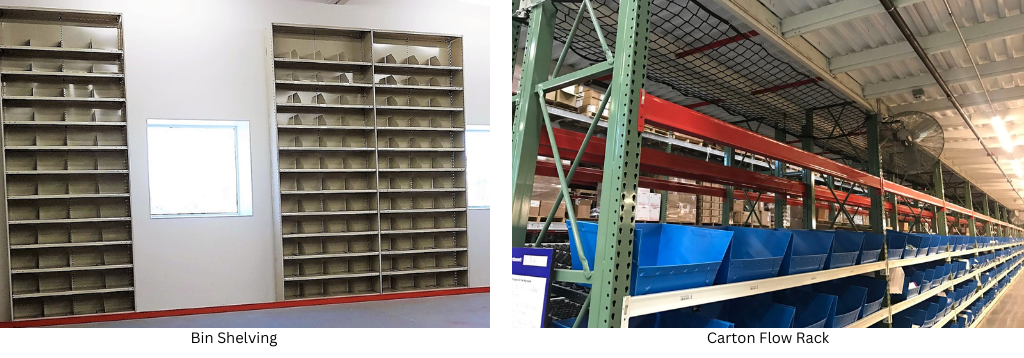
Bin shelving is best suited for organizing smaller goods in bins, boxes, or totes. These shelves usually have shallower depths—12 to 24 inches—for easy reach, while widths may vary between 12 and 60 inches. The shelves can be made from solid materials or outfitted for compartment storage, and optional side or back panels provide added containment.
For high-volume operations needing efficient tote or carton handling, carton flow systems may be a better fit. These roller or wheeled rails can be added to the lower levels of pallet racks or set up as stand-alone units, supporting tasks like order fulfillment, assembly, or kitting.
Get Professional Help with Your Carolinas Warehouse Layout
Making the most of your warehouse footprint is key to controlling costs and boosting productivity. Efficient storage cuts down on worker travel time and equipment use, helping your team operate more effectively. Apex Warehouse Systems offers full-service support throughout the Carolinas. Our experts will evaluate your needs and recommend the most efficient and cost-effective layout. Reach out today to speak with a warehouse design specialist.
