
The Ultimate Guide to Pallet Shuttle Systems: Features, Benefits, and Applications

Going Deep with 2-Way, 4-Way, and Mother-Child ASRS Pallet Shuttle Systems
A pallet shuttle system is an automated storage solution designed to improve the efficiency and accuracy of high-volume pallet storage and fulfillment. These systems use shuttle vehicles to transport pallets to and from designated storage locations within a high-density, multi-level racking system, offering a faster and safer alternative to traditional non-automated methods.
How Do Pallet Shuttle Systems Work?
Battery-operated shuttle vehicles operate within racking lanes, navigating in either a 2-way (forward and backward) or 4-way (adding lateral and vertical movement) direction, depending on the system type. For more advanced applications, mother-child ASRS (Automated Storage and Retrieval Systems) combines a shuttle “child” vehicle with a “mother” carrier to allow multi-lane functionality, further increasing throughput and storage density.
In 2-way semi-automated systems, forklifts load shuttles and pallets into the designated storage lane. In the fully automated 4-way and mother/child systems, mechanical lifts deliver shuttles and pallet loads to the designated storage levels.
Each system is designed to meet specific operational needs, ensuring flexibility and scalability for a variety of warehouse configurations.
Key Benefits of Pallet Shuttle Systems

2-Way Pallet Shuttle System
1. Speed: Pallet shuttle systems drastically reduce the time required for storing and retrieving pallets compared to manual, forklift-based methods. Their high-speed operation supports faster processing, thus improving warehouse throughput.
2. Safety: Automation minimizes the need for forklifts and human involvement within racking systems, reducing the risk of accidents and equipment damage in high-density storage environments.
3. Accuracy: With automated precision, pallet shuttle systems enhance inventory management by accurately placing and retrieving pallets. This minimizes errors and improves the efficiency of order picking and inventory tracking processes.
4. Quality: Shuttle systems improve pallet quality control by detecting prior pallet placements and systemically creating a consistent gap between each load (unlike pallet flow and push-back systems). This feature eliminates product-to-product contact —protecting product integrity and reducing damage. The gapping between pallets is also favored by insurance carriers and fire marshals, as natural water flue paths are created in the dense rack system.
5. Density: Pallet shuttle systems maximize storage capacity by enabling high-density configurations, using deep-lane racking and vertical space efficiently. This reduces the overall footprint required for storage while accommodating more inventory, making them ideal for warehouses with limited space or high-volume storage needs.
Choosing the right pallet shuttle system—whether a 2-way, 4-way, or mother-child ASRS—depends on your operational needs, such as throughput requirements, storage density, and available space. Apex specializes in data-driven analysis to identify the optimal solution for each warehouse environment. By tailoring recommendations to your specific challenges and goals, Apex ensures maximum efficiency to meet your needs.
Let’s take a closer look at each type of shuttle system design and application.
2-Way Semi-Automated Pallet Shuttle Systems
The 2-way system is the simplest of the three pallet shuttle designs, ideal for managing high-volume inventory with basic storage and retrieval needs. A forklift places the shuttle and pallets into the channel, where the shuttle lifts and transfers each pallet to the next available position along load-bearing rails. Once the lane is full, the shuttle is extracted and moved to another channel for loading or retrieval, enhancing efficiency and minimizing manual handling.
The shuttles are controlled via a remote device and can be integrated with Warehouse Management System (WMS) or Enterprise Resource Planning (ERP) systems, to automate inventory tracking and streamline warehouse operations.
Applications
The 2-way pallet shuttle system is best suited for high-density storage environments with basic storage and retrieval needs, particularly for facilities handling a limited number of SKUs with predictable inventory turnover.
Benefits
1. Cost-Effective
The 2-way pallet shuttle system offers a budget-friendly solution for warehouses seeking to improve efficiency without investing heavily in automation technology.
2. Simplicity for Less Complex Operations
With no software integration required, the system is easy to operate, maintain, and scale, making it a practical choice for operations with minimal technical requirements.
3. Lower Installation Costs
Its straightforward setup reduces installation time and costs compared to more advanced systems, allowing for a faster return on investment.
4. No Software Required
Operated via remote control, the system is simple and intuitive, eliminating the need for specialized training or reliance on high-tech software.
4-Way Pallet Shuttle Solutions
A 4-way pallet shuttle system elevates automated pallet storage by enabling movement in all four directions—forward, reverse, cross-aisle, and vertical. This multidirectional capability allows seamless lane switching without additional equipment or manual intervention.
Excelling in dynamic, high-density environments, the 4-way system offers enhanced flexibility, superior space optimization, and increased throughput compared to 2-way systems. Integrated with Warehouse Execution System (WES) and Warehouse Control System (WCS) software, the system ensures precise coordination, efficient inventory management, and seamless operation across all levels of the storage process.
Further automation is achieved with integrated lifts that transport shuttles and pallet loads to designated levels within the system for storage. These lifts also retrieve pallets from storage and deliver them to automated conveyors for takeaway, significantly reducing reliance on forklifts and manual operations while streamlining overall workflow. The more levels, the more cost-effective your system becomes.
Applications
4-way pallet shuttle systems are ideal for warehouses with diverse inventory, multiple high-volume SKUs, and/or high-throughput demand.
Benefits
1. Routing Flexibility
The 4-way shuttle offers exceptional routing flexibility, moving in all directions to enable efficient pallet positioning and retrieval.
2. High Throughput for Dynamic Operations
In environments with diverse inventory or high turnover, the 4-way system delivers rapid and frequent pallet movements. Speeds typically range from 100–150 FPM when loaded (double that when unloaded), and the system can handle loads of up to 3,300 lbs.
3. Reduced Equipment Interference
The 4-way system’s ability to maneuver autonomously across racking lanes reduces the need for forklifts or manual equipment to interact with storage areas, improving both workflow efficiency and safety.
4. Enhanced Scalability
The flexibility and multi-directional capabilities of 4-way shuttles make them better suited for future warehouse expansions or layout changes.
What is a Mother-Child Automated Storage and Retrieval System (ASRS)?
The mother-child ASRS system consists of a “mother” vehicle, which serves as the primary carrier, and a “child” shuttle, which is responsible for moving pallets within storage lanes. Elevators (usually external) move stacks between storage levels –again, like the 4-way systems, the more levels, the more economical your system becomes. The system is supported by WES and WCS software, ensuring precise management and tracking. Each level and cross-lane requires a fast-moving mother vehicle capable of supporting loads up to 3,300 lbs. The mother vehicle also charges the shuttles via induction charging, eliminating the need for additional charging stations.
Functionality
1. Mother Vehicle Picks Up the Pallet
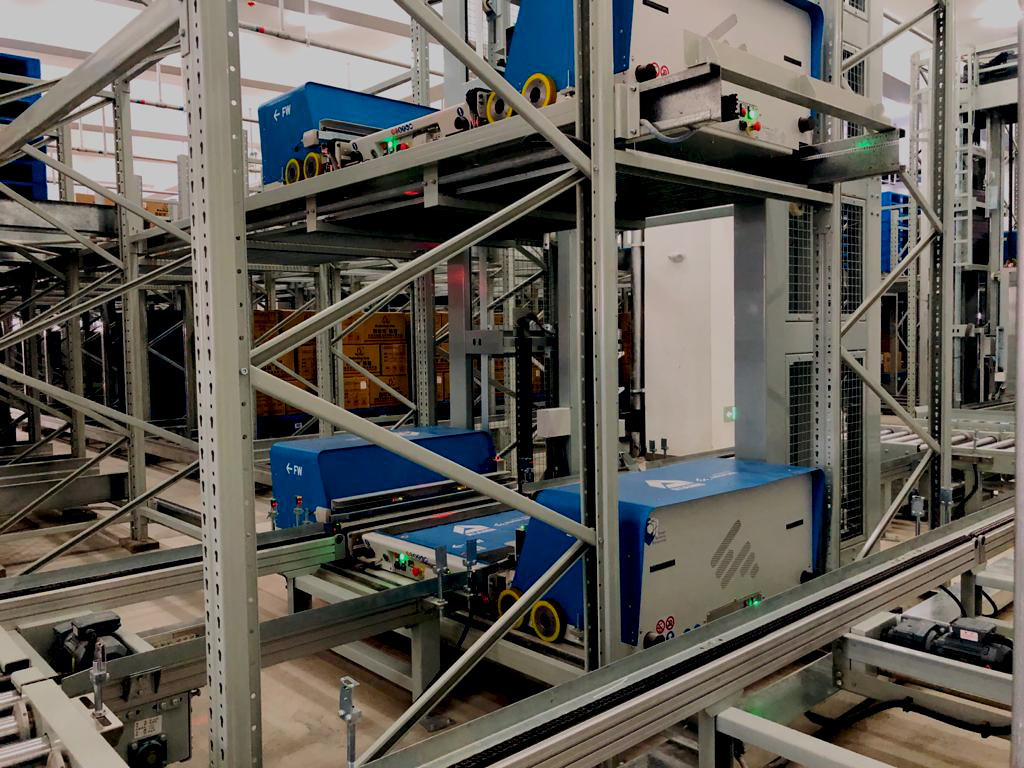
Mother-Child ASRS
-
- The mother vehicles integrate with a centralized automated system, such as vertical lifts or conveyor networks, to transport pallets from the receiving or picking area into the shuttle racking.
- Every level and cross lane requires a mother vehicle.
2. Pallet Transfer to the Child Shuttle
-
- Once positioned within the racking aisle, the mother vehicle deploys a child shuttle.
- The shuttle takes the pallet for storage or retrieves it using internal transfer mechanisms like rollers or conveyors.
3. Child Shuttle Places the Pallet in Storage
-
- The child shuttle navigates the storage lane, placing or retrieving pallets in the designated positions. It then returns to the mother vehicle for the next task.
4. Pallet Retrieval Process
-
- Retrieved pallets are carried by the mother vehicle to the outbound transfer point for further processing.
This process is highly efficient due to seamless coordination between the mother vehicle and child shuttle, reducing delays and ensuring smooth operation. Advanced sensors and automation enable precise pallet alignment and movement, minimizing errors. Additionally, the centralized transport design optimizes energy usage by reducing the need for multiple shuttles to travel long distances.
Applications
Mother-Child ASRS systems are ideal for cold storage facilities with predictable volumes and low SKU counts. They are best suited for facilities that rely on automation to enhance efficiency and precision in their operations. These systems excel in sophisticated storage environments, offering the flexibility, scalability, and high throughput to meet complex and dynamic warehousing demands.
Benefits
1. High Capacity and Scalability
The Mother-Child ASRS can handle large volumes of pallets with ease. Its modular design allows for easy scaling as warehouse needs grow, ensuring long-term viability.
2. Efficient Space and Energy Utilization
By reducing the need for multiple aisle-dedicated shuttles, the system optimizes both storage density and energy consumption. The mother vehicle streamlines movement between lanes, minimizing idle time and unnecessary energy use.
3. Tailored for High-Volume, Complex Operations
This system excels in environments with intricate inventory management and high throughput requirements, significantly boosting productivity and accuracy.
Choosing the Right Pallet Shuttle System

Automated Pallet Storage System
Selecting the right pallet shuttle system is a critical decision that directly impacts your warehouse’s efficiency, storage density, and overall performance. To ensure the best fit for your operational needs, consider the following factors and tips.
Factors to Consider
1. Available Space and Layout – The dimensions of your warehouse, aisle widths, and racking configuration play a significant role in determining which system will work best.
2. Inventory Type and Warehouse Climate – Consider the warehouse climate in addition to the size, weight, volume, and number of SKUs of the products you’ll store.
3. Throughput and Order-Picking Needs – Assess the flow of inbound and outbound palletized inventory as well as order-picking demands.
4. Budget and Long-Term Scalability – Initial investment costs should align with your budget, but don’t overlook the long-term benefits of scalability.
Work with a trusted provider like Apex to conduct a data-driven analysis of your warehouse’s unique requirements. An expert assessment ensures that the chosen solution aligns with your efficiency, scalability, and cost-effectiveness goals.
Make the Smart Move for Your Warehouse Efficiency

Choosing the right pallet shuttle system involves balancing your current needs with future growth potential. By carefully considering your warehouse layout, inventory characteristics, and operational demands, you can select a system that maximizes efficiency, optimizes space, and supports long-term success. Apex’s expertise ensures that your decision is backed by data and tailored to your unique challenges, delivering the best results for your warehouse.
Ready to find the perfect pallet shuttle system for your warehouse?
Contact the Apex team today for a free consultation, and let us help you optimize your operations for maximum efficiency and productivity!
