
Elevate Your Storage Game: Vertical Lift Modules vs Vertical Carousels – What’s the Difference?

ACHIEVE SKY-HIGH PRODUCTIVITY WITH VERTICAL LIFT MODULES AND VERTICAL CAROUSELS
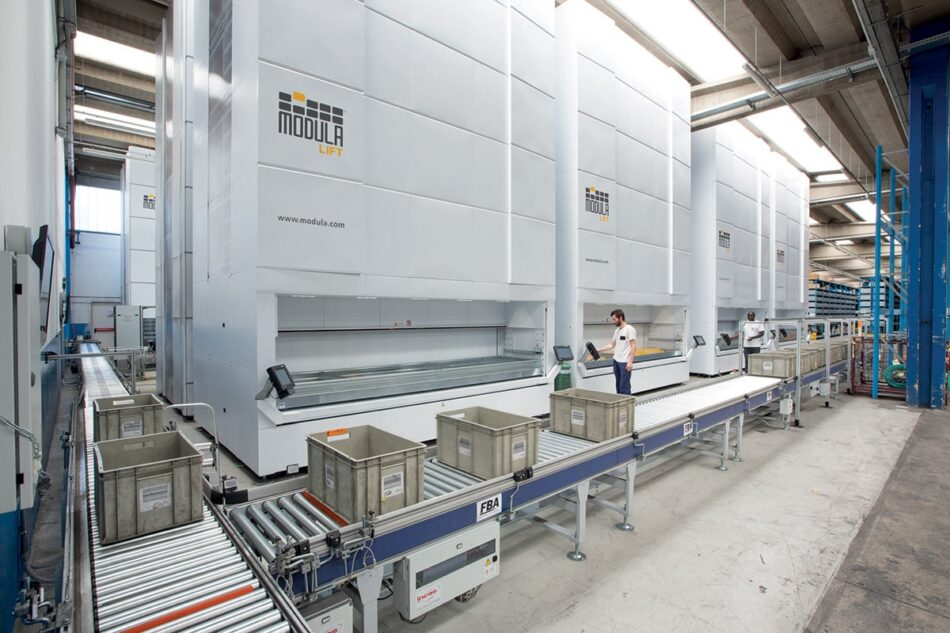
Vertical Lift Modules and Vertical Carousels share one important aspect: vertical space. They are both vertical automated storage retrieval systems (ASRS) that deliver batched inventory at an ergonomic height to the worker. The key difference between the two is the retrieval method: Vertical Lift Modules (VLMs) retrieve a single tray from a tightly stacked column, while Vertical Carousels (VCs) rotate all of the trays to present the correct one. With both ASRS systems, the small footprint keeps valuable floor space clear of additional racking. Added options like put-to-light software to interface with a WMS and scanners make incorporating them into existing picking operations simple and user-friendly.
Advantages of Vertical Carousels and Vertical Lift Modules
- Speed up inventory-handling by delivering items to the person
- Accurately pick multiple items from an illuminated section
- Categorize and store similar parts
- Monitor mishandling or theft through operator tracking software and custom reports
- Improve ergonomics by keeping items at the optimum reaching height and distance
- Minimize labor costs
- Reduce the necessary footprint to store products
While any ASRS system is a step towards a more efficient facility, warehousing operations that require high-volume, high-variety, or high-accuracy handling in a small space should consider vertical goods-to-person delivery.

Vertical Carousel
VERTICAL CAROUSELS: THE FERRIS WHEEL OF INVENTORY MANAGEMENTVertical carousels work by sorting inventory into evenly-spaced carriers. These carriers are usually chai n-driven and follow an internal track that loops around – the same way a Ferris wheel travels. The motor can operate in either direction, which means the requested tray will reach the station in the shortest available path. Inventory batches should be planned to maximize productivity – keeping the items most frequently requested or similar to each other on adjacent carriers means less overall travel around the closed loop. In high-volume packaging, this optimization can have a significant impact on throughput. |

Tray spacing inside VLM
VERTICAL LIFT MODULES: A LARGE-SCALE VENDING MACHINEVertical Lift Modules have an assortment of organized trays stacked vertically in the front and back. An elevator-like mechanism drives up the center, pulling and delivering trays to an ergonomic picking height – much like how a vending machine picks and places a drink. Tray spacing is determined by sensors and is dependent on the height of the inventory stored – planning is equally as important for this type of delivery system. Keeping shorter items together means more trays can be stacked inside overall, maximizing the amount of storage a vertical lift module offers. |
CHOOSING THE RIGHT SYSTEM
There are several important factors to consider when deciding between a vertical lift module or a vertical carousel:
- Inventory volume and storage capacity
- Consistency and frequency of use
- Picking speed requirements
- Future needs
- Space constraints
IT STARTS WITH STORAGE
Choosing the right system starts with understanding your specific storage needs. Industries that use larger items, heavier parts, or inventory varying greatly in size between batches should consider a vertical lift module. VLMs use sensors to allow for dynamic shelf height. By design, they can carry up to 2200 lbs, with a total payload of up to 200,000 lbs. This heavy capacity is because the elevator only has to pick up one tray at a time.
In contrast, a vertical carousel is limited by the tray spacing being uniform and the allowable torque of the motor: overloading it or having an unbalanced load can cause maintenance issues in the long term. A typical vertical carousel can sustain 1400 lbs per carrier. This makes vertical carousels well-suited for light-duty applications like component storage or medical distribution.

SPACE CONSIDERATIONS & PRODUCT MIX CHANGES
If weight is not what tips the scale for VLMs or VCs, physical space is the next major factor. Vertical carousel carriers are uniformly spaced to keep the load balanced on either side of the carousel. The distance between carriers is determined by the maximum inventory height plus clearance to prevent jams. Once set up, trying to change the spacing between them is a manual task that will require downtime. The overall unit is more compact than a vertical lift module: it’s only two columns of carriers, keeping the footprint tight at 5 feet deep by 13 feet wide for a larger carousel. In comparison, the VLMs require more floor space for the elevator chute in between two columns of trays.
A vertical lift module footprint is deeper. They range from 10 to 18 feet deep and are 6 to 14 feet wide. Vertical lift modules can reach towering heights above 90 feet, whereas vertical carousels range from 8 to 32 feet high. If ceiling height is limited, a vertical carousel is the better choice.
Tray size versus carrier size is like comparing apples to oranges: Carriers range from 4 to 12 ft wide and can be up to 2 ft deep. Trays match the size of the VLM ordered, with a depth of up to 4 feet. The added depth helps with certain customizations like a jib crane or lift assist for the operator. These are especially useful for heavy or awkward inventory that exceeds ergonomic handling standards. This also opens the door for semi or fully-automated processes – like adding a packaging robot or moving inventory with automated conveyors. If long-term scalable growth is the goal, consider a vertical lift module.
Case Conveyor
SPLURGE ON SPEEDY ORDER FULFILLMENT ACCESSORIES
High-density storage is not the only area of inventory management where vertical ASRS systems shine. For example, in packaging and distribution industries, they are a means of fool-proofing order picking accuracy with loads of options available:
- Pick- and Put-to-Light
- Laser pointers
- Product display monitors
- Barcode scanners
- Alphanumeric LED bar
- Scales
- RFID or magnetic user authentication
- WMS for automated inventory tracking
An error-proof process is an efficient process, and reducing the ability to mishandle goods will streamline your operation. The speed difference between the two systems depends on the specific configuration, load size, and the exact operational setup. Generally speaking, a VLM is often faster than a VC, primarily due to how the system retrieves and delivers items. Both systems rely on slotting to keep the most frequently sought-after products readily available – discuss with an Apex expert to maximize the return on your investment.
SO, WHICH SYSTEM IS BEST FOR YOUR OPERATION?
Choosing between a Vertical Lift Module and a Vertical Carousel depends on your specific application needs. Each offers unique advantages for compact storage solutions. If ceiling height is a limitation, consider exploring Horizontal Carousels. These systems provide comparable speed, accessibility, and capacity but are designed for spaces with lower ceilings. Contact your Apex representative to discuss which option best suits your storage requirements.
Common Applications:
|
|
Increase your throughput, maximize your floor space, and eliminate worker strain with a vertical ASRS system. The Apex team is ready to create a solution tailored to your needs. Contact a representative to build your custom solution.
